


















Lesson 8 of 49 · The Entrepreneurial Mindset
Resilience and learning from failure
Learn what resilience and growth mindset really mean for founders, why failure is information, and how to run a blameless post-mortem after a setback.
Almost every venture meets setbacks: a customer who cancels, a product that breaks, a launch that nobody notices, a partner who leaves. Founders who last are rarely those who avoid setbacks; they are those who recover from them and extract something useful. That ability is usually called resilience.
Resilience is often described as a trait, as though some people are simply tough. A better description is that it is a set of practices: how you interpret events, how you manage energy and money so one failure does not end everything, and how you turn bad outcomes into lessons. This lesson looks at the research on mindset, separates healthy persistence from stubbornness, and gives you a concrete method for reviewing a failure so it teaches you something.
What you will learn
- What resilience is and what research says about it.
- How a fixed versus a growth mindset changes the way you respond to setbacks.
- How to tell healthy persistence from the sunk-cost trap.
- How to run a blameless post-mortem and a pre-mortem.
Key terms
Resilience: the ability to recover from setbacks and continue working toward a goal.
Growth mindset: the belief that abilities can be developed through effort, strategies and feedback.
Sunk cost: money, time or effort already spent that cannot be recovered and should not drive future decisions.
Pivot: a structured change of strategy while keeping what you have learned.
Post-mortem: a structured review after a failure to find causes and lessons.
What the research says about mindset
Psychologist Carol Dweck contrasted two mindsets. People with a fixed mindset treat ability as set: a failure means "I am not good at this". People with a growth mindset treat ability as trainable: a failure means "I have not learned how yet". In her studies with students, those encouraged to adopt a growth view tended to approach hard tasks with more effort. The idea became hugely popular.
It is worth being careful. Later large studies found that mindset interventions have, on average, small effects, and that the benefits depend on context and on whether the person also receives good strategies and support. A fair summary: believing you can improve is helpful and costs nothing, but belief does not replace skill, feedback or favorable circumstances. Treat growth mindset as a useful habit of interpretation, not a guarantee.
Angela Duckworth's research on "grit", a combination of perseverance and passion, was also influential. Critics have noted that grit overlaps heavily with conscientiousness and that its power to predict success may be smaller than first reported. Again, the practical lesson is modest: sticking with difficult goals helps, but only if the goal is worth pursuing.
Failure is information
A failed experiment tells you something real. Suppose you offer a 10-dollar tutoring package to 100 students and nobody buys. That is not a verdict on you; it is data. Perhaps the price is wrong, the message is unclear, the channel is wrong or the need is not there. A good founder converts "it failed" into a list of specific hypotheses and chooses the cheapest next test.
This is why Chapter 3 will teach you to run experiments that are designed to teach. When an experiment is designed to teach, even a "no" has value. The painful failures are those that cost a lot and teach nothing, such as spending a year building in secret and discovering at launch that nobody cares.
Not all failures are equal. It helps to sort them:
- Basic failures: preventable mistakes, such as forgetting to check a regulation. Reduce these with checklists.
- Complex failures: several small things going wrong together. Reduce these with slack and monitoring.
- Intelligent failures: good experiments in new territory that simply did not work. Celebrate these; they are the price of learning.
The management scholar Amy Edmondson used this taxonomy in her research on organizational learning. The key point for a founder is that punishing intelligent failures stops you from experimenting.
Persistence versus the sunk-cost trap
Persistence is valuable, but there is a trap. Suppose you have spent 3,000 dollars and six months on a product and early sales are poor. The money and time are gone whichever way you decide. The only rational question is: given what I know now, will the next dollar and the next month be better spent here than elsewhere? Many people instead continue because they have already invested so much, which is the sunk-cost fallacy.
A useful practice is to set kill criteria before you begin. For example: "If after 60 days fewer than 20 customers have paid, I will change the offer or stop." Writing this rule in advance protects your future self from emotional attachment. When a rule is triggered, you do not have to quit; you may pivot, which means changing one major element, such as the customer, the price or the channel, while keeping what you have learned.
Running a blameless post-mortem
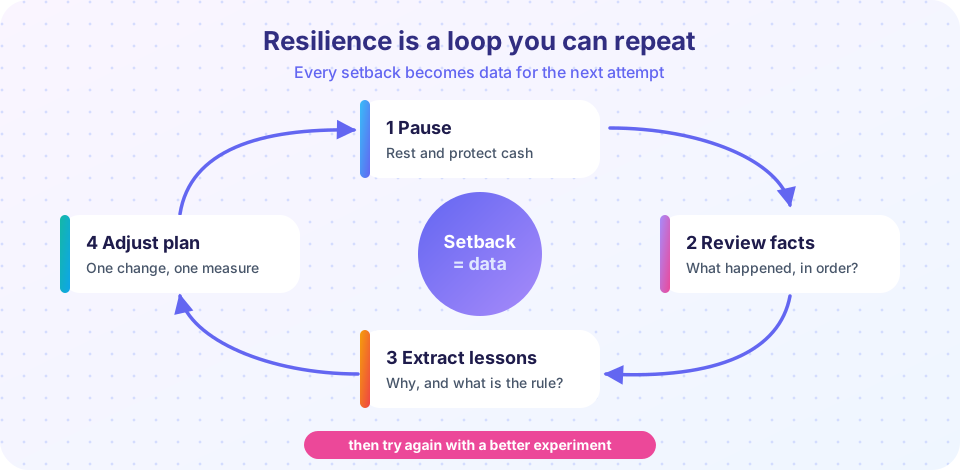
A post-mortem is a short, structured conversation after a setback. Four steps work well.
- State the facts. Write what happened in order, without judgments. "We ran 40 ads, received 600 clicks and 3 purchases."
- Find causes. Ask "why" several times. "Why so few purchases? Visitors left the checkout page. Why? Shipping costs appeared only at the end."
- Extract lessons. Turn each cause into a rule. "Show total price early."
- Decide the next action. Choose one change and one measurement.
The word blameless matters. If people fear punishment they hide information, and you lose the lesson. Even when you are alone, avoid writing "I am an idiot"; write "the process lacked a price check".
A pre-mortem, popularized by psychologist Gary Klein, does the reverse before you start: imagine the venture has failed a year from now and write down why. This unlocks honest worries and often reveals fixable problems early.
Looking after yourself
Resilience also depends on health. Founders report stress, long hours and isolation. Sleep, exercise, supportive friends and mentors are not luxuries; they are the way you keep your judgment sharp. Keeping a financial cushion (even a small one) also reduces panic. This course offers educational information, not medical advice; if stress becomes overwhelming, talk to a trusted person or a qualified professional.
Common misconceptions
"Never give up." Persisting with a doomed idea wastes resources. Smart founders persist with the mission while changing the approach, and they stop when evidence says stop.
"Failure is always a great teacher." Failure teaches only when you examine it. Without a review, you may repeat the same mistake or draw the wrong lesson.
"Successful founders rarely fail." Many famous founders had earlier failed ventures. Their advantage was learning faster and surviving to try again.
Try it
The first tool is a post-mortem template. Fill in the facts and causes for a fictional failed test and let the script print a clean one-page review.
Press Run (or Ctrl + Enter) to see the result here.
Program input · what you'd type while the program runs
Type the answers before you press Run, one per line. Each time the program reads a line (with input()), it gets the next line from this box.
The second tool visualizes kill criteria. It plots a fictional venture's weekly paying customers against a threshold you set in advance, so the decision to pivot or continue is based on a rule rather than a mood.
Press Run (or Ctrl + Enter) to see the result here.
Program input · what you'd type while the program runs
Type the answers before you press Run, one per line. Each time the program reads a line (with input()), it gets the next line from this box.
Check your understanding
Quick check · 5 questions
of 5 answered You scored / 5 · perfect!
-
1. What is the main idea of a growth mindset?
Dweck contrasted fixed and growth mindsets. The growth view treats ability as trainable, though its measured effects are modest. -
2. You have already spent 3,000 dollars on a product that sells poorly. What should drive your next decision?
Sunk costs cannot be recovered, so only future costs and benefits matter. -
3. What is a pivot?
A pivot changes one major element, such as customer, price or channel, based on evidence. -
4. Why is a post-mortem called blameless?
Focusing on process rather than blame keeps information flowing. -
5. Which is an example of an intelligent failure in Edmondson's taxonomy?
Intelligent failures come from good experiments in unfamiliar areas and are the price of learning.
Summary
- Resilience is a set of practices: interpreting events well, protecting your resources and learning from outcomes.
- Growth mindset and grit are helpful but have modest measured effects; they do not replace skill or evidence.
- Failures are data: sort them into basic, complex and intelligent, and learn from each differently.
- Avoid the sunk-cost trap with kill criteria set in advance; pivot when the evidence says so.
- Run blameless post-mortems after setbacks and pre-mortems before launches.
Track your progress
Create a free account to tick off lessons and pick up where you left off on any device.
of Entrepreneurship lessons completed