


















Lesson 35 of 49 · Teams and Operations
Hiring and culture
Learn when to make your first hires, how to run structured interviews with a scorecard, how to weigh skill and values, and how to build a lasting culture.
In a company of three, one hire is a third of the team. A strong first employee can double what you accomplish; a poor one can drain months of energy and leave a mark on everyone who stays. Yet hiring is a skill most founders have never practiced. They interview the way they were interviewed: a pleasant chat, a gut feeling, a quick decision. Research on hiring suggests that is a poor predictor of how someone will actually perform.
This lesson shows how to hire deliberately, even when you are busy and short of cash, and how the people you hire and the way you treat them create a culture, intended or not.
What you will learn
- How to decide when and whom to hire first
- How to write a scorecard and run a structured interview
- Ways to reduce bias and test real work
- What culture is, how it forms and how to shape it
Key terms
Scorecard: a written list of outcomes and traits for a role, used to rate every candidate on the same criteria.
Structured interview: an interview where each candidate gets the same questions and is rated on the same scale.
Work sample: a short, realistic task that resembles the job, used to judge ability directly.
Fully loaded cost: salary plus taxes, benefits, equipment and overhead for an employee.
Culture: the shared habits and unwritten rules that govern how people behave.
When to hire, and whom
Do not hire because the company "should have a team". Hire when a specific, recurring job is holding you back and you can describe it in a sentence: "answer support requests within two hours", "build the checkout page", "call 20 prospects a day".
Before hiring a full-time employee, consider cheaper options. A freelancer, a part-time contractor, an agency or an automation may solve a defined job without a permanent commitment. For truly core roles, though, an employee who cares about the outcome beats a series of short contracts.
Your first few hires should usually be generalists with the right attitude: people comfortable with unclear tasks, changing priorities and doing things that are not in their job description. Specialists become useful when a function (finance, security, enterprise sales) is large enough to deserve one.
Compute the cost before you commit. The fully loaded cost of an employee is more than their salary: add payroll taxes, benefits, equipment, software, and the founder time spent managing them. A common planning rule is to add 20% to 40% to salary, though the right figure depends on your country. Also remember ramp time: a new person may take two to six months to become fully productive.
Write a scorecard first
Many hiring mistakes begin with a vague job description such as "rockstar developer, team player". A scorecard replaces it with three parts:
- Mission: one sentence on why the role exists. ("Make the product reliable so customers stop emailing about outages.")
- Outcomes: three to five things the person must achieve in the first year. ("Reduce error rate by half within six months; set up monitoring and an on-call routine.")
- Competencies and values: the skills and traits needed to reach those outcomes, such as "debugs methodically", "writes clearly", "takes ownership of mistakes".
Rate each candidate against the same list, with a number from 1 to 5 and a note on the evidence. Evidence matters: "gave a specific example of tracing a production bug" is evidence; "seemed smart" is not.
Interviews that predict performance
A large body of research reviewing decades of studies, including a well-known 1998 meta-analysis by Frank Schmidt and John Hunter, found that unstructured conversations are weak predictors of job performance. Work-sample tests and structured interviews do better. Practical steps:
- Ask the same questions in the same order to every candidate, and rate answers on a pre-defined scale. This makes candidates comparable and cuts down the effect of mood and charm.
- Ask for behavior, not opinion. "Tell me about a time you had to deliver something with unclear requirements. What did you do, and what happened?" beats "How do you handle ambiguity?"
- Use a work sample. Give a small task that resembles real work, with a fair time limit, and pay for substantial tasks. Reviewing a candidate's actual output tells you far more than a résumé.
- Rate before discussing. Each interviewer writes scores before the group talks, so the loudest voice does not set everyone's view.
- Check references with specific questions. "Would you hire them again? What did you need to coach them on?" is more useful than "Was she good?"
Bias and fairness
People tend to prefer others who resemble them, a pattern often called similarity bias, and to give too much weight to a first impression. Structured questions, a written scorecard and diverse interviewers reduce these effects. Teams with a mix of backgrounds can also spot problems a uniform team misses, though how much this helps varies by setting, and no hiring process eliminates bias entirely. Make sure you also follow the employment laws in your country on discrimination, contracts and pay.
Press Run (or Ctrl + Enter) to see the result here.
Program input · what you'd type while the program runs
Type the answers before you press Run, one per line. Each time the program reads a line (with input()), it gets the next line from this box.
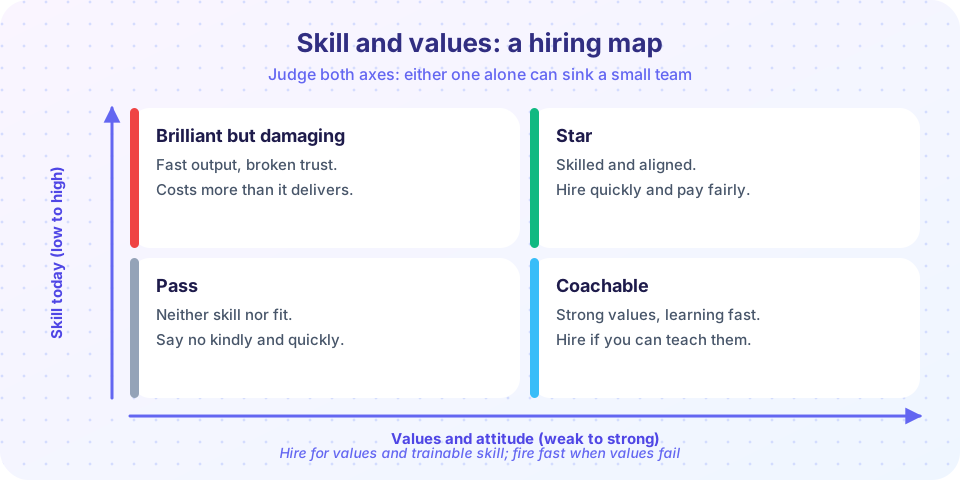
Candidate A has the highest problem-solving score but the lowest values fit. The weighted total is one input, not the decision: if a rating of 2 on values is a deal-breaker for you, say so before you look at totals, and define a minimum for the criteria that cannot be traded.
Pay, equity and the offer
Early employees often accept below-market cash in exchange for equity. Be clear and fair: explain the number of options or shares, the vesting schedule (usually the same four-year, one-year-cliff pattern as founders), the strike price for options, and the real chance that equity ends up worth little. Never imply certainty about a future payout. Where the law requires, give written contracts, pay on time, and follow rules on working hours and leave.
Make the offer in writing with the role, pay, start date and reporting line, and give the candidate a few days to decide. A good candidate with several offers wants to see that you take them seriously.
Onboarding: the first 90 days
New hires decide quickly whether they made a good choice. A short onboarding plan helps: a written first-week schedule, a clear first project with an achievable goal, regular one-to-one meetings, and a buddy who answers small questions. Early wins build confidence, and early feedback prevents small misunderstandings from growing.
Press Run (or Ctrl + Enter) to see the console output here.
No output.
The last line is a useful test: if a role does not clearly create more than it costs, the problem may be your plan, not the person.
Culture: what you reward and tolerate
The organizational psychologist Edgar Schein described culture at three levels: visible artifacts (office, rituals, dress), espoused values (what the company says it cares about), and underlying assumptions (what people actually believe and do when nobody is watching). The deepest level is the real culture. If your wall says "we value honesty" but the first person to report a mistake gets blamed, the real value is "hide problems".
You shape culture mostly through behavior:
- What you praise. Public recognition tells people what matters.
- What you tolerate. A brilliant colleague who belittles others, left unchallenged, teaches everybody that results excuse cruelty.
- How you decide. Do decisions get explained? Can people disagree openly?
- How you handle failure. A team that can talk about mistakes learns faster than one that hides them.
Write a few values as behaviors rather than adjectives: not "integrity", but "we tell customers about a problem before they find it". Use them in hiring, feedback and decisions. When a person repeatedly breaks the values, act. Keeping them signals that the values were decoration.
Feedback and difficult exits
Give feedback early, specifically and privately: describe what you observed, its effect, and what you would like instead. Regular one-to-one meetings make this normal. If performance does not improve after clear feedback and a fair chance, parting ways is kinder to everyone than a long decline. Follow the law and your contract, document the process, and treat the person with respect: how you handle an exit is watched closely by those who stay.
Common misconceptions
"I can tell in five minutes whether someone is good." Rapid impressions favor people who are like you and who interview well. Structured methods predict performance better.
"Culture fit means hiring people like us." Fit should mean shared values and ways of working, not shared backgrounds. Copies of yourself leave blind spots.
"Equity makes up for low pay." It can attract people, but it is risky and may be worth nothing. Pay enough that employees can live, and be honest about equity.
Check your understanding
Quick check · 5 questions
of 5 answered You scored / 5 · perfect!
-
1. What is the main purpose of a hiring scorecard?
A scorecard defines what success looks like in the role and gives a consistent basis for comparing candidates. -
2. Which interview method generally predicts job performance better than an unstructured chat?
Studies including Schmidt and Hunter's 1998 review found structured interviews and work samples more predictive than unstructured conversations. -
3. A salary is $48,000 and overhead is 25%. What is the yearly fully loaded cost?
48,000 x 1.25 = $60,000. -
4. In Edgar Schein's model, which level is the 'real' culture?
Artifacts and stated values can differ from behavior. The assumptions revealed under pressure are what shape the culture. -
5. Why should interviewers write scores before discussing a candidate?
Independent scoring preserves each interviewer's honest view and reduces group bias.
Summary
- Hire when a specific job holds you back; start with generalists who handle uncertainty.
- Write a scorecard with mission, outcomes and competencies, and compute the fully loaded cost.
- Use structured questions, work samples, independent scoring and specific reference checks.
- Be honest about equity and pay, and onboard new people with a clear first project.
- Culture is what you reward and tolerate; write values as behaviors and act on breaches.
Track your progress
Create a free account to tick off lessons and pick up where you left off on any device.
of Entrepreneurship lessons completed