


















Lesson 23 of 49 · Marketing and Sales
Marketing and sales: the big picture
See how segments, positioning, channels, pricing, sales and retention fit together before you dive into the details of marketing a new venture.
A product that nobody hears about earns nothing. You can build the best tool in your city, and if the people who need it never find it, never understand it, or never feel it is worth the price, your business stops. This chapter is about the work that connects a finished product to a paying customer: marketing (creating demand and understanding the buyer) and sales (asking for the decision and handling the answer).
New founders often treat these as the same thing, or as something to do "after the product is ready". Neither is true. Marketing starts on the day you pick who you are building for, and good sales conversations are one of the fastest ways to learn what is missing from your product. In this chapter you will learn a handful of tools that real companies use every week, and you will practice each one with small numeric examples you can run yourself.
What you will learn
- How marketing and sales differ, and why a startup needs both
- The six decisions that make up a go-to-market plan
- How to read the chapter: what each lesson adds
- A simple vocabulary you will use in every later lesson
Key terms
Marketing: everything you do to understand buyers and make your offer attractive to them.
Sales: the process of turning an interested person into a paying customer.
Go-to-market (GTM) plan: your plan for who you sell to, how you reach them, and at what price.
Customer acquisition cost (CAC): the average money you spend to win one new customer.
Retention: the share of customers who keep buying over time.
Marketing versus sales
Think of a farmers' market stall. The hand-painted sign, the free sample of cheese on a toothpick, the neat label that says "made 12 km from here" are marketing. They get a stranger to stop. The moment you say "that is $6; shall I wrap it?" is sales. Marketing makes the right people stop; sales helps them decide.
In an online business the two blur together. A landing page is both: it explains the offer (marketing) and has a "Buy" button (sales). In a business that sells to other businesses, a salesperson might spend weeks with one buyer, while marketing produces the guides and case studies that make those conversations easier.
A practical difference is volume versus depth. Marketing talks to many people with one message and measures averages: how many visitors, how many sign-ups. Sales talks to one person at a time, adapts to what they say, and measures individual outcomes: did this deal close? Startups need both skills even if one founder does all of it.
The six decisions
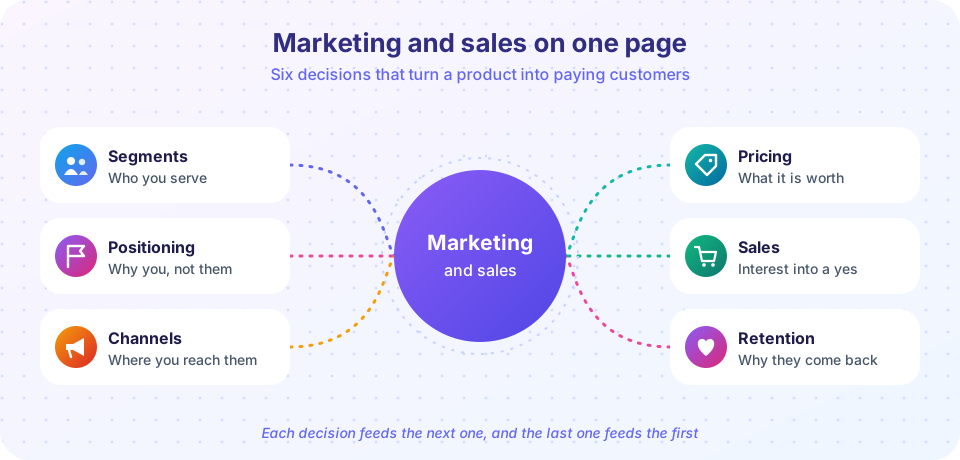
Every go-to-market plan answers the same six questions. Learn them as a chain, because each answer constrains the next.
- Segments. Who exactly are you serving? "Everyone" is not a segment. A segment is a group of buyers who share a need and behave similarly, such as "freelance designers who invoice more than five clients a month".
- Positioning. What single idea do you want that group to associate with you? Positioning is a promise relative to alternatives, including doing nothing.
- Channels. Where will you reach them? Search, social posts, partnerships, a sales team, a stall at a trade fair: each has a cost and a conversion rate.
- Pricing. What is it worth to them, and what is it worth to you? A price is both a number and a message about quality.
- Sales. How does an interested person become a customer? This includes the page, the demo, the contract, and the follow-up.
- Retention. Why do they come back? Winning a customer is expensive; keeping one is where profit usually appears.
The picture above puts retention on the right, but in a healthy business it loops back to the left: happy customers tell you which segment really loves you, and that sharpens everything else.
How the lessons in this chapter fit
| Lesson | What it adds |
|---|---|
| Segments and positioning | Choose a market and claim a clear place in it |
| Channels and the funnel | Reach buyers and measure each step with numbers |
| Sales and pricing | Set a price, run a pipeline, keep customers |
| Chapter review | A recap table and a ten-question check |
Marketing finds. Sales closes.
Start with who
Then how
Then keep them
Retention feeds back into your segment choice.
Common misconceptions
"Good products sell themselves." A few do, but only after people know they exist and trust them. Most products need deliberate effort to reach the first hundred customers.
"Marketing is advertising." Advertising is one tool. Choosing the segment, naming the product, setting the price and writing the onboarding email are all marketing too.
"Sales is pushy." Honest sales is diagnosis: you ask questions, find out whether you can really help, and say no when you cannot.
Try it
The first TryIt is a tiny planning card. Fill in the six decisions for an idea of your own, and the page assembles them into a one-paragraph go-to-market summary. It runs in your browser only and stores nothing.
The second TryIt is a console-style checklist that counts how many of the six decisions you have answered with something specific. It is a demonstration of "vague versus specific": the word "everyone" scores zero.
Press Run (or Ctrl + Enter) to see the console output here.
No output.
Edit the answers and run it again. Notice how hard it is to write a specific answer for a segment, and how much easier everything else becomes once you do.
Check your understanding
Quick check · 4 questions
of 4 answered You scored / 4 · perfect!
-
1. Which sentence best describes the difference between marketing and sales?
Marketing creates attention and understanding for many people; sales works with individuals to reach a decision. Both exist in companies of every size. -
2. Why does the chapter place segments first among the six decisions?
Positioning, channels and pricing all change with the buyer. Choosing the segment first constrains and simplifies everything else. -
3. What does customer acquisition cost (CAC) measure?
CAC is acquisition spending divided by the number of new customers it produced. -
4. Which of these is a specific segment?
A useful segment shares a need and behavior, and you can picture finding one. The others are too broad or too vague to act on.
Summary
- Marketing creates understanding and demand for many people; sales helps individuals decide.
- A go-to-market plan answers six linked questions: segments, positioning, channels, pricing, sales and retention.
- Start with a narrow segment, because every other choice depends on it.
- Retention feeds back to the start of the chain: happy customers teach you whom to serve.
- You will practice each decision with small numeric models in the next lessons.
Next: Segments and positioning
Track your progress
Create a free account to tick off lessons and pick up where you left off on any device.
of Entrepreneurship lessons completed