


















Lesson 9 of 49 · The Entrepreneurial Mindset
Creativity and opportunity recognition
Learn where business ideas come from, how to practice noticing opportunities, and how to turn a hunch into a testable opportunity statement.
Where do business ideas come from? Popular stories suggest lightning strikes: a sudden flash of inspiration in the shower. Studies of founders tell a quieter story. Most ideas grow out of experience, from noticing a frustration, spotting a trend or combining something familiar in a new way. The skill of noticing is called opportunity recognition, and it can be practiced like any other skill.
This lesson explains the main sources of opportunities, shows a handful of thinking tools for generating ideas, and ends with the most important step: turning a vague hunch into a precise statement that you can test with real people.
What you will learn
- Four common sources of business opportunities.
- Why prior knowledge and networks shape what you notice.
- Practical idea-generation tools such as SCAMPER and "jobs to be done".
- How to write an opportunity statement that can be tested.
Key terms
Opportunity recognition: noticing a gap between needs and current solutions.
Trend: a lasting direction of change in technology, behavior, regulation or demographics.
Jobs to be done: the idea that customers "hire" products to make progress in a situation.
Prior knowledge: what you already know from work, study, hobbies and daily life.
Opportunity statement: a short sentence naming a customer, a problem and how you will test it.
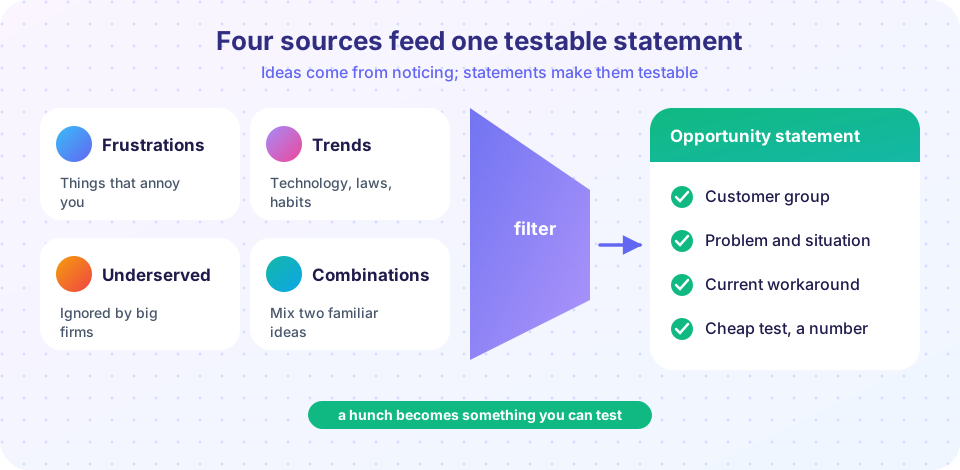
Four sources of opportunities
1. Your own frustrations. Many ventures begin when a person is annoyed by a problem in their own life. If you struggle to find a reliable tutor, a safe place to store a bike or a way to track a club's money, others probably do too. Your own experience gives you a rare advantage: you understand the problem from the inside.
2. Changing trends. Change opens gaps. When smartphones spread, thousands of new products became possible. When populations age, the demand for home care and accessible design grows. Rising energy prices create demand for efficiency. When laws change, for example when a new rule restricts single-use plastics, new products are needed. Look for changes in technology, laws, demographics, culture and prices.
3. Unserved or underserved groups. Companies often ignore small or unusual groups: people with rare dietary needs, farmers in remote villages, left-handed users, small shops that find enterprise software too expensive. A group that is too small for a giant firm can be a very good market for a small venture.
4. New combinations. Schumpeter's "new combinations" apply here. Combine an existing idea with another: a bakery plus a subscription, a repair workshop plus a community class, a farm plus a delivery app. Many successful products are creative recombinations rather than inventions.
Why you notice what you notice
Research by Scott Shane on how people discover opportunities found that prior knowledge matters a great deal: people tend to notice opportunities connected to what they already know. A nurse sees problems in hospital equipment, a farmer sees problems in storage and a gamer sees problems in online communities. Your job, hobbies and family life are therefore a raw material, not a distraction.
Networks matter too. People who talk to many different kinds of people hear about more problems and more possible solutions. Joining a club, volunteering or simply asking friends about their frustrations widens what you can notice. Ideas rarely arrive in isolation; they arrive in conversation.
Tools for generating ideas
The frustration log. Carry a notebook or a phone note for one week. Each time something annoys you or someone else, write it down: what happened, who was affected and what they did instead. Review the list on Sunday. Repeated entries point to real problems.
SCAMPER. A checklist of verbs to apply to an existing product: Substitute, Combine, Adapt, Modify (or magnify), Put to another use, Eliminate, Reverse (or rearrange). Apply each to a familiar product. What if a bicycle repair shop came to you (Reverse)? What if umbrellas were rented (Put to another use)?
Jobs to be done. The innovation scholar Clayton Christensen argued that customers do not buy products; they "hire" them to do a job. People do not want a quarter-inch drill; they want a quarter-inch hole, or better, a shelf on the wall. Ask: "What progress is the customer trying to make, and what are they using today?" Competing with their current workaround can reveal opportunities.
Analogies. Take a solution that works in one field and ask where else it could apply. Ride-sharing apps matched drivers and riders; what else could be matched, such as tutors and learners or spare tools and neighbors?
From idea to opportunity statement
A hunch such as "something with food waste" cannot be tested. An opportunity statement is precise enough that you can go and check it. A simple template:
"[Customer group] struggles with [problem] when [situation]. They currently [workaround]. I will test whether [specific offer] makes it easier, by [cheap test]."
Example: "Student flats with limited storage struggle to dispose of food leftovers when cooking for one. They currently throw it away. I will test whether a shared leftovers swap among flatmates reduces waste, by asking 15 flats to use a simple message group for two weeks."
This statement names the customer, the problem, the workaround and the cheap test. It can be wrong, and that is the point. You will build on this in Chapter 3 with customer interviews and experiments.
Common misconceptions
"Good ideas are rare and secret." Opportunities are everywhere; execution and learning are scarce. Keeping an idea secret usually just prevents the feedback you need.
"If it were a good idea, someone would have done it already." Many opportunities exist because of recent changes, local conditions or overlooked groups. Also, competition is a sign that demand exists.
"Creativity means being artistic." Business creativity is usually practical: finding a better way to serve a need. It can be systematic and learned.
Try it
The first tool is a small frustration-log analyser. Paste or edit a week of entries; it counts repeated themes so you can see which problem keeps coming up.
Press Run (or Ctrl + Enter) to see the result here.
Program input · what you'd type while the program runs
Type the answers before you press Run, one per line. Each time the program reads a line (with input()), it gets the next line from this box.
The second tool turns your answers into an opportunity statement using the template from this lesson. Edit the five fields and read the sentence aloud: does it sound testable?
Press Run (or Ctrl + Enter) to see the result here.
Program input · what you'd type while the program runs
Type the answers before you press Run, one per line. Each time the program reads a line (with input()), it gets the next line from this box.
Check your understanding
Quick check · 5 questions
of 5 answered You scored / 5 · perfect!
-
1. Which is NOT one of the four sources of opportunities in this lesson?
The four sources are frustrations, trends, underserved groups and combinations. Copying secrets is neither legal nor creative. -
2. Why does prior knowledge matter for opportunity recognition?
Research by Scott Shane found that prior knowledge shapes which opportunities people discover. -
3. In 'jobs to be done', what do customers do with products?
Christensen's idea is that customers use products to get a job done, such as making a shelf rather than owning a drill. -
4. What should a good opportunity statement include?
The statement must be precise enough to be tested cheaply. -
5. What does the S in SCAMPER stand for?
SCAMPER: Substitute, Combine, Adapt, Modify, Put to another use, Eliminate, Reverse.
Summary
- Opportunities come from frustrations, trends, underserved groups and new combinations.
- Prior knowledge and diverse networks shape what you notice; widen both.
- Tools such as a frustration log, SCAMPER, jobs to be done and analogies generate ideas.
- Turn a hunch into an opportunity statement with customer, problem, workaround and a cheap test.
- Competition and shared ideas are normal; learning and execution matter more than secrecy.
Next: Chapter 2 review
Track your progress
Create a free account to tick off lessons and pick up where you left off on any device.
of Entrepreneurship lessons completed