


















Lesson 21 of 49 · Business Models and Plans
Business plan and pitch
Learn what a useful business plan contains, how long it should be, how to write an executive summary, and how to structure a short pitch for investors or partners.
A plan is a way of thinking before it is a document. Writing your idea down forces you to notice gaps: you cannot fill in the "How will customers find us?" section without deciding. A pitch is the short, spoken version that you give to someone whose help you need, such as an investor, a bank manager, a supplier or a future co-founder.
This lesson explains what a good business plan contains, how to adapt its length to your purpose, and how to build a pitch of about three to five minutes. It ends with a checklist for the questions that reviewers will ask, so you can prepare honest answers.
What you will learn
- The sections of a practical business plan and what belongs in each.
- How long a plan should be, for different audiences.
- How to write an executive summary that people actually read.
- How to structure and rehearse a pitch.
Key terms
Business plan: a document that describes the venture, the market, the operations and the finances.
Executive summary: a one-page overview placed at the start of the plan.
Pitch: a short presentation that persuades a specific audience to take a specific action.
Traction: evidence that the venture is working, such as sales, sign-ups or pilots.
The ask: what you want from the audience, such as an amount of money or an introduction.
Why write a plan?
A plan has three uses. First, it clarifies your thinking: numbers and assumptions are visible. Second, it communicates to others who need to understand the venture: lenders, partners, landlords or investors. Third, it is a baseline you can compare against later: you will see which assumptions were right and which were wrong.
The plan itself matters less than the planning. Many founders find that their assumptions change within weeks. That is not a reason to avoid planning; it is a reason to keep the plan short and update it often.
Sections of a practical plan
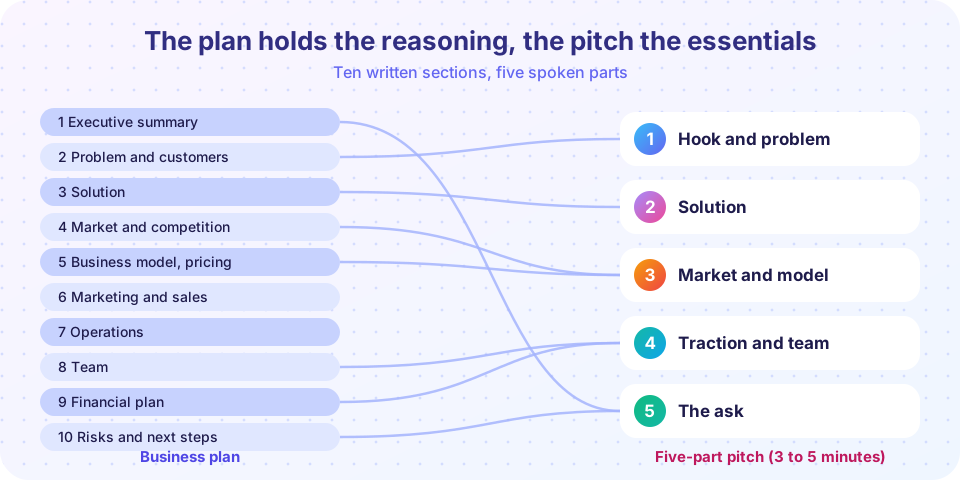
- Executive summary (one page). Written last. Include the problem, the solution, the market, the business model, traction, the team and the ask.
- Problem and customers. Who has the problem, how do they cope today and what evidence do you have from interviews?
- Solution and value proposition. What you offer and why it is better. Keep technical detail short.
- Market and competition. Market size (TAM, SAM, SOM), trends and competitors, with an honest comparison of strengths and weaknesses.
- Business model and pricing. Revenue streams, price, unit economics.
- Marketing and sales. How you will reach customers and what it costs (you will deepen this in Chapter 5).
- Operations. How you will produce and deliver: suppliers, location, equipment and processes.
- Team. Who the people are and why they can do this; gaps and how you will fill them.
- Financial plan. A forecast of revenue, costs and cash for 12 to 36 months with the assumptions written beside the numbers; start-up costs and funding needs (Chapter 6).
- Risks and next steps. The main risks and how you will handle them; milestones for the next six to twelve months.
How long should it be?
Match length to purpose. A one-page canvas or lean plan is enough to organize your own thinking and to talk to mentors. A five to ten-page plan suits a bank loan, a landlord, a grant application or a partner who wants details. A longer plan is rarely read in full; reviewers skim. Some funders (accelerators, grant bodies, banks) specify their own format, so always check their requirements.
Write plainly. Avoid inflated claims like "no competitors" or "guaranteed 10 percent market share". Use specific evidence: "12 of 15 cafes interviewed currently schedule staff on paper; 4 agreed to a trial."
The financial section
Reviewers read the financials skeptically. Show the assumptions behind each number: price, number of customers per month, conversion, churn, costs. Provide best, expected and worst cases. Include break-even and the cash needed to reach it, since the main reason ventures fail is running out of cash, not lacking profit on paper. Be consistent with the unit economics you worked out in the last lesson.
Building a pitch
A pitch is not a plan read aloud. It has one job: to make the listener want the next conversation. A common five-part structure for a three to five-minute pitch:
- Hook and problem (30 to 45 seconds). A short story or startling fact about the customer's pain.
- Solution (30 to 45 seconds). What you do, shown with a demo, a photo or a prototype if you can.
- Market and model (45 seconds). Who pays, how much, how big the market is.
- Traction and team (45 seconds). Interviews, pre-orders, pilots, the experience of the founders.
- The ask (30 seconds). Precisely what you want and what you will do with it: "We are asking for 40,000 dollars to fund six months of development and a pilot with 30 cafes."
Practice aloud until you can do it within the time limit. Use a few slides with big images and little text. Prepare answers to likely questions: "Who are your competitors?", "Why will customers switch?", "What happens if a large company copies you?", "How will you spend the money?"
Honesty matters
Never exaggerate numbers, claim partnerships that do not exist or hide risks. Reviewers talk to others, check claims and remember. Being straightforward about what you do not know ("We have not yet tested pricing above 29 dollars") builds trust. In many places, misleading investors or lenders can also break the law.
Common misconceptions
"A longer plan is better." Reviewers want clear thinking, not volume. Short and specific wins.
"If I show a big forecast, investors will be impressed." Experienced reviewers distrust hockey-stick forecasts without evidence. Show realistic assumptions and traction.
"A pitch must be perfect and polished." Clarity and credibility count more than design. Know your numbers and be ready for questions.
Try it
The first tool is a plan checklist with word counts. It checks that your executive summary covers the seven essentials and is the right length.
Press Run (or Ctrl + Enter) to see the result here.
Program input · what you'd type while the program runs
Type the answers before you press Run, one per line. Each time the program reads a line (with input()), it gets the next line from this box.
The second tool times a pitch. Enter your section lengths in seconds and see how they fit a three-minute slot, with a bar chart of the balance.
Press Run (or Ctrl + Enter) to see the result here.
Program input · what you'd type while the program runs
Type the answers before you press Run, one per line. Each time the program reads a line (with input()), it gets the next line from this box.
Check your understanding
Quick check · 5 questions
of 5 answered You scored / 5 · perfect!
-
1. Which part of a plan should be written last?
The summary compresses everything else, so write it once the rest is clear. -
2. What is 'the ask' in a pitch?
A pitch must end with a specific request, such as an amount of money and its use. -
3. A bank loan application most likely needs a plan of about
Match length to purpose and follow the funder's requirements. -
4. Why include the assumptions next to financial numbers?
Visible assumptions make forecasts credible and updatable. -
5. What is traction?
Traction is evidence of progress with real customers.
Summary
- Planning clarifies thinking; the plan communicates and sets a baseline.
- A practical plan covers problem, solution, market, model, marketing, operations, team, finances and risks.
- Match length to purpose: one page for yourself, five to ten for lenders and partners.
- A pitch has five parts: hook, solution, market and model, traction and team, and the ask.
- Be honest, show assumptions and rehearse for questions.
Next: Chapter 4 review
Track your progress
Create a free account to tick off lessons and pick up where you left off on any device.
of Entrepreneurship lessons completed