


















Lesson 7 of 49 · The Entrepreneurial Mindset
Risk and uncertainty
Learn the difference between risk and uncertainty, how founders shrink both with small experiments and affordable loss, and how to compute expected value.
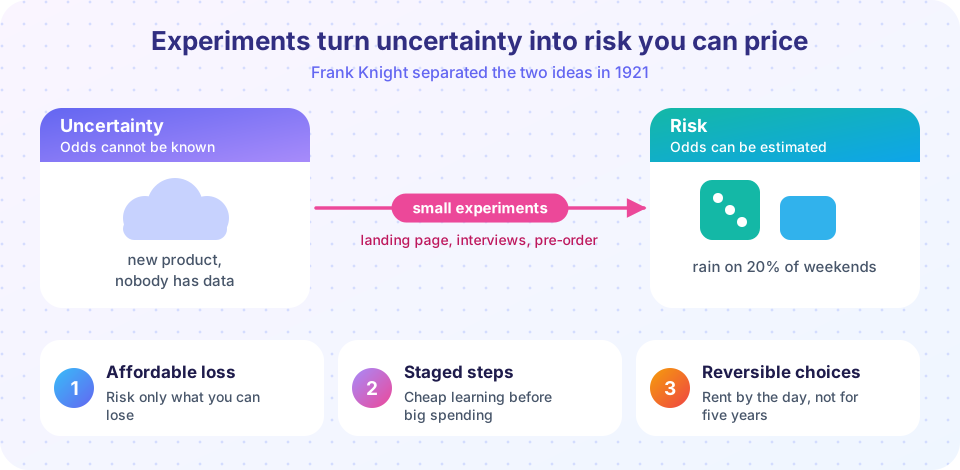
Ask a hundred people what entrepreneurs do and many will say "take risks". That is true but incomplete, and the incomplete part can lead you astray. Some of what founders face is risk in the technical sense: outcomes whose probabilities can be estimated. But much of it is uncertainty: situations where you cannot even list the outcomes, let alone assign probabilities. Different kinds of unknown call for different tools.
This lesson separates the two, teaches a simple method for comparing risky choices (expected value), and introduces the practical principles that experienced founders use to keep their downside small: affordable loss, staged commitments and reversible decisions.
What you will learn
- The difference between risk and uncertainty, as described by Frank Knight.
- How to compute and interpret an expected value.
- Why variance and the worst case matter as much as the average.
- Practical ways to limit downside: affordable loss, staging and reversibility.
Key terms
Risk: a situation where possible outcomes and their probabilities are known or can be estimated from data.
Uncertainty: a situation where outcomes or their probabilities cannot be reliably known in advance.
Expected value: the average result of a choice, weighting each outcome by its probability.
Downside: the loss if things go badly; the upside is the gain if they go well.
Reversible decision: a choice you can undo cheaply if it turns out wrong.
Risk: when you can calculate
Suppose a fictional baker named Priya sells cakes at a weekend market. From the last twenty weekends she knows that rainy weekends, which happened four times, cut her sales in half. She can estimate the probability of rain (about 20 percent) and the cost of a bad weekend. That is risk: a situation in which past data lets her estimate odds. She can buy rain insurance, bake fewer cakes when the forecast is poor or price her stall rent accordingly.
Insurance companies, casinos and banks built entire industries on measurable risk. When the data exist, mathematics helps.
Uncertainty: when you cannot
Now suppose Priya considers launching a subscription box of gluten-free pastries delivered to offices. Nobody has data about how many offices will subscribe, what price they will accept or how competitors will respond. She cannot list all the outcomes, let alone their chances. Frank Knight, in 1921, argued that this kind of genuine uncertainty is where entrepreneurial profit comes from: it cannot be insured against, and someone must make a judgment.
The practical lesson is not to give up, but to change the question. Instead of asking "What is the probability this works?" ask "What is the cheapest way to learn more about whether it works?" A weekend test with ten office managers, a landing page with a sign-up form or a pre-order can convert uncertainty into evidence. Each test turns a fog of unknowns into a small number of estimates you can reason about.
Expected value
Expected value (EV) lets you compare choices that have several possible outcomes. Multiply each outcome by its probability and add the results.
Example: Priya can run a pop-up stall at a festival. Rent costs 300 dollars. If the festival is busy (probability 0.3) she earns 1,500 dollars in sales; if it is average (probability 0.5) she earns 700; if it is quiet (probability 0.2) she earns 200. Ingredients cost 40 percent of sales. Expected sales are 0.3 x 1,500 + 0.5 x 700 + 0.2 x 200 = 450 + 350 + 40 = 840 dollars. Expected ingredients cost is 0.4 x 840 = 336. Expected profit is 840 - 336 - 300 = 204 dollars. On average the stall pays, so the choice looks sensible.
But averages hide the spread. In the quiet case she earns 200 and pays 80 for ingredients and 300 for rent, a loss of 180 dollars. If she can only afford to lose 100 dollars, this option breaks her rule even though its expected value is positive. That brings us to the principle of affordable loss.
Affordable loss and staged commitments
Saras Sarasvathy found that expert entrepreneurs often ask "how much can I afford to lose?" rather than "how much can I gain?". This changes the design of an experiment: they choose steps whose worst case they can live with, and they commit more only after learning something.
A staged plan might look like this. Stage 1: ask ten potential customers about the problem (cost: your time). Stage 2: make a simple prototype or a pre-order page (cost: 50 dollars). Stage 3: a small pilot with five customers (cost: 500 dollars). Stage 4: invest in equipment only if the pilot succeeds (cost: 5,000 dollars). At every stage the worst case is small compared with the total project. The key is to place the big spending after the cheap learning.
Reversibility matters too. Amazon's founder Jeff Bezos has described "two-way door" decisions, which are easy to reverse, versus "one-way door" decisions, which are not. Rent a market stall by the day rather than signing a five-year lease; use a month-by-month software subscription rather than buying a lifetime license. Keep doors open when you are still learning.
Risks beyond money
Not every cost is financial. Founders also risk time (months of work that might not pay), relationships, health, reputation and opportunity cost, which is the value of the best alternative you give up. A student who spends a year on a venture gives up a year of study or job experience, though it may bring skills worth more. Counting only dollars underestimates what a venture really costs, and failing to count benefits such as learning understates what it can give.
Common misconceptions
"Higher risk always means higher reward." Riskier choices have a wider spread of outcomes, but that does not mean they pay more on average. Many high-risk options have a lower expected value than safer ones.
"If expected value is positive, always do it." Expected value ignores whether you can survive the bad outcomes. A positive-EV bet that can bankrupt you is not affordable.
"Uncertainty is just risk with unknown numbers." Genuine uncertainty may involve outcomes you cannot even list. Guessing a probability for them can create false confidence.
Try it
The first tool computes expected value for any list of outcomes. Edit the outcomes for the festival stall, or for your own option, and read both the average and the worst case.
Press Run (or Ctrl + Enter) to see the result here.
Program input · what you'd type while the program runs
Type the answers before you press Run, one per line. Each time the program reads a line (with input()), it gets the next line from this box.
The second tool simulates many festival weekends to show how the spread of results around the average looks. It uses the same invented probabilities.
Press Run (or Ctrl + Enter) to see the result here.
Program input · what you'd type while the program runs
Type the answers before you press Run, one per line. Each time the program reads a line (with input()), it gets the next line from this box.
Check your understanding
Quick check · 5 questions
of 5 answered You scored / 5 · perfect!
-
1. Which situation is best described as risk rather than uncertainty?
Risk applies when past data let you estimate outcomes and probabilities, as with weather records. -
2. Outcomes are 100 dollars with probability 0.5 and 20 dollars with probability 0.5. What is the expected value?
0.5 x 100 + 0.5 x 20 = 50 + 10 = 60. -
3. What does the affordable loss principle tell a founder to do?
Affordable loss shifts the question from 'how much could I win' to 'how much can I stand to lose'. -
4. Why is a reversible decision valuable while you are still learning?
Reversibility keeps options open while information is still arriving. -
5. A bet has a positive expected value but could bankrupt you. What should you conclude?
A founder who is wiped out cannot collect the long-run average, so survivability matters.
Summary
- Risk has outcomes and probabilities you can estimate; uncertainty does not.
- Experiments convert uncertainty into evidence by revealing real customer behavior cheaply.
- Expected value weights each outcome by its probability, but hides the spread and the worst case.
- Affordable loss, staged commitments and reversible decisions limit the downside.
- Costs include time, relationships and opportunity cost, not only money.
Track your progress
Create a free account to tick off lessons and pick up where you left off on any device.
of Entrepreneurship lessons completed