


















Lesson 43 of 49 · Projects and Practice
Projects and practice: the big picture
Turn what you learned into skills: build a 36-month financial model, shape a pitch deck, solve practice problems and use the glossary and cheat sheet.
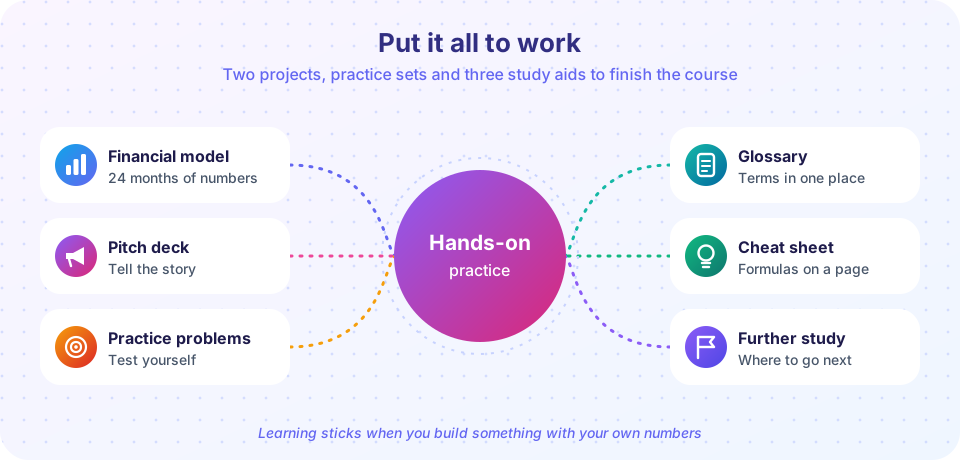
Reading about entrepreneurship teaches you the vocabulary. Building something with your own numbers teaches you the craft. In this last chapter you stop collecting ideas and start using them: you will build a small financial model of an imaginary company, assemble a pitch around it, work through practice problems at three levels, and finish with three study aids you can keep: a glossary, a one-page cheat sheet and a guide to what to learn next.
Nothing here requires special software. Every model runs in your browser, and every number is an invented example that you can replace with your own. The goal is not to predict the future, which nobody can do, but to learn how a business behaves when you change a price, a churn rate or a budget.
What you will learn
- What each lesson in this chapter asks you to build or do
- How to approach a project: assumptions first, then results, then decisions
- How to check your own work
- How to use the study aids after the course
Key terms
Assumption: a number you choose rather than measure, such as expected churn or price.
Model: a simplified calculation that shows how outputs change when inputs change.
Sensitivity: how much an output moves when one input changes.
Pitch: a short, structured presentation that asks for money, time or a commitment.
Cheat sheet: a one-page summary of formulas and tests for quick reference.
A good way to approach any project
Start with the question. A financial model is not a spreadsheet for its own sake. It answers a question: "How much money do we need before we break even?" or "Is a $30 price better than a $20 price?" Write the question at the top.
List your assumptions. Put every guess in one place with a note on where it came from: a customer interview, a competitor's price, a rough guess. When a result looks surprising, you will know which assumption to test.
Build the simplest version first. A model with six rows that you understand beats one with sixty that you do not. Add detail only when it changes a decision.
Test sensitivity. Change each assumption by 20% and see which one moves the answer most. Those are the numbers worth researching.
Write down the decision. The output of a project is a choice, such as "raise $120,000", "raise the price to $24", or "do not enter this market". If you cannot state a decision, the model is unfinished.
The lessons
| Lesson | What you do |
|---|---|
| A 36-month financial model | Build revenue, cost, cash and break-even for a subscription app |
| A pitch deck | Turn the model into a story with eight beats and a market-size estimate |
| Practice problems | Twelve problems at three levels, each checked by a calculator |
| Glossary | Look up and test yourself on the key terms |
| Cheat sheet | The formulas and tests of the whole course |
| Further study | Where to go next on this site and how to keep practicing |
Question first
Then assumptions
Build and test
End with a decision
A model that ends without a decision is only a calculation.
How the study aids work after the course
The glossary, cheat sheet and further-study guide are meant to be used after you finish, not just read once. Keep the glossary open when you read articles, listen to investors or review a contract, and add the terms you meet that are not on the list. Use the cheat sheet as a pre-flight check before a meeting: before you present a number, find its formula and confirm you used it correctly. Use the further-study guide as a planner: pick one track, set a weekly time, and schedule a date to review what you learned.
One tip for the projects themselves is to work in the open. Show your financial model to a friend who knows nothing about your idea and ask them to explain it back. If they cannot, the model is too complicated. Pitch your deck to someone who will interrupt, and notice the questions that arise every time; those questions point to the slides that need work. The quickest improvement in any plan comes from showing an unfinished version to a few honest people, rather than polishing it alone.
Finally, be kind to yourself about errors. A model with a mistake is a normal draft. What matters is that you can find the mistake, which is easier when assumptions are listed, and that you fix it before you rely on it.
Common misconceptions
"A detailed model is an accurate model." More rows do not mean more truth. Early numbers are guesses, so keep the model simple and honest about uncertainty.
"Investors want a perfect forecast." They know forecasts are wrong. They look for sensible assumptions, a clear logic and a founder who understands the drivers.
"Practice problems are only for exams." Quick arithmetic is a professional skill: founders who can compute payback or dilution in their head can negotiate better.
Try it
Before you start the first project, practice the habit of listing assumptions. The tool below turns a handful of assumptions into a one-line forecast and shows how sensitive the answer is to each one. It uses a simplified model and invented numbers.
Press Run (or Ctrl + Enter) to see the console output here.
No output.
Run it and see which assumption moves the profit most. In this example the price has the biggest effect, which is why pricing deserves more research than many founders give it.
Check your understanding
Quick check · 4 questions
of 4 answered You scored / 4 · perfect!
-
1. What should a financial model start with?
A model exists to inform a decision, so start by writing the question. -
2. Why list every assumption in one place?
A visible list makes it clear what to research and what to change when results look surprising. -
3. What is sensitivity analysis?
It shows which inputs matter most, so you can focus on the numbers that deserve research. -
4. What is the proper end of a modelling project?
A model is useful when it leads to a choice such as how much to raise or what to charge.
Summary
- Projects turn knowledge into skill; start with a question and list your assumptions.
- Build the simplest model first, test sensitivity and end with a decision.
- The chapter has two projects, a practice set, a glossary, a cheat sheet and a study guide.
- Models are about learning how a business behaves, not predicting exact numbers.
Track your progress
Create a free account to tick off lessons and pick up where you left off on any device.
of Entrepreneurship lessons completed