


















Lesson 36 of 49 · Teams and Operations
Operations and legal basics
Learn to map and measure processes, find bottlenecks, plan inventory with EOQ, and understand business structures, contracts and intellectual property.
Operations is the unglamorous part of a business: the machinery that delivers what you promised, every time, at a cost you can afford. A beautiful brand and a clever product go nowhere if orders ship late, support emails vanish or invoices are never sent. For a one-person company operations is mostly habits; for a team of ten it becomes a system; for a company of a hundred it is a core skill.
This lesson teaches you to see a business as a set of processes, to find the step that limits everything else, and to plan stock and capacity with simple arithmetic. It also covers the legal basics every founder meets: choosing a structure, protecting what you create, and signing contracts with eyes open. Law differs from country to country, so use this as a map of questions to ask a local professional, not as legal advice.
What you will learn
- How to map, measure and improve a process
- How to find a bottleneck and why improving other steps does not help
- How to use checklists and write down what you know
- How to plan inventory with economic order quantity and a reorder point
- The basics of business structures, contracts and intellectual property
Key terms
Process: a repeatable sequence of steps that turns an input into an output.
Bottleneck: the step with the lowest capacity, which limits the output of the whole process.
Throughput: how many units a process completes per unit of time.
Economic order quantity (EOQ): the order size that minimizes the total of ordering and holding costs.
Intellectual property (IP): legal rights over creations such as code, designs, names and inventions.
Map, measure, improve
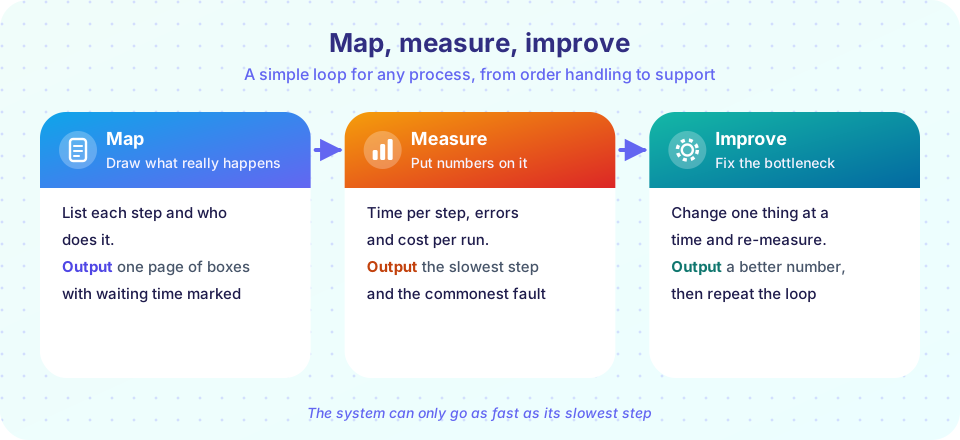
Map. Pick one process, for example "customer places an order and receives it", and write each step on a sticky note in the order it really happens, not the way it is supposed to happen. Note who does it, how long it takes, and where the work waits. Often the biggest delays are not in the work itself but in the waiting between steps: an email that sits unread, an approval that depends on one person who is away.
Measure. Collect a few numbers: time per step, error rate, cost per run, and how often the process is delayed. You do not need perfect data; a week of tallies on paper reveals plenty.
Improve. Choose the step that costs the most time, money or customer satisfaction, change it, and measure again. Change one thing at a time so you know what helped.
Bottlenecks
Eliyahu Goldratt's 1984 novel The Goal popularized the theory of constraints: in any process one step limits the output, and improving any other step changes nothing. If packing can handle 24 orders an hour and picking can handle 30, you will ship 24 an hour however fast your labeling is.
Finding the bottleneck is arithmetic: compute each step's capacity per hour and take the minimum. The output of the whole process equals the capacity of its slowest step. To increase output you must raise that capacity, and when you do, the bottleneck moves to the next-slowest step. After you improve packing from 24 to 32 an hour, picking (30 an hour) becomes the limit, so the gain is 25%, not 33%.
Press Run (or Ctrl + Enter) to see the result here.
Program input · what you'd type while the program runs
Type the answers before you press Run, one per line. Each time the program reads a line (with input()), it gets the next line from this box.
Checklists, documentation and automation
Aviation, surgery and construction rely on checklists because even experts forget steps under pressure. Atul Gawande's 2009 book The Checklist Manifesto describes how a short list of critical steps reduced errors in hospitals. In a startup, a one-page checklist for onboarding a customer, publishing a release or closing the month's books lets a new person do the job correctly on day one, and lets you take a holiday.
Write down how things are done while you do them. Documentation does not need to be elegant; a shared document with screenshots is enough. The rule of thumb: the second time you do a task, write the steps; the third time, ask whether software could do it. Automation (email rules, invoice reminders, scheduled reports) saves hours, but automate stable processes: automating a messy process just makes mistakes faster.
Measure a few operational numbers weekly: orders shipped, average response time to customers, defect or refund rate, and on-time delivery. A tiny dashboard on a shared screen focuses the team on what matters.
Inventory and capacity
If you sell physical goods, stock is cash sitting on a shelf. Too little and you lose sales; too much and you tie up money, risk waste and pay storage. Two simple tools help.
The economic order quantity balances the cost of placing an order against the cost of holding stock. With yearly demand D, a fixed cost S for each order, and a holding cost H per unit per year:
EOQ = √(2 × D × S ÷ H)
With D = 12,000 units, S = $50 and H = $2, EOQ = √(2 × 12,000 × 50 ÷ 2) = √600,000 ≈ 775 units. Ordering about 775 at a time means roughly 15 or 16 orders a year.
The reorder point tells you when to order: daily demand × supplier lead time + safety stock. Daily demand is 12,000 ÷ 365 ≈ 32.9 units. With a five-day lead time, expected demand during the wait is about 164 units; a safety stock of 50 units against surprises gives a reorder point of roughly 214.
The EOQ model assumes steady demand and constant costs, so it is a starting point. If your product is perishable, seasonal or trending, order smaller amounts more often. Also compare against supplier discounts and minimum order sizes.
Press Run (or Ctrl + Enter) to see the console output here.
No output.
Choosing a legal structure
Registering a business is not only paperwork: the structure you choose affects who is responsible for debts, how taxes work and how investors can join.
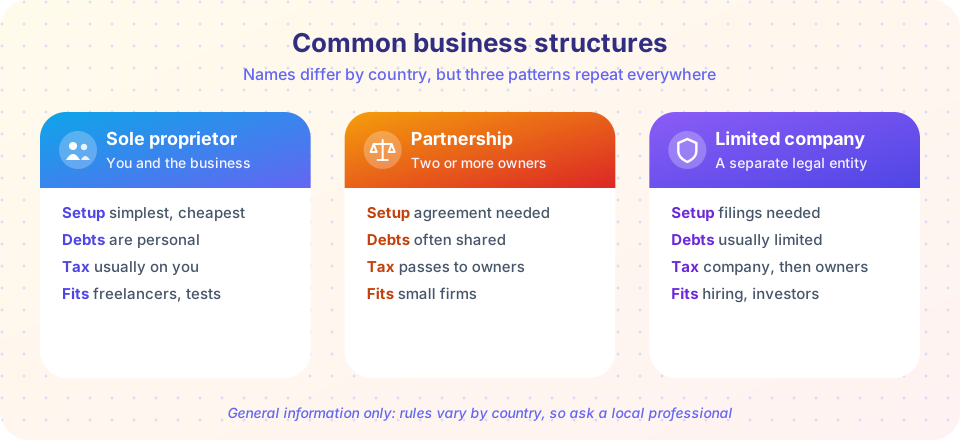
- A sole proprietorship means you and the business are legally the same. It is the simplest and cheapest, but you are personally responsible for the debts and legal claims of the business.
- A partnership has two or more owners, ideally under a written agreement. In many places partners are jointly responsible for the partnership's debts.
- A limited company (called an LLC, a limited liability company, a corporation, a GmbH, an SAS or another name depending on the country) is a separate legal entity. Owners' personal assets are usually protected from the company's debts, with exceptions such as personal guarantees or fraud. It involves registration, filings and sometimes higher costs, but it is almost always required if you want outside investors or employees with stock options.
Ask a local accountant or lawyer about tax treatment, filing deadlines, required registrations, and whether your activity needs a license. Many startups begin as a sole trader to test an idea, then form a company when revenue, hiring or investment appears.
Contracts
A contract is an agreement the law will enforce. Key points for founders:
- Put important agreements in writing: with customers, suppliers, contractors, co-founders and employees. Spell out scope, price, payment terms, deadlines, who owns the work, and how to end the agreement.
- Read what you sign. Pay attention to automatic renewals, termination notice, liability limits and who owns the output.
- Terms of service and privacy policy are needed for any website or app that collects user data. Laws such as the European Union's GDPR set strict rules on personal data of people in the EU. Seek advice if you collect or process such data.
- Employment contracts and contractor agreements differ: misclassifying an employee as a contractor can carry penalties in many countries.
Intellectual property
Four main types protect different things.
- Copyright protects original expression, such as code, text, images and music, automatically in most countries once created. It does not protect ideas, only the way they are expressed.
- Trademarks protect names, logos and slogans that identify your brand. Registering a mark in the places you trade gives stronger protection. Check that a name is free before you invest in it.
- Patents protect certain new inventions for a limited time, in exchange for disclosing them. They are expensive and slow, and software patents are treated differently in different countries.
- Trade secrets protect confidential business information such as formulas or customer lists, as long as you keep them secret with sensible measures like confidentiality agreements.
The most common mistake is not registering anything but not assigning ownership: when freelancers or co-founders create code or designs, make sure a written agreement says the company owns the result. Without it, the creator may keep the rights.
Common misconceptions
"A limited company protects me from everything." It usually limits liability for business debts, but not for your own wrongdoing, personal guarantees, or unpaid taxes in some places.
"A handshake is enough." Memories differ and friendships end. A short written agreement protects both sides.
"Speeding up any step speeds up the whole process." Only improving the bottleneck raises output. Other improvements may reduce cost, but not throughput.
Check your understanding
Quick check · 5 questions
of 5 answered You scored / 5 · perfect!
-
1. Four steps can handle 40, 25, 35 and 50 units per hour. What is the process throughput?
Throughput equals the capacity of the slowest step: 25 units per hour. -
2. After you raise the slowest step from 25 to 45 units per hour (others: 40, 35, 50), what is the new throughput?
The bottleneck moves to the next-slowest step, which handles 35 units per hour. -
3. Using EOQ = sqrt(2DS/H) with D = 8,000, S = $40 and H = $4, what is the economic order quantity?
2 x 8,000 x 40 / 4 = 160,000, whose square root is 400. -
4. Which type of intellectual property automatically protects the way your code is written in most countries?
Copyright protects original expression, such as code, without registration in most countries. Ideas themselves are not protected. -
5. Why should a freelancer who writes code for you sign an agreement about ownership?
Unless a written agreement assigns the rights, ownership may remain with the creator, which can cause problems later.
Summary
- Map, measure and improve one process at a time; the slowest step sets the output.
- Use checklists and short documents so work does not depend on one person's memory.
- EOQ and a reorder point give a first plan for stock; adjust for seasonality and supplier terms.
- Structures differ in liability, tax and investor readiness: sole proprietorship, partnership, limited company.
- Put agreements in writing and make sure the company owns the IP it pays for.
Next: Chapter 7 review
Track your progress
Create a free account to tick off lessons and pick up where you left off on any device.
of Entrepreneurship lessons completed