


















Lesson 25 of 49 · Marketing and Sales
Channels and the funnel
Learn how to choose marketing channels, test them cheaply, read a conversion funnel and compute customer acquisition cost with worked numbers.
Once you know whom you serve and what you promise, the next question is practical: where do those people spend their attention, and how do you get in front of them for a price you can afford? The places and methods you use are your channels. The path a person follows from first hearing about you to paying is your funnel. Together they turn a vague wish ("we need more users") into a measurable system ("each 1,000 visitors from this forum produce 12 customers at a cost of $40 each").
You do not need a big budget for this. You need discipline: try a few channels in small, cheap experiments, write down the numbers, and put more money behind the one that works.
What you will learn
- The difference between paid, owned and earned channels
- How to test channels with small experiments and compare them fairly
- How to read a funnel and find the weakest step
- How to calculate customer acquisition cost (CAC), including the costs people forget
Key terms
Channel: a route to reach potential customers, such as search ads, a newsletter, partners or direct outreach.
Conversion rate: the share of people at one step who move to the next step.
Funnel: the sequence of steps from awareness to purchase (and sometimes referral).
CAC (customer acquisition cost): acquisition spending divided by the number of new customers it won.
Attribution: deciding which channel deserves credit for a customer.
Three families of channel
Marketers often group channels by who controls them.
Paid channels buy attention: search engine ads, social media ads, sponsorships, trade show booths. They scale quickly (double the budget, roughly double the visitors) and stop the moment you stop paying. Their danger is that prices rise as more advertisers compete.
Owned channels are assets you control: your website, email list, app, blog, community. They are slow to build and cheap to run. An email list of 5,000 people who asked to hear from you is worth more than 50,000 followers on a platform that can change its rules overnight.
Earned channels are attention others give you: press mentions, reviews, word of mouth, a partner recommending you. You cannot buy them directly, but you can create the conditions: a remarkable product, an easy way to share, a story journalists want to tell.
In Traction (2015), Gabriel Weinberg and Justin Mares list nineteen channels and propose a "bullseye" method: brainstorm one idea for each, pick the three most promising, run cheap tests for each, and then concentrate on the single best. The lesson is that you should be skeptical of the channel you personally like most; the data decides.
Running a cheap channel test
A good test has four parts:
- A question: "Can we win customers from design forums for under $60 each?"
- A small fixed budget of time or money, large enough to see a pattern (a few dozen visitors at least), small enough to lose.
- A tracked link or code so you know which visitors came from which channel (for example, a distinct web address for each).
- A decision rule written before you start: "If CAC is below $60 and at least 10 people buy, we double the spend."
Writing the rule first protects you from arguing yourself into a result you hoped for. Small tests are noisy: with 200 visitors and a 2% conversion you expect only four customers, and the true rate could easily be double or half. Treat early numbers as direction, not proof, and re-test before scaling.
Reading a funnel
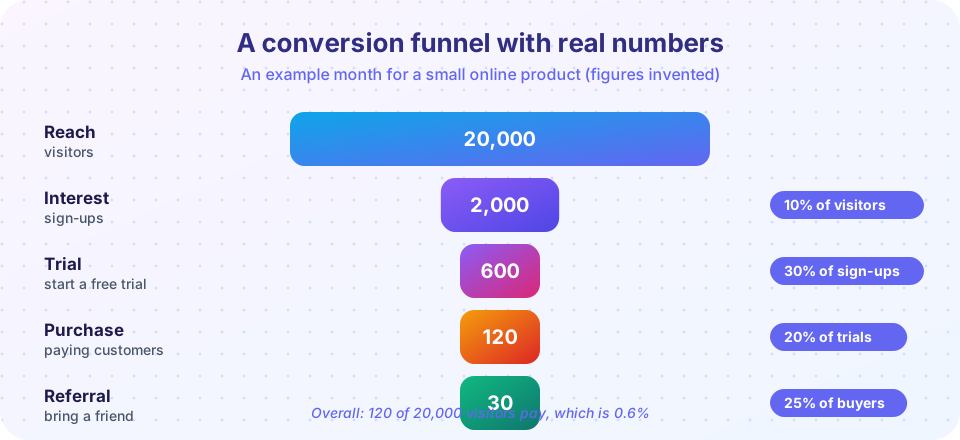
A funnel is a chain of conversion rates. In the picture above, 10% of visitors sign up, 30% of sign-ups start a trial, and 20% of trials pay. To find the overall conversion, multiply:
0.10 × 0.30 × 0.20 = 0.006, which is 0.6%. Of 20,000 visitors, 120 become customers.
This multiplication shows why improving a weak step is powerful. Suppose trials convert at only 20%. If better onboarding lifts that to 30%, customers rise from 120 to 180, a 50% increase, without a single extra visitor. By contrast, doubling the visitor count needs double the ad spend. Always ask: which step has the lowest rate relative to what peers achieve, and which can I change cheaply?
Funnel steps differ by business, but the pattern is shared:
| Stage | Typical question | A lever you control |
|---|---|---|
| Reach | Do they know we exist? | Channel, message, creative |
| Interest | Do they care enough to sign up? | Headline, promise, social proof |
| Trial | Do they try it? | Onboarding, friction, time to first win |
| Purchase | Do they pay? | Price, trust, checkout, sales call |
| Referral | Do they tell others? | Sharing prompts, rewards, product quality |
Not every funnel is a straight line. People bounce, return later and switch devices. Treat the funnel as a useful simplification, not a law of nature.
Customer acquisition cost
CAC is the number that links marketing to the finances of the business:
CAC = money spent on acquisition ÷ new customers won in the same period
If you spend $2,000 on search ads in a month and win 40 customers, CAC is $50. There are two common mistakes.
Leaving out hidden costs. A blended CAC divides all sales and marketing cost (salaries, tools, agency fees) by all new customers. A paid CAC counts only ad spend. Both are useful, but when you compare channels to the price of your product, include the time you or your team spend. Your hours are not free; they are the cost you cannot see.
Mixing periods. If a sales cycle is 60 days, spend in March produces customers in May. Comparing March spend with March customers understates CAC for a growing business. Use a lag or a longer window.
CAC means little alone. It must be compared with what a customer is worth over time, a topic we cover in the finance chapter. For now, a working rule of thumb used by many software companies is that a customer should pay back their acquisition cost within about a year, but the right threshold depends on your margins and cash.
Press Run (or Ctrl + Enter) to see the result here.
Program input · what you'd type while the program runs
Type the answers before you press Run, one per line. Each time the program reads a line (with input()), it gets the next line from this box.
Notice that the channel with the biggest spend is not the cheapest. Partnerships and blog content win customers for far less, but they have limited volume, which brings us to a second rule: a channel is only useful if it can absorb enough budget to matter.
Capacity, saturation and focus
Every channel has a ceiling. A niche forum may give you 20 customers a month however much you try; a social network can absorb a large budget but at rising cost per customer as you reach less-interested people. When your best channel saturates, you add a second. Until then, resist spreading thin: a startup that runs seven channels at 5% effort learns nothing from any of them.
Interactive funnels help build intuition. In the demonstration below, change the visitor count and each conversion rate and watch the number of customers move. It is a calculator that applies the multiplication above, not a prediction for your business.
Try lifting only the "Trial to paid" slider from 20% to 30%, then lifting visitors by 50%. Both give the same number of customers; which one would cost you more?
Common misconceptions
"Go where everyone else is." Crowded channels are expensive. Many startups win by choosing an overlooked channel that matches their segment, such as a niche community or a partner's newsletter.
"More traffic fixes conversion." If the product or page does not persuade, extra traffic just wastes budget faster. Fix the leakiest step first.
"Attribution is exact." A customer might see an ad, read a review, and then type your name into a search box. Any single credit rule is a simplification; ask customers "How did you hear about us?" as a sanity check.
Check your understanding
Quick check · 5 questions
of 5 answered You scored / 5 · perfect!
-
1. A business spends $3,000 on ads in a month and wins 60 customers. What is the paid CAC?
CAC is spending divided by new customers: 3,000 / 60 = $50. -
2. Visitors convert to sign-ups at 8%, sign-ups to purchase at 25%. Out of 10,000 visitors, how many purchase?
10,000 x 0.08 = 800 sign-ups; 800 x 0.25 = 200 purchases. Overall conversion is 2%. -
3. Which channel family is most under your control and cheapest to run once built?
Owned channels such as an email list or your own site are assets you control. They take time to build but cost little per contact later. -
4. Why should you write the decision rule for a channel test before running it?
A pre-registered rule keeps you honest when early numbers are noisy and you are emotionally invested. -
5. Why is a blended CAC usually higher than a paid-only CAC?
Blended CAC divides all sales and marketing cost, including people and tools, by all new customers.
Summary
- Channels are paid, owned or earned; test several cheaply, then focus on the one that works.
- Write a decision rule before each test, and treat small samples as direction, not proof.
- A funnel multiplies conversion rates; improving the weakest step often beats buying more traffic.
- CAC equals acquisition spending divided by new customers; include hidden costs and match time periods.
- Every channel saturates, so plan the second one before the first runs dry.
Next: Sales and pricing
Track your progress
Create a free account to tick off lessons and pick up where you left off on any device.
of Entrepreneurship lessons completed