


















Lesson 2 of 49 · Getting Started
Chapter 1 overview: getting started
The big picture of entrepreneurship: what it is, why it matters to economies and societies, and what the lessons in Chapter 1 will cover.
Every business you have ever bought from was once an idea in one person's head, and usually a shaky one. Someone decided that a problem was worth solving, took a first small step, and kept going when the result was uncertain. Chapter 1 gives you the map for that territory: what entrepreneurship is, what it is not, and the many forms a new venture can take.
Before you learn tools such as customer interviews, business models and financial statements, you need a shared vocabulary and a realistic picture. Many beginners arrive with a movie version of entrepreneurship: a lone genius, a garage, a lucky break and a billion-dollar ending. The real picture is more interesting, more varied and far more accessible.
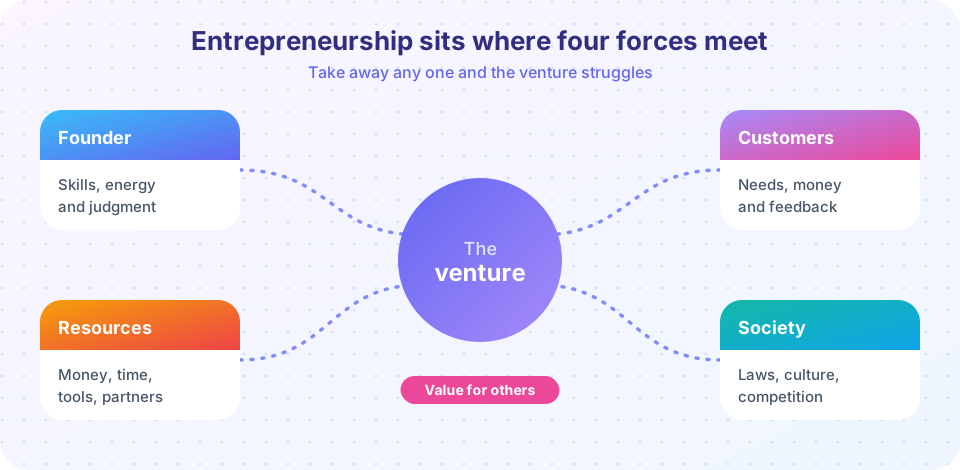
The big picture
Entrepreneurship links four forces. A founder brings energy, skills and judgment. Customers supply the demand that makes a venture worth running. Resources such as money, time, tools and partners make building possible. Society gives the context: laws, culture, competition and the real needs a venture can meet. If any one of these is missing, the venture struggles. A brilliant product nobody wants fails; so does a popular product that the founder cannot afford to make.
The economist Joseph Schumpeter described entrepreneurs as the people who carry out new combinations: a new product, a new method of production, a new market or a new way of organizing work. He called the resulting churn "creative destruction", because new ventures can make older ways of doing things obsolete. Other thinkers, such as Israel Kirzner, stressed alertness: noticing gaps and mispricings that others miss. You will meet both ideas in the next lesson.
Why study entrepreneurship?
What this chapter covers
Three useful habits to start
What each lesson in this chapter covers
- What is entrepreneurship? defines the word, tells the stories of three very different founders, and sorts out common myths from facts.
- Types of ventures compares lifestyle businesses, small businesses, scalable startups, social enterprises and corporate ventures, and shows how the type changes the goals.
- Chapter 1 review pulls the chapter together in one picture and a ten-question quiz.
Why entrepreneurship matters
For individuals, entrepreneurship is a way to earn a living, build independence and apply their skills to a problem they care about. For communities, new ventures provide jobs, services and competition that keeps prices fair and quality improving. For economies, new firms are an important source of new products and processes, and a steady supply of them helps older industries adapt. For societies, ventures can address needs that markets and governments have been slow to serve, from clean cooking stoves to online education.
None of this means every venture is good or every founder wise. Ventures can cause harm, waste resources, or fail and leave debts. That is why this course teaches careful testing, honest finances and ethical thinking alongside the excitement.
A first look at the numbers
Most new ventures are small and many do not last for decades. Rather than quote statistics that vary by country and year, the interactive tool below lets you explore why survival is uncertain: a venture needs revenue to exceed costs for long enough to keep going. Try changing the numbers to see how quickly a small business moves from loss to profit.
Try it
Press Run (or Ctrl + Enter) to see the result here.
Program input · what you'd type while the program runs
Type the answers before you press Run, one per line. Each time the program reads a line (with input()), it gets the next line from this box.
The chart version shows the same story visually. The point where revenue crosses costs is the break-even point you will study again in Chapter 4.
Press Run (or Ctrl + Enter) to see the result here.
Program input · what you'd type while the program runs
Type the answers before you press Run, one per line. Each time the program reads a line (with input()), it gets the next line from this box.
Check your understanding
Quick check · 4 questions
of 4 answered You scored / 4 · perfect!
-
1. Which four forces does the chapter say entrepreneurship links?
The overview picture shows a founder connected to customers, resources and society. The other sets are different frameworks. -
2. What did Schumpeter mean by creative destruction?
Schumpeter used the phrase for the churn caused when new products and methods replace old ones. -
3. In the street-food example, what happens to profit as meals sold rise above the break-even point?
After break-even, each extra meal adds the difference between price and variable cost to profit. -
4. Why does the course teach testing and ethics alongside the excitement of starting up?
Careful testing reduces waste, and ethical thinking reduces harm to customers, staff and communities.
Summary
- Entrepreneurship connects a founder, customers, resources and society.
- Schumpeter stressed new combinations and creative destruction; Kirzner stressed alertness to gaps.
- New ventures matter for jobs, choice and solutions, but they can also fail or cause harm.
- Chapter 1 defines the field, maps the types of ventures and ends with a review.
- Break-even is where revenue equals costs, a number every founder should know.
Track your progress
Create a free account to tick off lessons and pick up where you left off on any device.
of Entrepreneurship lessons completed