


















Lesson 47 of 49 · Projects and Practice
Glossary of entrepreneurship terms
A plain-language glossary of about 70 entrepreneurship terms from segment to liquidation preference, grouped by market, money, people, operations, growth and exit.
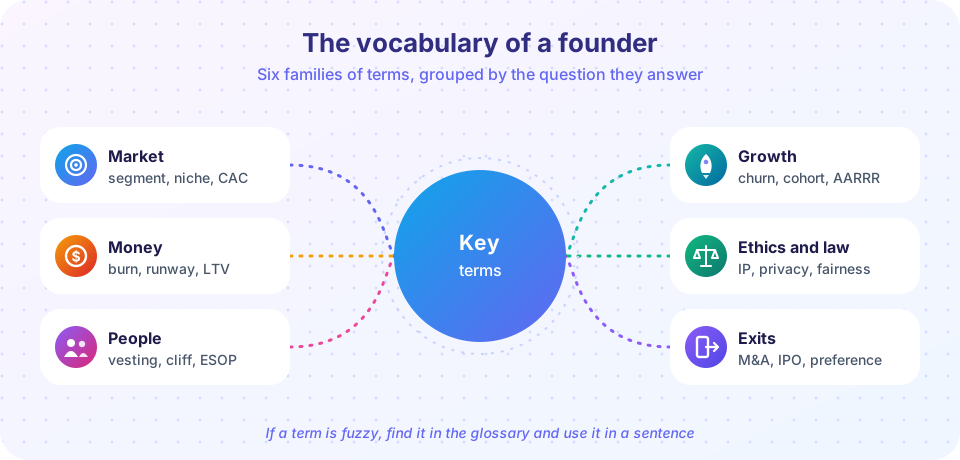
Every field has its own shorthand, and entrepreneurship has more than most, because it borrows from marketing, finance, law, operations and psychology. A new founder in a room of investors can feel as if everyone else speaks a secret language. This glossary decodes it. The terms are grouped by the question they help answer, so you can read one family at a time, and each entry gives a short, plain definition with a pointer to where the idea appeared in the course.
Use it three ways: look up a word you have forgotten, read a whole family as a review, or test yourself with the flashcards below the tables. If a definition does not feel solid, find the original lesson and rework the example.
What you will learn
- The meaning of about 70 terms used throughout the course
- How the terms group into families
- How to use flashcards to test your recall
Key terms
Glossary: an alphabetical or thematic list of terms with short definitions.
Jargon: specialist vocabulary; useful among experts, confusing to everyone else.
Plain language: explaining an idea without unnecessary jargon.
Mnemonic: a memory aid, such as AARRR for the five growth metrics.
Market and customers
| Term | Meaning |
|---|---|
| Segment | A group of buyers who share a need and respond similarly to an offer |
| Target market | The segment or segments you decide to serve first |
| Beachhead market | A small, winnable first segment you aim to dominate before expanding |
| Positioning | The place your product occupies in the buyer's mind compared with alternatives |
| Value proposition | A short promise of the benefit you deliver and why it is different |
| Channel | A route to reach customers: search, email, partners, sales team and so on |
| Funnel | The sequence of steps from first awareness to purchase |
| Conversion rate | The share of people at one step who move on to the next |
| CAC | Customer acquisition cost: acquisition spending divided by new customers |
| Attribution | Deciding which channel deserves credit for a customer |
| Pipeline | A list of prospective deals and the stage each one has reached |
| Win rate | The share of deals at a stage that eventually close |
| Price elasticity | How much the quantity sold changes when the price changes |
| TAM, SAM, SOM | Total, serviceable and obtainable market: all possible, reachable, and realistically winnable revenue |
Money and funding
| Term | Meaning |
|---|---|
| Unit economics | The revenue and costs of one unit of the business, such as one customer |
| Contribution margin | Price minus the variable cost of one sale |
| Variable cost | A cost that rises with each unit sold, such as materials or shipping |
| Fixed cost | A cost that stays the same whatever you sell in the period, such as rent |
| LTV | Lifetime value: total margin expected from a customer, roughly margin per month divided by churn |
| Payback period | Months a customer takes to repay their acquisition cost |
| Break-even | The sales volume at which revenue equals total cost |
| Cash flow | The movement of money into and out of your bank account |
| Burn rate | Cash spent per month; net burn subtracts cash received |
| Runway | Months you can survive: cash divided by net burn |
| Bootstrapping | Funding the business from savings and early revenue |
| Equity | Ownership of the company, held as shares |
| Debt | Money borrowed that must be repaid, usually with interest |
| Pre-money valuation | The agreed value of the company before a new investment |
| Post-money valuation | Pre-money value plus the new investment |
| Dilution | The fall in an owner's percentage when new shares are issued |
| SAFE | Simple agreement for future equity: an investment that converts to shares at a later round |
| Convertible note | A loan that converts into shares at a later round, often with a discount or cap |
| Option pool | Shares reserved for future employees |
People and teams
| Term | Meaning |
|---|---|
| Co-founder | A person who shares the risk, work and ownership from the start |
| Founders' agreement | A written record of roles, ownership, decision rights and leaver terms |
| Vesting | Earning shares gradually over a schedule instead of owning them at once |
| Cliff | An initial period of vesting during which nothing vests, after which a first block does |
| Leaver provision | A rule that sets what a departing founder keeps or must sell back |
| Scorecard | A written list of outcomes and traits used to rate every candidate on the same criteria |
| Structured interview | An interview with the same questions and rating scale for every candidate |
| Work sample | A short realistic task used to judge ability directly |
| Fully loaded cost | Salary plus taxes, benefits, equipment and overhead for an employee |
| Culture | The shared habits and unwritten rules of how people behave |
Operations and legal
| Term | Meaning |
|---|---|
| Process | A repeatable sequence of steps that turns an input into an output |
| Bottleneck | The step with the lowest capacity, which limits the whole process |
| Throughput | How many units a process completes per unit of time |
| EOQ | Economic order quantity: the order size that minimizes ordering plus holding costs |
| Reorder point | Stock level at which to place an order: demand during lead time plus safety stock |
| Sole proprietorship | A business legally identical to its owner, with personal liability |
| Limited company | A separate legal entity whose owners usually have limited liability |
| Intellectual property | Legal rights over creations such as code, designs, names and inventions |
| Copyright | Automatic protection for original expression, such as code and text |
| Trademark | Protection for names, logos and slogans that identify a brand |
| Patent | A time-limited right over a new invention, granted in exchange for disclosure |
| Trade secret | Confidential business information protected by keeping it secret |
Growth and metrics
| Term | Meaning |
|---|---|
| Compound growth | Growth where each period's increase builds on the previous total |
| Rule of 72 | Doubling time is roughly 72 divided by the growth rate in percent |
| Cohort | A group of customers who started in the same period, tracked together |
| Retention | The share of customers who keep using or buying over time |
| Churn | The share of customers who leave in a period |
| Viral coefficient | New users brought in by each existing user |
| Product-market fit | A product satisfying strong demand in a market, often seen in flat retention curves |
| AARRR | Acquisition, activation, retention, revenue, referral: five growth stages |
| Vanity metric | A number that looks impressive but does not guide decisions |
| MRR | Monthly recurring revenue from subscriptions |
| Net revenue retention | Revenue from existing customers now compared with a period ago, including upgrades and losses |
Ethics and exits
| Term | Meaning |
|---|---|
| Ethics | Reasoning about what people ought to do, beyond what the law requires |
| Stakeholder | Anyone affected by a company's actions |
| Dark pattern | A design that tricks users into actions they did not intend |
| Externality | A cost or benefit that falls on people outside the transaction |
| Data minimization | Collecting only the personal data you need for a clear purpose |
| Acquisition | One company buying another |
| Acqui-hire | An acquisition mainly to hire the team |
| IPO | Initial public offering: first sale of shares to the public on an exchange |
| Due diligence | A buyer's detailed check of a company's finances, contracts and technology |
| Liquidation preference | Investors' right to be paid first when the company is sold |
| Earn-out | Part of a sale price paid later, only if targets are met |
Try it
The first TryIt is a flashcard deck. Click a card to flip it, then move to the next. It stores nothing, so refresh for a new order.
The second TryIt is a tiny lookup function in the console editor. Add your own terms to the dictionary as you meet them.
Press Run (or Ctrl + Enter) to see the console output here.
No output.
Common misconceptions
"Knowing the word means knowing the idea." A definition is a doorway. You know a term when you can compute with it or give an example.
"All founders use the terms the same way." Definitions vary. "Churn" can mean customers or revenue lost; "burn" can be gross or net. Ask, and state which you mean.
"Jargon makes you sound credible." Plain language makes you credible. Use a term when it saves words and your audience knows it.
Check your understanding
Quick check · 5 questions
of 5 answered You scored / 5 · perfect!
-
1. Which pair of terms correctly describes cash spent per month before and after counting cash received?
Gross burn is total cash spent; net burn subtracts the cash received. -
2. What does a cliff do in a vesting schedule?
The cliff is a delay at the start of the schedule, commonly one year. -
3. Which term means a cost that falls on people outside the transaction?
Pollution borne by neighbors is the classic externality. -
4. Which describes a liquidation preference?
Preferred investors have a claim on the first proceeds of a sale, ahead of common holders. -
5. What is AARRR?
It is a framework of five metrics from first visit to referral.
Summary
- Terms fall into families: market, money, people, operations and legal, growth, and ethics and exits.
- Each term is a shortcut for an idea you can compute or illustrate; test yourself with examples.
- Definitions vary across companies, so confirm what others mean by a term.
- Use plain language whenever possible.
Next: Cheat sheet
Track your progress
Create a free account to tick off lessons and pick up where you left off on any device.
of Entrepreneurship lessons completed