


















Lesson 46 of 49 · Projects and Practice
Practice problems
Twelve entrepreneurship problems in three levels: margin, CAC, funnels, LTV, runway, dilution, EOQ, pricing, hiring, liquidation preferences and a go or no-go decision.
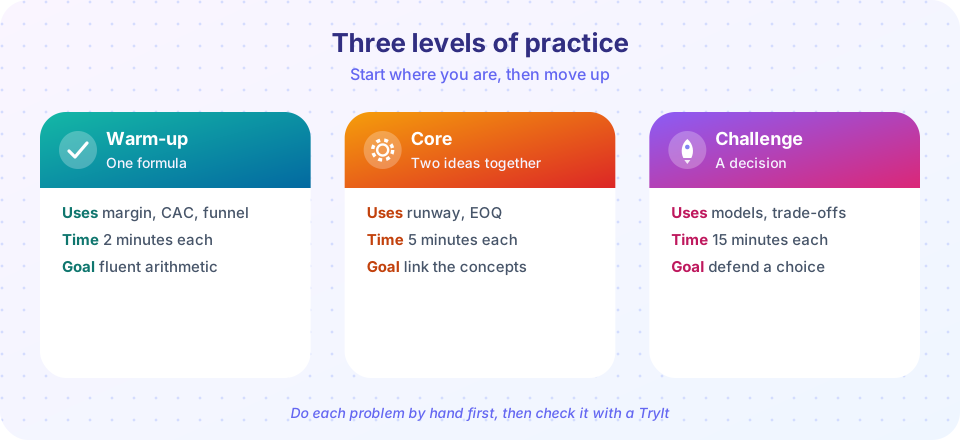
The fastest way to make a formula yours is to use it on a problem you have not seen before. This lesson gives you twelve problems at three levels. Warm-ups apply one formula, core problems link two ideas, and challenge problems ask for a decision you must defend. All companies and numbers are invented.
How to use it: read a problem, work it on paper, then compare with the worked solution lower down. If you got it wrong, find which step went wrong, not just the final number. Then use the drill generator at the end for unlimited extra practice.
What you will learn
- How to apply the course's main formulas under time pressure
- How to combine concepts (unit economics with runway, pricing with demand)
- How to turn a calculation into a recommendation
- How to find your own errors
Key terms
Contribution margin: price minus variable cost per unit.
Payback: acquisition cost divided by monthly margin.
Net burn: cash out minus cash in per month.
Post-money valuation: pre-money valuation plus the investment.
Non-participating preference: investors take the larger of their money back or their ownership share of the sale.
Level 1: warm-up
- A jacket sells for $64 and its variable costs are $39. What is the contribution margin per jacket, and what percentage of the price is it?
- A shop spends $4,500 on advertising in a month and wins 90 new customers. What is the CAC?
- A site has 25,000 visitors. 4% sign up, and 25% of sign-ups buy. How many customers buy, and what is the overall conversion?
- CAC is $120 and each customer brings $30 of margin a month. What is the payback period?
Level 2: core
- A subscription costs $30 a month, the cost to serve is $12, monthly churn is 6% and CAC is $90. Find the LTV and the LTV to CAC ratio.
- A company holds $210,000. Gross burn is $45,000 a month and customers pay $17,000 a month. What is the runway? If gross burn is cut by $6,000, what is the new runway?
- An investor puts $750,000 into a company at a $3,000,000 pre-money valuation. What share does the investor own? If the founders owned 100% before, what do they own after? A later round sells 15% of the company. What do the founders own then?
- Yearly demand is 20,000 units, each order costs $40 to place, and holding a unit for a year costs $2.50. Find the economic order quantity. Daily demand uses 365 days; with a 7-day lead time and 100 units of safety stock, find the reorder point.
Level 3: challenge
- Demand follows
q = 900 − 25pand the unit cost is $12. Find the profit-maximizing price, the units sold at that price and the profit. - A salesperson costs $6,000 a month fully loaded and each closed deal brings $500 of margin. How many deals a month are needed to break even? The person needs three months to ramp up, with no deals during that time: how much does the ramp cost?
- Investors put $1.5 million into a company for 15% with a 1x non-participating preference. What do they receive if the company sells for $6 million? For $15 million? At what sale price are they indifferent between taking the preference and converting?
- A subscription company has 200 customers, adds 40 per month and loses 5% of customers a month. Price is $15, variable cost $5, CAC $60 and fixed costs $5,000 a month. Find the customers needed to cover monthly fixed and acquisition costs, the steady-state customer count, and roughly how many months it takes to reach break-even. Should the founders go ahead as planned? Justify your answer.
Worked solutions
Try the problems first. Each solution names the formula and the main step.
1. Contribution margin = price − variable cost = 64 − 39 = $25, which is 25 ÷ 64 ≈ 39% of the price.
2. CAC = spend ÷ new customers = 4,500 ÷ 90 = $50.
3. Sign-ups = 25,000 × 0.04 = 1,000. Buyers = 1,000 × 0.25 = 250. Overall conversion = 250 ÷ 25,000 = 1% (or multiply the rates: 0.04 × 0.25 = 0.01).
4. Payback = CAC ÷ monthly margin = 120 ÷ 30 = 4 months.
5. Margin = 30 − 12 = $18 a month. LTV = margin ÷ churn = 18 ÷ 0.06 = $300. LTV to CAC = 300 ÷ 90 ≈ 3.3, a healthy ratio by the usual benchmark of about 3.
6. Net burn = 45,000 − 17,000 = $28,000. Runway = 210,000 ÷ 28,000 = 7.5 months. After the cut, gross burn is $39,000 and net burn is $22,000, so runway = 210,000 ÷ 22,000 ≈ 9.5 months. A $6,000 cut added about two months.
7. Post-money = 3,000,000 + 750,000 = $3,750,000. Investor share = 750,000 ÷ 3,750,000 = 20%. Founders keep 80%. After a round selling 15%, founders hold 80% × (1 − 0.15) = 68%.
8. EOQ = √(2 × 20,000 × 40 ÷ 2.5) = √640,000 = 800 units. Daily demand = 20,000 ÷ 365 ≈ 54.8. Reorder point = 54.8 × 7 + 100 ≈ 383.6 + 100 ≈ 484 units.
9. With q = a − bp, a = 900, b = 25, c = 12: p* = (a ÷ b + c) ÷ 2 = (36 + 12) ÷ 2 = $24. Units = 900 − 25 × 24 = 300. Profit = (24 − 12) × 300 = $3,600.
10. Break-even deals = 6,000 ÷ 500 = 12 deals a month. Ramp cost = 3 × 6,000 = $18,000 of salary with no sales. If the person closes only 8 deals a month, the role loses money each month (4,000 of margin against 6,000 of cost), and the hire only makes sense if the average deal value rises or the person is expected to close more.
11. At $6 million: preference = $1.5 million; converting = 15% × 6 = $0.9 million. They take the preference, $1.5 million. At $15 million: converting = 15% × 15 = $2.25 million, more than the $1.5 million preference. Indifference: 0.15 × P = 1.5 million, so P = $10 million.
12. Margin per customer = 15 − 5 = $10. Monthly fixed + acquisition cost = 5,000 + 40 × 60 = $7,400. Break-even customers = 7,400 ÷ 10 = 740. Steady state = 40 ÷ 0.05 = 800. The customer count follows 800 − 600 × 0.95^t (starting from 200). Setting it equal to 740 gives 0.95^t = 0.1, so t ≈ 45 months. Decision: the plan barely works. At the steady state the business earns only 800 × 10 − 7,400 = $600 a month, and it takes almost four years to reach break-even, so it needs a lot of funding for little return. A sensible recommendation is to change a driver before spending: raise the price (each extra $1 adds $800 of monthly margin at the steady state), cut churn, or reduce CAC.
Press Run (or Ctrl + Enter) to see the result here.
Program input · what you'd type while the program runs
Type the answers before you press Run, one per line. Each time the program reads a line (with input()), it gets the next line from this box.
If any line differs from your answer, find the step where the two calculations part ways. Often the culprit is a unit mismatch (monthly against yearly) or using the wrong base for a percentage.
Drill generator
Use the generator below for unlimited warm-up practice. It creates a random problem of one of four types, checks your answer and keeps a score. It stores nothing and sends nothing.
Common misconceptions
"If the final number matches, I understood it." A right answer from a wrong method is luck. Check each step.
"Percentages can be added." Rates in a funnel multiply; growth rates compound; a 20% rise followed by a 20% fall does not return to the start.
"A calculation is a decision." Problems 10 and 12 show that the number is only the input; the recommendation must weigh risks and alternatives.
Check your understanding
Quick check · 6 questions
of 6 answered You scored / 6 · perfect!
-
1. A product sells for $90 with $55 variable cost. What is the contribution margin?
90 - 55 = $35. -
2. A company has $150,000, gross burn of $30,000 and revenue of $12,000 a month. What is the runway?
Net burn is 18,000; 150,000 / 18,000 = about 8.3 months. -
3. An investor puts $2M into a company at $8M pre-money. What share do they own?
Post-money is $10M, so the share is 2 / 10 = 20%. -
4. Demand is q = 600 - 20p and unit cost is $10. What is the profit-maximizing price?
a/b = 30, so p* = (30 + 10) / 2 = $20. -
5. With a 1x non-participating preference of $2M and a 20% stake, at what sale price are investors indifferent?
0.20 x P = 2M gives P = $10M. -
6. In problem 12, which change would most directly shorten the time to break-even?
Lower churn raises the steady-state customer count and a higher price raises margin per customer, both reducing the time to break-even.
Summary
- Warm-ups use one formula; core problems link two; challenges end in a decision.
- Work on paper first, then check each step against the solution.
- Typical errors: mixed time units, wrong base for percentages, and treating a calculation as a decision.
- Use the drill generator for unlimited practice.
Next: Glossary
Track your progress
Create a free account to tick off lessons and pick up where you left off on any device.
of Entrepreneurship lessons completed