


















Lesson 30 of 49 · Funding and Finance
Cash flow and runway
Understand why cash differs from profit, build a monthly cash forecast, calculate burn and runway, and test scenarios that stretch your months of survival.
Imagine you run a small design studio. In March you finish a $12,000 project and send the invoice. Your accounting software records $12,000 of revenue for March. Your client pays on day 60, so the money reaches your bank in May. In April, you pay two contractors and your rent, $9,000 in total. On paper you are doing well. In the bank, April is a crisis.
This is the difference between profit (revenue minus expenses, recorded when earned and incurred) and cash flow (money actually entering and leaving your account). This lesson teaches you to forecast cash, measure how fast you are using it, and work out how long you can last. These skills decide survival more often than any clever strategy.
What you will learn
- The difference between profit and cash, with a worked example
- How to build a simple monthly cash forecast
- How to compute gross burn, net burn and runway
- Practical levers to extend runway and a "default alive" test
Key terms
Cash flow: the movement of money into and out of your bank account over a period.
Gross burn: total cash spent per month.
Net burn: cash spent minus cash received per month.
Runway: the number of months you can survive: cash balance divided by net burn.
Receivable: money a customer owes you for work already done.
Profit versus cash
The mismatch has several common sources.
- Late payment. Customers pay 30, 60 or even 90 days after the invoice. You spent the money earlier.
- Up-front costs. You buy stock, equipment or a year's software license now and sell the goods later.
- Annual billing. Customers who pay a year in advance give you cash far ahead of the revenue you will "earn" month by month. The reverse also happens when you pay suppliers a year ahead.
- Taxes, loan repayments and owner withdrawals. These move cash but are not part of profit (repaying the principal on a loan is not an expense, for example).
The practical lesson: never plan from profit alone. Keep a cash forecast, even a rough one in a spreadsheet, that shows the bank balance at the end of each month for the next 12 months, and update it every week or month with real numbers.
Press Run (or Ctrl + Enter) to see the console output here.
No output.
Run it and compare the profit column (positive in most months) with the balance column (below zero in every month). Try setting payDelay to 0 and see how much healthier the account looks: the invoices are the same, only the timing differs.
A simple cash forecast
A monthly forecast has three blocks:
- Opening balance: cash at the start of the month.
- Cash in: customer payments, new funding, loan proceeds, tax refunds.
- Cash out: salaries, rent, suppliers, tools, taxes, loan repayments, owner pay.
Closing balance = opening balance + cash in − cash out. Next month's opening balance is this month's closing balance.
Forecast the receipts according to when you expect payment, not when you invoice. Be conservative about revenue and generous about costs: new customers rarely arrive as fast as hoped, and costs almost always exceed the first estimate. It is common to build three versions: expected, pessimistic (revenue 30% lower) and optimistic. The pessimistic case tells you how worried to be.
Burn and runway
Two terms get used in the startup world, and the distinction matters.
- Gross burn is everything you spend in a month. If payroll is $18,000, rent $3,000 and tools $4,000, gross burn is $25,000.
- Net burn is gross burn minus money coming in. If customers pay you $6,000 that month, net burn is $19,000.
Runway is the cash balance divided by net burn:
runway (months) = cash balance ÷ net monthly burn
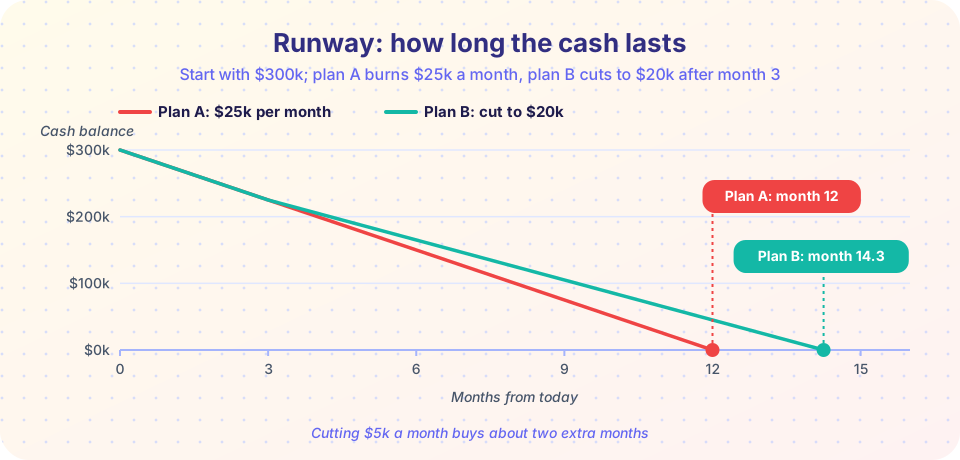
With $300,000 in the bank and a net burn of $25,000 a month, runway is 12 months. If you cut net burn to $20,000 after three months (having spent $75,000 and keeping $225,000), the remaining $225,000 lasts 225,000 ÷ 20,000 = 11.25 months, so total life is 3 + 11.25 = 14.25 months. The cut of $5,000 a month bought 2.25 extra months, as in the picture above.
Two rules for using runway honestly:
- Use net burn including likely cost increases. If you plan to hire two people next quarter, include them.
- Count time to raise money. Fundraising commonly takes three to six months or longer, so a business with six months of runway is already late to start. Many advisers suggest starting to raise when you still have at least nine to twelve months left.
Press Run (or Ctrl + Enter) to see the result here.
Program input · what you'd type while the program runs
Type the answers before you press Run, one per line. Each time the program reads a line (with input()), it gets the next line from this box.
Levers to extend runway
If runway is shorter than you would like, there are only a few levers, and you can compute the effect of each.
Reduce costs. Review every line. Cancel unused software, renegotiate rent, delay hires. Cutting costs buys months directly: dropping $5,000 of monthly cost on $25,000 burn improves runway by 25% (from 12 to 15 months for $300,000 of cash).
Increase cash in. Sell annual plans at a discount (cash today), ask for deposits, invoice promptly and chase late payers, offer a small discount for fast payment, or add a higher-priced tier. Faster collection raises cash without raising revenue.
Stretch payments responsibly. Negotiating longer payment terms with suppliers (60 days instead of 30) keeps cash a little longer. Do this by agreement; paying late without telling anyone damages trust.
Add funding. Raise investment, take a loan, win a grant. Each has costs, covered in the next lesson.
Change the plan. Narrow the product, focus on the profitable customers, or pause the expensive channel. Sometimes the best runway extension is deciding what not to do.
Default alive or default dead?
Paul Graham of the startup accelerator Y Combinator wrote an essay in 2015 titled "Default Alive or Default Dead?" that gives a useful test: if the company's growth rate and expenses stay as they are, will it reach profitability before the money runs out? If yes, it is default alive; if no, it is default dead and must change something (raise money, cut costs, grow faster). The test turns a vague worry into a calculation you can repeat each quarter.
Run it yourself: project monthly revenue forward using a realistic growth rate, hold costs where they are, and see whether revenue crosses cost before the cash balance hits zero.
Common misconceptions
"Revenue is cash." Revenue is what you earned. Cash is what has arrived. Invoices, deposits, refunds and loan repayments all create gaps.
"We have 12 months of runway, so we can start raising in month 11." Fundraising takes months and often fails the first time. Start much earlier or plan an alternative.
"Cutting costs only slows growth." Cost cuts that remove waste, as opposed to the customer-facing engine, cost nothing in growth and add months of life.
Check your understanding
Quick check · 5 questions
of 5 answered You scored / 5 · perfect!
-
1. A client owes you $5,000 for work done in May and pays in July. In which month does it show as cash received?
Cash flow records money when it arrives in your account, which is July. Revenue was earned in May. -
2. Gross burn is $40,000 a month and customers pay $15,000 a month. What is net burn?
Net burn = gross burn - cash received = 40,000 - 15,000 = $25,000. -
3. With $200,000 in the bank and net burn of $16,000 a month, what is the runway?
200,000 / 16,000 = 12.5 months. -
4. Which action raises cash without raising revenue?
Annual prepayment brings the money in earlier. The revenue is recognized over the year, but the cash arrives now. -
5. If a company is 'default dead', what does that mean?
Default dead means current growth and spending will not reach profitability before cash runs out, so something must change.
Summary
- Cash and profit differ because of timing: late payments, up-front costs, taxes and loan repayments.
- Forecast cash by month using payment dates, with a pessimistic case.
- Net burn is cash spent minus cash received; runway is cash divided by net burn.
- Cut waste, collect faster, bill early, negotiate terms, raise money, or change the plan to extend runway.
- Start fundraising with many months to spare and apply the default alive test regularly.
Next: Funding and valuation
Track your progress
Create a free account to tick off lessons and pick up where you left off on any device.
of Entrepreneurship lessons completed