


















Lesson 48 of 49 · Projects and Practice
Cheat sheet: formulas and tests
One-page entrepreneurship cheat sheet: CAC, funnel, pricing, LTV, runway, dilution, vesting, EOQ, compounding, ethics tests and exit payouts, each with a quick example.
When you are in a meeting, or building a model late at night, you do not want to reread a lesson to remember whether payback divides by margin or by price. This page gathers every formula and test from the course in one place, each with a one-line example you can check in your head. Bookmark it, print it, or copy it into your notes.
The two illustrations hold the formulas at a glance; the sections below explain when to use each and what to watch out for. Where a formula is a rule of thumb rather than an exact law, the text says so.
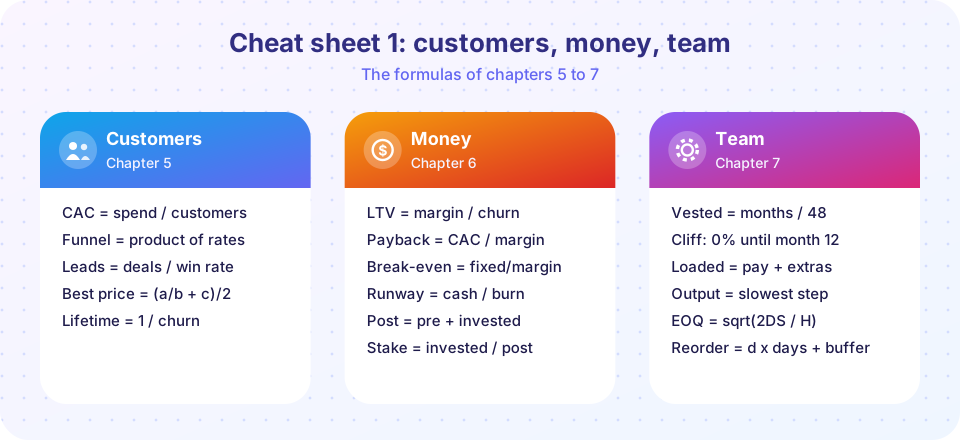
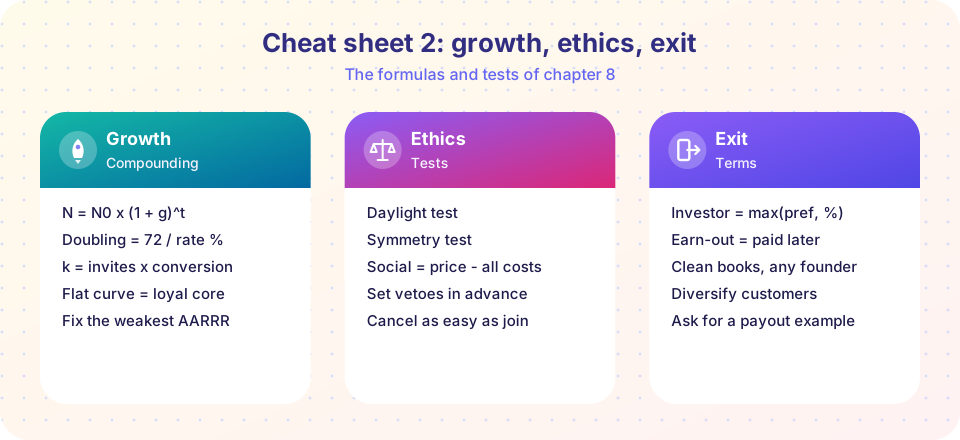
What you will learn
- A quick recall of every main formula in the course
- When to use each one and its limits
- A short checklist for decisions
- How to check your arithmetic by a rough estimate
Key terms
Formula: a rule that links quantities, such as CAC = spend ÷ new customers.
Rule of thumb: a rough guideline that is useful but not exact.
Sanity check: a quick estimate to see whether a result is plausible.
Assumption: a number chosen rather than measured; check it first when a result looks odd.
Customers and sales
| Idea | Formula | Quick example |
|---|---|---|
| CAC | spend ÷ new customers | $3,000 / 60 = $50 |
| Conversion through a funnel | multiply the stage rates | 10% × 30% × 20% = 0.6% |
| Leads needed | target deals ÷ overall win rate | 12 ÷ 0.048 = 250 |
| Best price (linear demand q = a − bp, unit cost c) | p* = (a ÷ b + c) ÷ 2 | (1000/30 + 10)/2 ≈ $21.67 |
| Customer lifetime | 1 ÷ churn | 1 ÷ 0.05 = 20 months |
Limits. The funnel assumes steps are sequential and rates are stable. The best-price formula assumes a straight-line demand curve and a constant unit cost; treat it as a way to think about the trade-off, then test prices on real customers. Cost-plus pricing gives a floor, value-based pricing a ceiling, and competitors set the neighborhood.
Unit economics and cash
| Idea | Formula | Quick example |
|---|---|---|
| Contribution margin | price − variable cost | $20 − $8 = $12 |
| LTV | margin per month ÷ monthly churn | 12 ÷ 0.05 = $240 |
| LTV to CAC | LTV ÷ CAC (about 3 or more is a common benchmark) | 240 ÷ 80 = 3 |
| Payback | CAC ÷ monthly margin | 80 ÷ 12 = 6.7 months |
| Break-even units | fixed costs ÷ margin per unit | 6,000 ÷ 12 = 500 |
| Net burn | cash out − cash in per month | 25,000 − 6,000 = 19,000 |
| Runway | cash ÷ net burn | 300,000 ÷ 25,000 = 12 months |
Limits. LTV assumes constant churn and ignores discounting. Cash differs from profit because of timing: late payments, up-front costs, taxes and loan repayments. Always forecast cash by payment date, and start fundraising with nine to twelve months of runway left.
Funding and ownership
| Idea | Formula | Quick example |
|---|---|---|
| Post-money valuation | pre-money + investment | $4M + $1M = $5M |
| Investor share | investment ÷ post-money | 1 ÷ 5 = 20% |
| Dilution | old share × (1 − share sold) | 90% × 0.8 = 72% |
| Vested fraction (4 years, 1-year cliff) | 0 before month 12, then months ÷ 48 | month 30: 30/48 = 62.5% |
| Equity weighted split | sum of weight × score per founder, then normalize | see the equity lesson |
Limits. Option pools and convertible notes complicate real cap tables. Read the actual documents and have a lawyer review them.
People and operations
| Idea | Formula or test | Quick example |
|---|---|---|
| Fully loaded cost | salary × (1 + overhead rate) + recruiting and ramp | $60,000 × 1.25 = $75,000 |
| Throughput | the capacity of the slowest step | 24 per hour from steps of 30, 24, 40 |
| EOQ | √(2 × D × S ÷ H) | √(2 × 12,000 × 50 ÷ 2) ≈ 775 |
| Reorder point | daily demand × lead time + safety stock | 32.9 × 5 + 50 ≈ 214 |
| Hiring | scorecard, structured questions, work sample, independent scoring | rate before discussing |
Limits. EOQ assumes steady demand and constant costs, so adjust for seasonality and supplier terms. Process improvement follows a loop: map, measure, improve the bottleneck, repeat.
Growth and metrics
| Idea | Formula or test | Quick example |
|---|---|---|
| Compound growth | N = N0 × (1 + g)^t | 100 × 1.05^52 ≈ 1,264 |
| Rule of 72 | doubling time ≈ 72 ÷ rate in percent | 72 ÷ 5 = 14.4 weeks |
| Viral coefficient | invites per user × conversion | 4 × 0.20 = 0.8 |
| AARRR | acquisition, activation, retention, revenue, referral | fix the weakest stage first |
| Retention curve | does it flatten? | a flat tail suggests a loyal core |
| Net revenue retention | (start + expansion − contraction − churn) ÷ start | above 100% means customers alone grow revenue |
Limits. Growth rates fall as the base gets large, and 5 to 7% weekly is a guide for tiny early-stage products only. Vanity metrics (totals that only rise) do not guide decisions.
Ethics and exits
| Idea | Formula or test | Quick example |
|---|---|---|
| Daylight test | would customers and a journalist be comfortable seeing exactly how this works? | hidden fees fail it |
| Symmetry test | would we accept this as the customer? | cancel should be as easy as join |
| Social net value | price − private cost − external cost | 20 − 15 − 7 = −2 |
| Veto rule | any criterion below a floor removes the option | trust score 1 = out |
| 1x non-participating preference | investor gets max(min(investment, price), share × price) | $2M in for 20%: at $5M gets $2M |
| Indifference price | investment ÷ share | 2 ÷ 0.20 = $10M |
Limits. Real term sheets add participation, caps, seniority and multiples above 1x. Ask for a worked payout example at several sale prices.
A decision checklist
- What is the question and the decision it informs?
- Which assumptions drive the answer, and which are guesses? Test each by 20% up and down.
- What does cash do, not only profit? Check runway under a pessimistic case.
- Who else is affected? Apply the daylight and symmetry tests.
- What would make me change my mind? Write the condition before you start.
- When will we review? Put the date in the calendar.
Try it
Here is the whole cheat sheet as code: a small library of functions you can call with your own numbers. Edit the examples at the bottom.
Press Run (or Ctrl + Enter) to see the result here.
Program input · what you'd type while the program runs
Type the answers before you press Run, one per line. Each time the program reads a line (with input()), it gets the next line from this box.
The second TryIt is a quick sanity-check habit: estimate the answer roughly before you calculate, and compare.
Press Run (or Ctrl + Enter) to see the console output here.
No output.
Common misconceptions
"A formula gives the answer." It gives the consequence of your assumptions. Wrong inputs give wrong outputs with great precision.
"Rules of thumb are laws." Benchmarks such as an LTV to CAC ratio of 3 or weekly growth of 5% are guides that vary by industry and stage.
"I do not need to memorize these." You do not need to memorize every formula, but the ones you can use in your head, margin, CAC, payback, runway and dilution, make you faster and harder to mislead.
Check your understanding
Quick check · 5 questions
of 5 answered You scored / 5 · perfect!
-
1. What is the payback period when CAC is $150 and monthly margin is $25?
150 / 25 = 6 months. -
2. Which formula gives the estimated lifetime value of a subscriber?
LTV = margin per month / monthly churn, a rough estimate that assumes constant churn. -
3. An investor puts $1M at a $3M pre-money valuation. What share do they own?
Post-money is $4M, so 1 / 4 = 25%. -
4. How long, by the rule of 72, does it take to double at 8% per period?
72 / 8 = 9. -
5. Which test asks whether you would accept the tactic as the customer?
The symmetry test compares how you treat customers with how you would want to be treated.
Summary
- Keep the core formulas handy: CAC, funnel, price, LTV, payback, break-even, burn, runway, valuation, dilution, vesting, EOQ, compounding and preference payouts.
- Use benchmarks as guides, not laws, and write down every assumption.
- Check results with a rough estimate before trusting them.
- Apply the daylight and symmetry tests to every growth tactic.
- Follow the six-question checklist for decisions and set a review date.
Next: Further study
Track your progress
Create a free account to tick off lessons and pick up where you left off on any device.
of Entrepreneurship lessons completed