


















Lesson 19 of 49 · Business Models and Plans
Pricing and revenue models
Compare revenue models such as subscriptions, freemium and marketplaces, and learn cost-plus, competitor-based and value-based pricing with worked examples.
Price is the only element of a business model that directly produces revenue. Everything else, from product to marketing, costs money. Yet new founders often set prices in a few minutes, usually too low, by copying a competitor or by adding a small percentage to their costs. A better approach treats price as a decision with two parts: choosing how customers will pay (the revenue model) and choosing how much (the price level).
This lesson describes the common revenue models, three methods of setting a price, the psychology of how customers read prices and a simple way to estimate how demand changes when price changes. You will end with the tools to defend your price with reasons rather than guesses.
What you will learn
- The main revenue models and when each fits.
- Three pricing methods: cost-plus, competitor-based and value-based.
- How price ranges, tiers and anchoring influence customers.
- How to estimate profit at different prices using price elasticity.
Key terms
Revenue model: the way a venture charges customers, such as one-time, subscription or commission.
Cost-plus pricing: setting the price as cost plus a margin.
Value-based pricing: setting the price according to the value the customer gets.
Price elasticity: how much the quantity demanded changes when the price changes.
Gross margin: revenue minus the direct cost of what you sell, as a share of revenue.
Revenue models
One-time sale. The customer pays once for a product or a job: a repaired laptop, a pair of shoes. It is simple, but you must keep finding new customers.
Subscription. The customer pays regularly (monthly or yearly) for continued access or delivery: software, a meal box, a gym. Subscriptions create predictable revenue, but you must keep delivering value or customers cancel.
Freemium. A free basic version attracts many users, and a share of them pay for advanced features. It works when the free users cost little to serve and some of them value the paid features highly.
Marketplace commission. You connect buyers and sellers and take a share of each transaction, for example 10 percent. You need both sides to join, which is difficult at the start.
Advertising. The audience is free, and advertisers pay for access to it. It needs a very large audience and can conflict with the user experience.
Licensing and royalties. You let others use your intellectual property, such as a brand, a design or a software library, for a fee.
Usage-based pricing. Customers pay for what they use, such as per delivery, per message or per hour. It is fair, but revenue is harder to forecast.
Most ventures mix models. A bakery sells one-time items, offers a weekly subscription for bread and rents space for private classes.
Three ways to set a price
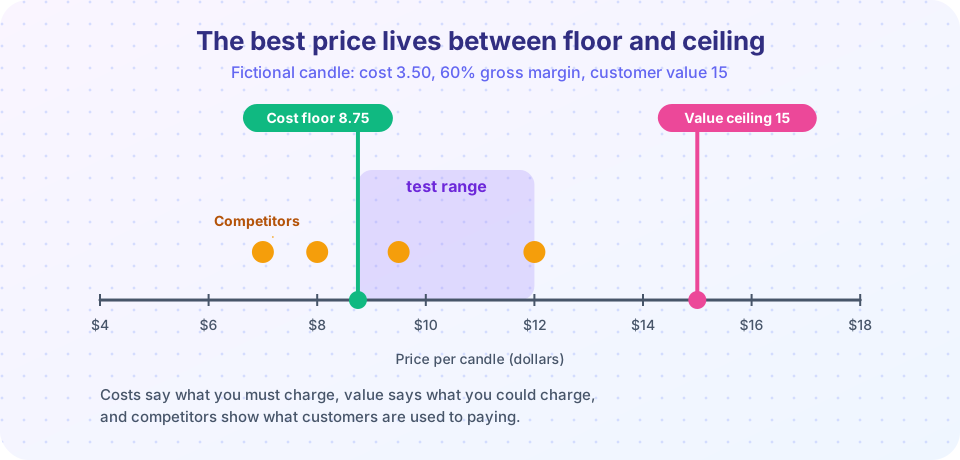
Cost-plus. Add up the cost of one unit and add a margin. If a candle costs 3.50 dollars in wax, wick, jar and labor and you want 60 percent gross margin, the price is cost divided by (1 minus margin) = 3.50 / 0.40 = 8.75 dollars. Note that adding 60 percent to cost gives a different number (5.60), so be clear which margin you mean. Cost-plus ensures you cover costs but ignores what customers will pay. It sets a floor, a price below which you lose money.
Competitor-based. Look at what similar offers cost. This gives a reference range and shows what customers are used to. But copying the price assumes you have the same costs and value, which is rarely true. Use competitor prices as an anchor, not as an answer.
Value-based. Estimate how much the customer gains and charge a portion of it. If your scheduling tool saves a cafe owner two hours a week and the owner's time is worth 20 dollars an hour, the monthly saving is about 160 dollars; a price of 29 dollars captures a small fraction of the value, which is attractive to the customer and may leave room to charge more. Value-based pricing sets the ceiling: customers will not pay more than the value they get.
A sensible price lies between the cost floor and the value ceiling, informed by competitors. The gap between them is the room you have to choose, and the larger it is, the easier your business is.
How customers read prices
Customers rarely judge price in isolation. Several effects are well documented, although their size varies.
- Anchoring: the first number seen influences judgments. Showing a premium plan next to a standard plan makes the standard look moderate.
- Tiers: offering three plans (basic, standard, premium) gives customers a choice and often moves many to the middle option. Each tier should have a clear difference.
- Charm pricing: prices ending in 9, such as 9.99, may increase sales in some markets, but evidence is mixed and for professional services it can look cheap.
- Reference price: customers compare to the price they expect. A sudden large increase causes complaints; small, announced steps are accepted more easily.
- Free is special: going from 1 dollar to free often changes behavior more than going from 3 to 2.
Be honest. Pricing tricks that hide fees or mislead customers can break consumer-protection laws and destroy trust.
Price and demand: a simple elasticity model
Raising the price earns more per sale but may lose customers. Price elasticity of demand is the percentage change in quantity divided by the percentage change in price. If a 10 percent price increase reduces sales by 5 percent, the elasticity is about -0.5 (demand is inelastic: revenue rises). If it reduces sales by 20 percent, elasticity is -2 (elastic: revenue falls).
Imagine a venture sells 200 units a month at 10 dollars with a unit cost of 6 dollars. Profit is 200 x 4 = 800. If it raises the price to 12 dollars (20 percent) and sales fall to 150 (25 percent), profit is 150 x 6 = 900, so the price rise helps. If sales fall to 100 instead, profit is 600, so it hurts. The right answer depends on how customers respond, which you find out through small price tests, for example showing two prices to different visitors of a landing page and comparing the conversion rates. Run such tests honestly and in line with local law.
Common misconceptions
"Lower prices always win customers." A very low price can signal low quality, attract difficult customers and leave no margin to improve the product. Many ventures struggle because they price too low.
"Price should equal cost plus a small markup." Costs say nothing about the value to customers. Cost-plus is a floor, not a strategy.
"One price suits everyone." Different segments value things differently. Tiers, discounts for students or business plans can serve several groups.
Try it
The first tool compares the three pricing methods for the candle example and prints a recommended range. Change the cost, margin, competitor prices and value estimate.
Press Run (or Ctrl + Enter) to see the result here.
Program input · what you'd type while the program runs
Type the answers before you press Run, one per line. Each time the program reads a line (with input()), it gets the next line from this box.
The second tool plots profit against price for a demand curve with a chosen elasticity, so you can see the price that maximizes profit and how sensitive the result is. The demand curve is a model with invented parameters.
Press Run (or Ctrl + Enter) to see the result here.
Program input · what you'd type while the program runs
Type the answers before you press Run, one per line. Each time the program reads a line (with input()), it gets the next line from this box.
Check your understanding
Quick check · 5 questions
of 5 answered You scored / 5 · perfect!
-
1. A candle costs 3.50 dollars to make. For a 60 percent gross margin, what price is needed?
Price = cost / (1 - margin) = 3.50 / 0.40 = 8.75 dollars. -
2. Which pricing method sets the ceiling on what customers will pay?
Customers will not pay more than the value they receive. -
3. Which revenue model charges a share of each transaction between buyers and sellers?
A marketplace connects two sides and takes a commission. -
4. A 10% price rise cuts sales by 5%. This demand is
Elasticity about -0.5 is inelastic; revenue grows when the price rises. -
5. What is a risk of pricing far below competitors?
Very low prices can undermine quality perception and margins.
Summary
- Choose both a revenue model (how customers pay) and a price level (how much).
- Cost-plus gives a floor, value-based gives a ceiling and competitors give a reference range.
- Anchoring, tiers and reference prices influence how customers judge a price; stay honest.
- Elasticity shows how sales respond to price; test two prices to learn it.
- Profit peaks at a specific price; low is not automatically better.
Next: Unit economics
Track your progress
Create a free account to tick off lessons and pick up where you left off on any device.
of Entrepreneurship lessons completed