


















Lesson 31 of 49 · Funding and Finance
Funding and valuation
Compare bootstrapping, investors, loans and grants, then learn pre-money and post-money valuation and calculate how each funding round dilutes your ownership.
Sooner or later every founder asks: where will the money come from? The honest answer is that there are several sources, each with a different price. Some cost you ownership, some cost you interest, some cost you time, and some cost you freedom. Choosing well starts with understanding what each source expects in return and which kinds of business it suits.
This lesson compares the main options and then teaches the arithmetic of selling a share of your company: how valuation turns into a percentage, and how successive funding rounds shrink the slice you keep.
What you will learn
- The main funding sources and which businesses suit each one
- The difference between equity and debt
- How pre-money and post-money valuation set the price of a share sale
- How to calculate dilution across rounds, including an option pool
Key terms
Equity financing: raising money by selling shares in the company.
Debt financing: borrowing money that must be repaid with interest.
Pre-money valuation: the company's agreed value before the new money is added.
Post-money valuation: pre-money valuation plus the new investment.
Dilution: the fall in an existing owner's percentage when new shares are issued.
The funding landscape
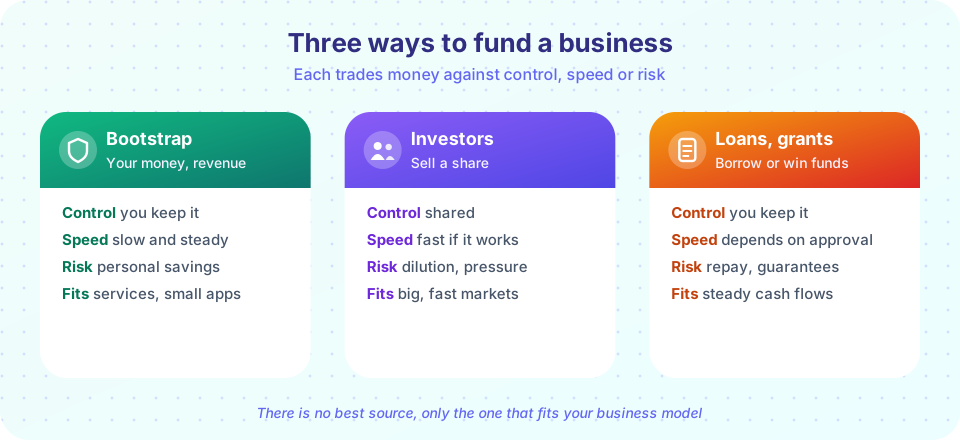
Bootstrapping. You fund the business with savings, early revenue and low costs. Control stays with you, and you learn to spend carefully. The limit is speed: growth is capped by the cash you generate. Many profitable service and software businesses are built this way, and it suits markets where customers pay quickly and the product can be built cheaply.
Friends and family. The earliest outside money often comes from people who believe in you personally. Treat it as seriously as any other deal: write down the terms, explain that the money could be lost, and agree what happens if the business fails. Unclear promises have ended more friendships than failed products.
Angel investors. Individuals, often former founders, who invest their own money in very early companies, typically in the range of tens of thousands to a few hundred thousand dollars. They often add advice and introductions along with cash.
Accelerators. Programs that provide a small investment, mentoring and a network for a fixed number of months, usually in exchange for a small share. Y Combinator, founded in 2005, is the best-known example.
Venture capital (VC). Funds that invest other people's money in companies they believe can become very large. Because most of their investments fail or return little, they need a few huge successes to make the fund work. That is why VCs push for fast growth and large markets. If your business is a healthy, steady company that can reach $2 million a year in profit, VC may be the wrong tool even if it is a great business.
Loans and credit. Banks and lenders give money you must repay with interest, whatever happens to the business. You keep your shares, but you carry fixed obligations and often personal guarantees. Debt suits businesses with steady cash flow and assets.
Grants and competitions. Governments, foundations and universities fund some kinds of work, such as research or social impact, without taking shares. They are slow and competitive, require paperwork, and can distract you from customers.
Crowdfunding. Raising small amounts from many people, either as pre-orders or rewards (you deliver a product) or in some countries as equity from the public. A campaign is also a marketing event; success depends heavily on your audience before launch.
Revenue-based financing and similar newer tools lend money repaid as a share of monthly revenue. They avoid selling shares but cost more than ordinary loans.
Equity versus debt
With debt, the lender has a claim to be repaid, but no claim on your future upside. With equity, the investor shares in both risk and reward: if the company fails, they lose their money; if it becomes enormously valuable, they gain a great deal. Equity does not need to be repaid on a schedule, which makes it suited to risky ventures with no early cash flow. Its cost is permanent: you give up a share of everything the company later becomes.
Valuation in plain arithmetic
When an investor puts money in for shares, two numbers define the deal: the amount invested and the valuation. The relationships are simple:
post-money valuation = pre-money valuation + investment
investor's share = investment ÷ post-money valuation
If an investor puts in $1,000,000 at a pre-money valuation of $4,000,000, the post-money valuation is $5,000,000 and the investor owns 1 ÷ 5 = 20% of the company. The existing owners hold the other 80% after the deal, down from 100%.
How is a young company's valuation set? Honestly, by negotiation. With no profits to measure, investors consider the team, the size of the market, early customers and growth, and what similar companies have raised. Valuation is an agreed price, not a scientific fact. A very high valuation can hurt you later: if you raise at a price you cannot grow into, the next round may be "down" (at a lower valuation), which damages morale and complicates the share structure.
SAFEs and convertible notes
Very early rounds often use an instrument that avoids setting a valuation yet. A convertible note is a loan that converts into shares at the next priced round, usually with a discount or a valuation cap. A SAFE (Simple Agreement for Future Equity), introduced by Y Combinator in 2013, is similar but is not debt, so it has no interest or repayment date. In the common "post-money SAFE", an investor who puts $500,000 into a SAFE with a $5,000,000 post-money cap will own about 500,000 ÷ 5,000,000 = 10% of the company, before the later round's own dilution. Read the exact terms of whatever document you sign, and have a lawyer check them.
Dilution across rounds
Each time you sell shares you own a smaller percentage, but you own it of a more valuable company, which is the whole point. Dilution is not a loss if the money creates more value than the share you gave up.
Suppose the founders start with 100% and set aside 10% as an option pool, shares reserved for future employees. At founding: founders 90%, pool 10%. In a seed round the company sells 20% of itself to new investors. Everyone else's slice is multiplied by 0.8: founders 90 × 0.8 = 72%, pool 8%, seed investors 20%. In a Series A, another 20% is sold: founders 72 × 0.8 = 57.6%, pool 6.4%, seed 16%, Series A 20%.
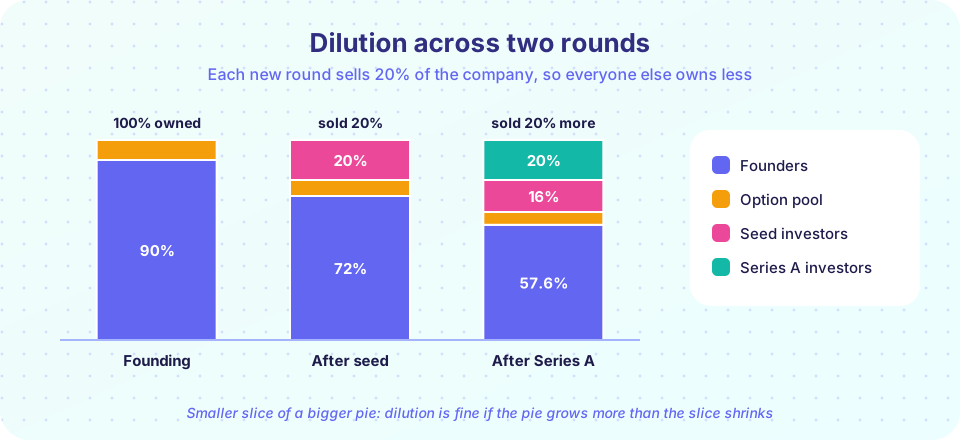
Real rounds also add new option pool shares, which dilute everyone, so actual founder percentages are usually a little lower than this tidy example.
Press Run (or Ctrl + Enter) to see the result here.
Program input · what you'd type while the program runs
Type the answers before you press Run, one per line. Each time the program reads a line (with input()), it gets the next line from this box.
Edit the rounds list: add a third round that sells 15%, or change the seed to 25%. Watch the founders' slice. You can see why founders count dilution before accepting each term sheet.
Try the investment calculator below too. It applies the two formulas above, so you can see how the same cash buys different shares at different valuations.
Before you raise: honest questions
Fundraising consumes months of founder time and rarely produces a quick yes. Ask yourself:
- Do I need it? Could customers, a smaller team or a slower plan reach the same goal?
- Is my business investable? Does the market size and growth potential match what that investor type needs?
- What will I do with the money? Investors want a specific plan, such as "hire two engineers and spend $40,000 on channels to reach 5,000 customers in 18 months".
- Who is on the other side of the table? Investors become part of your life for years. Talk to founders they have backed, including ones whose companies failed.
Also read the terms beyond price: board seats, voting rights, anti-dilution protection and liquidation preferences (covered in chapter 8) can matter as much as the valuation.
Common misconceptions
"A higher valuation is always better." A valuation you cannot grow into makes the next round harder, and often brings tougher terms elsewhere in the contract.
"Investors give money for ideas." Early investors back teams and evidence. An idea alone is cheap; proof that customers want it is not.
"Dilution means losing." Owning 40% of a company worth $10 million is better than owning 100% of one worth $1 million.
Check your understanding
Quick check · 5 questions
of 5 answered You scored / 5 · perfect!
-
1. An investor puts $500,000 into a company at a $2,000,000 pre-money valuation. What percentage do they own after the deal?
Post-money is 2,500,000, so the investor owns 500,000 / 2,500,000 = 20%. -
2. Which source of money does NOT dilute your ownership?
A loan must be repaid with interest but does not give the lender shares, so ownership percentages stay the same. -
3. Founders own 80% and sell 25% of the company in a round. What do the founders own afterward?
Existing holders are multiplied by (1 - 0.25) = 0.75, so 80% x 0.75 = 60%. -
4. Why do venture capital funds push for very large markets and fast growth?
VC returns come from a small number of outsized winners, so a business that can only be modestly large rarely fits the model. -
5. A post-money SAFE with a $4,000,000 cap receives $400,000. Roughly what ownership does it represent before the next round dilutes it?
400,000 / 4,000,000 = 10%.
Summary
- Funding sources include bootstrapping, friends and family, angels, accelerators, VC, loans, grants and crowdfunding; each fits particular businesses.
- Debt must be repaid but keeps your ownership; equity needs no repayment but shares your future.
- Post-money equals pre-money plus investment, and the investor's share is investment divided by post-money.
- Each round multiplies existing holders by one minus the share sold; option pools dilute as well.
- Raise only when you have a plan, an investable business and a partner you trust.
Next: Chapter 6 review
Track your progress
Create a free account to tick off lessons and pick up where you left off on any device.
of Entrepreneurship lessons completed