


















Lesson 12 of 49 · Finding and Validating Ideas
Finding problems worth solving
Learn how to judge whether a problem is frequent, painful and costly enough to support a business, and how to define a precise customer segment.
Not every problem is a business opportunity. Some problems are real but rare. Some are annoying but trivial. Some are painful but nobody will pay to solve them. The entrepreneur's first job is to find a problem that is worth solving: one that a specific group of people has often, feels strongly and would pay to be rid of.
This lesson gives you a scorecard for judging problems, explains how to define a customer segment narrowly enough to reach it, and shows how to separate "must have" problems from "nice to have" ones. These tools turn the vague opportunity statements you wrote in Chapter 2 into candidates you can investigate.
What you will learn
- The three tests of a problem worth solving: frequency, intensity and willingness to pay.
- How to define a customer segment narrowly.
- How to find evidence that people already try to solve the problem.
- The difference between a painkiller and a vitamin.
Key terms
Customer segment: a group of people with shared characteristics and a shared problem.
Pain point: a specific frustration, cost or risk customers experience.
Workaround: what customers do today to cope with the problem.
Painkiller: a solution to an urgent, costly problem. A vitamin is a nice-to-have improvement.
Early adopters: customers who feel the problem most strongly and will try a new solution first.
The three tests
Frequency: how often does the problem happen? A problem faced daily by many people is a stronger base than one faced once a decade. A commuter who loses ten minutes every morning feels the problem 200 times a year; a person who needs a wedding photographer feels it once. Rare problems can still support ventures if each occurrence is expensive, but you need enough customers.
Intensity: how much does it hurt? Intensity is measured in time lost, money wasted, stress or risk. A good sign is that the person has already tried to solve it: they cobbled together a spreadsheet, hired a freelancer or drove across town for an answer. A person who has done nothing about a problem for years may not care enough.
Willingness to pay: does a budget exist? Some groups have money allocated to the problem: a restaurant pays for supplies, a school pays for equipment, a family pays for childcare. Others, such as many students, have little to spend. It is not wrong to serve people with little money, but you must find a model that works, such as selling to a school instead of to individual pupils.
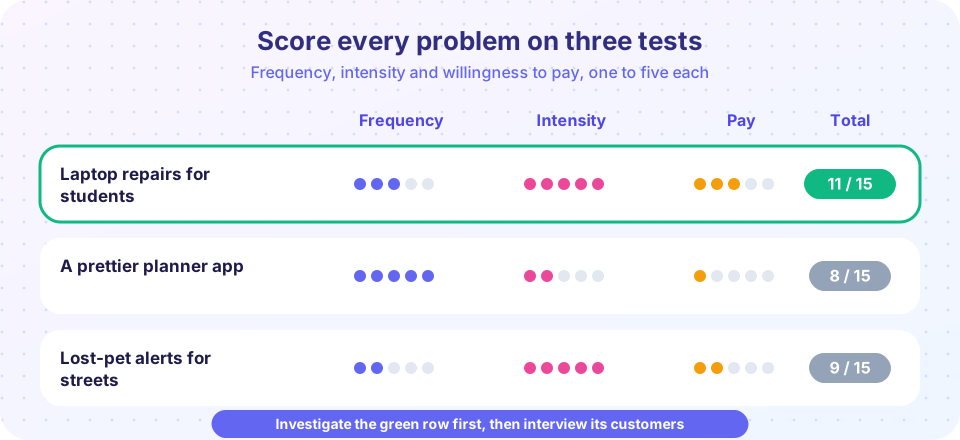
Score each test from 1 to 5. A problem with a 5 in all three is rare and valuable; a problem with any score of 1 needs a very good reason to continue.
Painkillers and vitamins
A common distinction in startups is between painkillers and vitamins. A painkiller relieves a problem that is urgent and costly: a hospital needs a system to avoid medication errors, a farmer needs to find buyers before crops spoil. A vitamin is pleasant but optional: a nicer font for a note-taking app. Vitamins can succeed, but they depend on mood and are easy to drop when budgets are tight.
Ask the customer: "What happens if this problem is not solved?" If the answer is "nothing much", you may be looking at a vitamin. If the answer is "we lose customers" or "I miss my child's recital", you may be looking at a painkiller.
Defining the customer segment
"Everyone" is not a customer segment. Founders often resist narrowing because they fear missing sales, but a narrow segment is easier to find, understand and serve, and it makes your messages sharper. Compare "people who want to eat healthily" (millions of different needs) with "shift workers in hospital canteens who have no time to cook" (a clear group, clear problem, clear places to find them).
A useful way to define a segment is to list four things: who they are (role, age or business type), where they are (places, websites, events), what they do today about the problem, and what triggers a search for a solution. If you cannot name five real people in the segment you could call tomorrow, the segment is probably too vague.
Within any segment, start with the early adopters: those who feel the problem most strongly. They will tolerate a rough first version because the pain is high. Winning them gives you stories, money and learning to reach the next group.
Finding evidence the problem is real
You do not need to wait for a survey. Look for signs in the world:
- Complaints: reviews of existing products that mention the same missing feature; posts in forums and community groups where people ask for help.
- Workarounds: spreadsheets passed around, groups where people trade tips, people paying a neighbor for a quick fix.
- Spending: what do people already pay for something similar? Existing spending proves a budget exists.
- Search behavior: many people asking the same question suggests real demand. Keyword tools and autocomplete suggestions give rough signals.
Remember that competition is not necessarily bad. If nobody offers a solution, ask why; perhaps no one wants it. If several competitors exist, the demand is probably real, and your job is to find a segment or an approach they serve poorly.
A worked example
Take Lena, a student who notices that her friends struggle to find reliable repair services for their laptops. She scores the problem. Frequency: a laptop problem occurs maybe twice a year per student, score 3. Intensity: a broken laptop during exams is severe, score 5. Willingness to pay: students have limited money but do pay for repairs, score 3. Total: 11 out of 15.
She compares it with another idea: a better-looking planner app. Frequency: daily, score 5. Intensity: mild, score 2. Willingness to pay: free alternatives exist, score 1. Total: 8 out of 15. The laptop problem looks stronger, though it needs a model that fits student budgets, which she will explore in later lessons.
Common misconceptions
"If I would use it, it must be a good problem." You are one person, and you may be unusual. Use your frustration as a starting point, then check whether others share it.
"A big problem means a big market." Climate change is huge, but a venture needs a specific problem and customer it can serve. Break big problems into pieces a small team can address.
"No competition means a great opportunity." It can also mean no demand. Check why nobody has solved it.
Try it
The first tool is a problem scorecard. Enter your own candidate problems and scores; it ranks them and warns you about weak dimensions.
Press Run (or Ctrl + Enter) to see the result here.
Program input · what you'd type while the program runs
Type the answers before you press Run, one per line. Each time the program reads a line (with input()), it gets the next line from this box.
The second tool plots frequency against intensity for several problems, with the bubble size showing willingness to pay. The upper-right bubbles are the best places to look first.
Press Run (or Ctrl + Enter) to see the result here.
Program input · what you'd type while the program runs
Type the answers before you press Run, one per line. Each time the program reads a line (with input()), it gets the next line from this box.
Check your understanding
Quick check · 5 questions
of 5 answered You scored / 5 · perfect!
-
1. Which three tests does the lesson use to judge a problem?
A worthwhile problem happens often, hurts and has a budget. -
2. A solution to an urgent, costly problem is called a
Painkillers relieve urgent problems; vitamins are optional improvements. -
3. Why is 'everyone' a poor customer segment?
A narrow segment is easier to reach and message, and its needs are clearer. -
4. What is a workaround?
Workarounds are evidence that a problem is real and painful. -
5. Why is no competition not necessarily good news?
If nobody offers a solution, ask why; perhaps people do not care enough to pay.
Summary
- A problem worth solving is frequent, intense and has a budget behind it.
- Painkillers beat vitamins because they hold up when budgets are tight.
- Define a narrow customer segment by who, where, what they do today and what triggers a search.
- Look for evidence in complaints, workarounds, spending and search behavior.
- Competition shows demand; no competition demands an explanation.
Next: Customer interviews
Track your progress
Create a free account to tick off lessons and pick up where you left off on any device.
of Entrepreneurship lessons completed