


















Lesson 26 of 49 · Marketing and Sales
Sales and pricing
Learn how to run a simple sales pipeline, set a price using cost, value and rivals, find a profit-maximizing price with numbers, and keep customers.
Interest is not income. Somewhere between "that looks useful" and a payment landing in your account, a person has to trust you, understand the offer, and agree to a price. This lesson covers those two last steps, sales and pricing, and one that comes after them: keeping the customer.
Both skills are learnable with arithmetic and good questions. You do not need to be an extrovert, and you do not need a sales team. You do need to count what happens, because sales is a numbers game in a very literal sense: if you know your win rate at each stage, you know how many conversations you need to reach a revenue target.
What you will learn
- The stages of a simple sales process and how to forecast with a pipeline
- How to ask discovery questions that find real needs
- Three pricing methods and how to combine them
- How to find a profit-maximizing price from a demand estimate
- Why retention often decides whether the business works
Key terms
Pipeline: the list of potential deals and the stage each one has reached.
Win rate: the share of deals at a stage that eventually close as customers.
Price elasticity: how much the quantity sold changes when the price changes.
Value-based pricing: setting price as a share of the benefit the customer receives.
Churn: the share of customers who stop buying in a period.
A simple sales process
Whatever you sell, the path usually looks like this: find a lead, qualify, learn the need, show the solution, agree terms, deliver, and follow up. Writing the stages down, even for a one-person company, helps you see where deals stall.
Qualify early. A qualified lead has a real problem, some authority or ability to decide, a budget (or a way to find one), and a reason to act now. Spending an hour on an unqualified lead is the most common way new sellers waste their week. A polite question such as "Who else would be involved in a decision like this?" uncovers whether you are talking to the decision-maker.
Discover before pitching. Neil Rackham's 1988 book SPIN Selling grew out of a large study of sales calls and argued that successful sellers ask more questions about the buyer's situation, problem, implication and need-payoff before describing their product. In plain terms: how do you do this today, what goes wrong, what does that cost you, and what would it be worth if it were fixed? The answers give you the words to use in your pitch and the figures to justify your price.
Handle objections as information. "It is too expensive" can mean "I do not see the value", "I have no budget until next quarter", or "I need to check with my manager". Ask a gentle follow-up before you respond. If the objection is real and you cannot overcome it honestly, say so and part on good terms. Referrals come from people you treated well even when they did not buy.
Ask for the decision. Many founders describe the product beautifully and never ask for the order. A clear next step ("shall I send the agreement today, or is there something else you need to see?") saves weeks.
Pipeline arithmetic
A pipeline turns activity into a forecast. Count how many prospects reach each stage and what share go on to the next. Multiplying the stage rates gives the overall win rate from first contact; dividing your target number of deals by that rate tells you how many leads to find.
For instance, suppose 40% of leads are qualified, 50% of qualified leads reach a demo, 60% of demos lead to a proposal, and 40% of proposals are accepted. The overall win rate is 0.40 × 0.50 × 0.60 × 0.40 = 0.048, or 4.8%. To close 12 deals in a month you need about 12 ÷ 0.048 = 250 leads. If you cannot generate 250 leads, you must raise a rate at some stage or accept a smaller target.
Press Run (or Ctrl + Enter) to see the result here.
Program input · what you'd type while the program runs
Type the answers before you press Run, one per line. Each time the program reads a line (with input()), it gets the next line from this box.
Change one rate (for example, raise "proposal to won" from 0.40 to 0.50) and see how the number of required leads falls. An improvement at the end of a pipeline is worth as much, in percentage terms, as the same relative improvement at the start, but it is often cheaper to achieve because you are working with fewer, warmer people.
Pricing: three starting points
Pricing is where many first-time founders flinch. They set the price they would pay themselves, or the lowest price in the market, and then wonder why the margins are thin. Three methods give you a structured starting point.
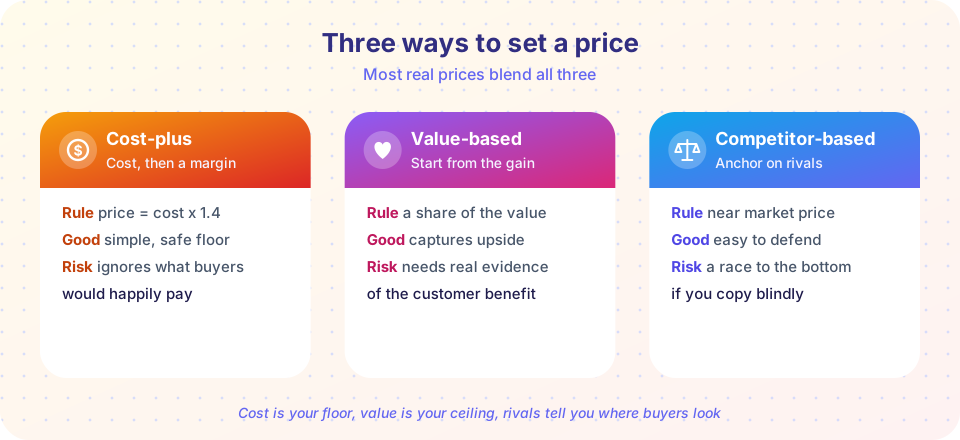
Cost-plus pricing adds a margin to your cost: if a unit costs $10 and you want a 40% markup, the price is $14. It is simple and gives a floor below which you lose money. Its weakness is that buyers do not care what your costs are. A bottle of water costs a few cents to produce and sells for different prices at a supermarket and at a stadium.
Value-based pricing starts from the benefit. If your tool saves a small business ten hours a month and their time is worth $30 an hour, the benefit is $300 a month. A price of $30 to $60 captures a modest share and still leaves the buyer feeling they won. This method usually earns the most, but only if you have evidence about value, which you get from the discovery questions above.
Competitor-based pricing looks at what buyers can get elsewhere. It helps you stay within the range buyers consider reasonable and tells you if you are making a statement (premium or budget). Copying a competitor's price blindly is risky, because their costs and strategy may differ from yours.
In practice, use cost as the floor, value as the ceiling, and rivals as the neighborhood.
Using a demand estimate
If you can estimate how quantity changes with price, you can compute a profit-maximizing price. Assume a simple straight-line demand curve: at a price p, you sell q = a − b × p units. With unit cost c, profit is (p − c) × q. Setting the slope of profit to zero gives the best price:
p* = (a ÷ b + c) ÷ 2
With a = 1000, b = 30 and c = 10, we have a ÷ b = 33.33, so p* = (33.33 + 10) ÷ 2 = 21.67. At that price you sell 1000 − 30 × 21.67 = 350 units and earn a profit of about $4,083 a month.
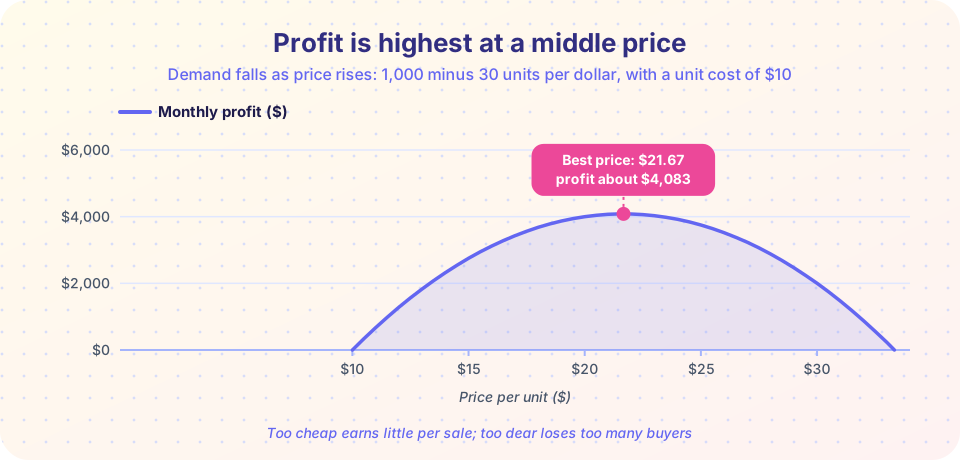
Real demand is not a straight line, and you only have a few observations, so treat the formula as a way of thinking. It teaches two lessons: the best price is above your cost by a lot more than "a little", and the best price depends on how quickly buyers leave when you raise it (the slope b).
Press Run (or Ctrl + Enter) to see the result here.
Program input · what you'd type while the program runs
Type the answers before you press Run, one per line. Each time the program reads a line (with input()), it gets the next line from this box.
Try raising b to 50 (buyers are more price-sensitive) and see the best price drop. Then lower c. Both changes shift the curve in ways you can predict from the formula.
Packaging and tiers
A single price forces everyone into one choice. Offering three plans, often called good-better-best, lets different buyers sort themselves: a small user takes the basic plan, a heavier user takes the middle one, and a few large users pay for the premium. The middle plan is usually designed to be the most attractive, with the top plan acting as a reference point that makes it look sensible.
Be honest in packaging. Hidden fees, confusing renewal terms and fake countdown timers may lift sales for a month, but they raise refunds and complaints and destroy trust. Chapter 8 returns to the ethics of persuasion.
Retention: the part after the sale
A customer who stays for three years is worth far more than one who leaves after three months, and keeping a customer is usually cheaper than winning a new one. Churn is the share of customers who leave in a period. If 5% of subscribers leave each month, the average customer stays about 1 ÷ 0.05 = 20 months. Halving churn to 2.5% doubles that to 40 months. We use this exact relationship in the next chapter to value a customer.
Retention begins at the first use: a person who gets a quick win in the first session is far likelier to stay. Ask churned customers why they left, and look for patterns; a handful of consistent reasons often points to the one change that matters most.
Common misconceptions
"A lower price always wins more customers." Price signals quality. A price that is much lower than alternatives can make buyers suspicious, and it makes it hard to fund support and growth.
"Cost-plus is the safe way." It is safe from losses on paper, but it often leaves money on the table when the product creates large value, and it can price you out when your costs are high.
"Selling is convincing people." Good selling is diagnosing. If you find yourself arguing, you are probably talking to the wrong person or have not understood the problem.
Check your understanding
Quick check · 5 questions
of 5 answered You scored / 5 · perfect!
-
1. Win rates through four stages are 50%, 40%, 50% and 20%. What is the overall win rate from the first stage?
Multiply the rates: 0.5 x 0.4 x 0.5 x 0.2 = 0.02, or 2%. -
2. What is the main purpose of qualifying a lead early?
Qualification checks need, authority, budget and timing so you focus your hours on real opportunities. -
3. Which pricing method sets a floor below which you lose money?
Cost-plus starts from your costs, so it shows the minimum viable price. Value and rivals decide how far above it you can go. -
4. With demand q = 600 - 20p and unit cost 10, what is the profit-maximizing price using p* = (a/b + c)/2?
a/b = 600/20 = 30; (30 + 10)/2 = 20. -
5. If monthly churn is 4%, about how long does the average customer stay?
The average lifetime is 1 / churn = 1 / 0.04 = 25 months.
Summary
- A pipeline turns stage conversion rates into a forecast and a lead target.
- Qualify early, ask discovery questions before pitching, and ask for the decision.
- Use cost as the floor, value as the ceiling and rivals as the neighborhood when pricing.
- With a demand estimate, the best price is found by
p* = (a/b + c)/2; sensitivity changes it. - Retention drives lifetime value; average customer lifetime is about one divided by churn.
Next: Chapter 5 review
Track your progress
Create a free account to tick off lessons and pick up where you left off on any device.
of Entrepreneurship lessons completed