


















Lesson 42 of 49 · Growth, Ethics and Exit
Chapter 8 review: growth, ethics and exit
Review compound growth, AARRR metrics, retention, scaling limits, ethical decision tools, externalities, exit routes and liquidation preferences with a ten-question quiz.
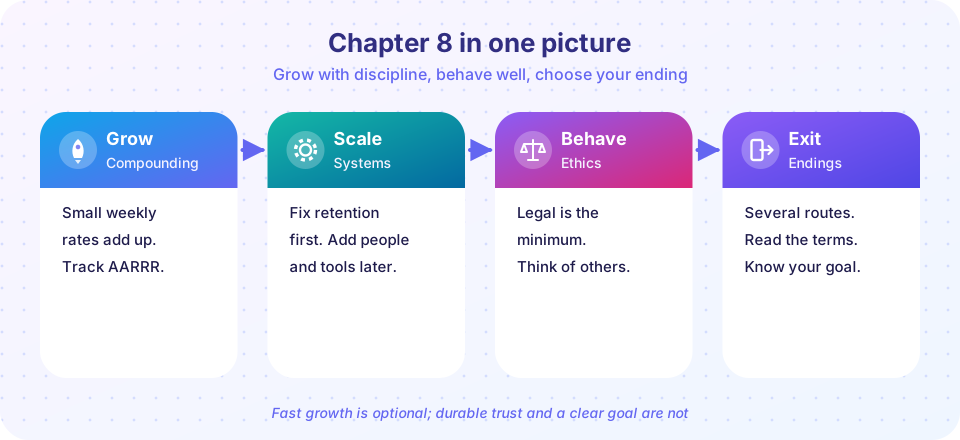
This chapter followed a company through the long middle and the end of its story: how it grows, how it should behave while it grows, and how it can leave the founders' hands. The ideas are less about formulas than about habits: measure the right things, count the costs others bear, and read the contract before you sign. The recap below collects the key points, then a mixed quiz checks them.
What you will learn
- A one-page recap of the chapter
- Which numbers and tests to use in each situation
- A ten-question mixed quiz
Recap table
| Topic | Key idea | Formula or test | Lesson |
|---|---|---|---|
| Compound growth | Rates compound; early curves look flat | N = N0 × (1 + g)^t; doubling ≈ 72 ÷ rate % | Scaling and metrics |
| AARRR | Five stages of the customer relationship | Acquisition, activation, retention, revenue, referral | Scaling and metrics |
| Retention curve | A curve that flattens shows lasting value | Cohort table, week-4 retention | Scaling and metrics |
| Viral coefficient | New users brought by each user | k = invites × conversion; k above 1 snowballs | Scaling and metrics |
| Vanity metrics | Numbers that only go up | Ask "what would I do differently?" | Scaling and metrics |
| Ethics frameworks | Consequences, duties, character | Three questions; look for agreement | Ethics and responsibility |
| Dark patterns | Interfaces that trick users | Symmetry test: cancel as easy as join | Ethics and responsibility |
| Externalities | Costs borne by others | Social net = price − private cost − external cost | Ethics and responsibility |
| Exit routes | Acquisition, IPO, merger, buyout, keep, wind down | Match the route to your goals | Exits |
| Liquidation preference | Investors paid first in a sale | Non-participating: max(preference, share × price) | Exits |
| Preparation | Clean books, documented processes, diverse customers | Reduce dependence on the founder | Exits |
The questions an expert asks
- Is growth coming with retention? If the retention curve falls to zero, extra acquisition only fills a leaking bucket.
- Which AARRR stage is weakest? Fix that before spending on others.
- What breaks next if we double? Communication, quality, cash or a single bottleneck usually answers it.
- Who else bears the cost? List stakeholders, including people who will not be in the room.
- Would we be comfortable with a customer seeing exactly how this works? If not, redesign.
- What would my payout be at $1M, $5M and $20M? Ask for a worked example before accepting terms.
Worked example: a decision with growth, conscience and a deal
Imagine a company that runs a meal-planning app. It has 20,000 monthly users, grows 4% a week and has a subscription that costs $8 a month. Three decisions arrive in the same quarter, and the chapter helps with each.
Growth. Growth of 4% a week doubles users in about 18 weeks by the rule of 72, but the team notices that most new users stop opening the app after the second week. Retention is falling to zero, and only about 6% of sign-ups ever pay. The AARRR check shows that acquisition is healthy, activation is weak (users never save a first plan) and retention is poor. The team stops buying ads for a month and redesigns the first-use flow so that a user sees a finished weekly plan in under two minutes. Week-four retention improves, and the retention curve begins to flatten, which is the first sign of a loyal core. Only then do they spend more on acquisition.
Ethics. A growth adviser suggests hiding the cancel button behind a menu and pre-ticking an annual plan at checkout. Conversion would rise in the short term. The team applies the tests. Would they be comfortable if customers saw exactly how it works? No. Would they accept this as customers? No. Who bears the cost? Customers who are charged for a year they did not intend to buy, and the support staff who handle the complaints. They also score the options in a matrix with a trust veto, and the hidden-button design is removed. Instead they offer a clear annual plan at a discount, with a visible cancel button, and measure whether it works. Legal compliance was never the question; the practice might have been lawful in some places and still wrong.
Exit. An acquirer makes an offer of $9 million. Investors hold 20% after putting in $2 million with a 1x non-participating preference. At $9 million, converting gives them $1.8 million, which is less than the $2 million preference, so they take the preference and the founders and employees share $7 million, not the 80% of $9 million, which is $7.2 million, that a simple percentage would suggest. The gap is small here but would grow with other terms. The founders ask for a worked payout table, check how much of the price is an earn-out tied to future revenue, and consider whether they want to sell at all or keep growing a profitable company. Their written definition of success, agreed years earlier, helps them decide.
The three decisions look different, but they share a method: gather the numbers, apply a simple test, check who is affected and write down the reasoning.
Try it
This small model combines growth, retention and a sale. Edit the inputs and run it again. The figures are invented examples.
Press Run (or Ctrl + Enter) to see the console output here.
No output.
Try raising weeklyChurn to 0.06: net growth drops to zero and the user count stays flat. Then try a sale price of 20: investors convert and take 25%, because 3 million is lower than 25% of 20 million (5 million).
Check your understanding
Quick check · 10 questions
of 10 answered You scored / 10 · perfect!
-
1. 100 users grow at 4% per week. About how many weeks to double? (Use the rule of 72.)
72 / 4 = 18 weeks. -
2. Which AARRR stage asks whether people come back later?
Retention measures whether users return, for example the share of a cohort active in week 4. -
3. Each user invites 6 people and 10% join. What is the viral coefficient?
k = 6 x 0.10 = 0.6, so each user brings fewer than one new user. -
4. What does a retention curve that flattens at 30% suggest?
A flat tail means a stable group keeps using the product, a good sign of product-market fit. -
5. Which is a vanity metric?
Totals only rise and cannot show whether a change worked. -
6. A product earns $6 profit per unit but causes $8 of harm to neighbors per unit. What is the social net value per unit?
6 - 8 = -2. The harm is an externality borne by others. -
7. What does the symmetry test ask?
If you would not accept the practice as a customer, treat it as a warning. -
8. Investors with a 1x non-participating preference invested $4M for 20%. The company sells for $10M. What do they receive?
Preference = $4M; converting gives 20% x $10M = $2M. They take the larger, $4M. -
9. In the same deal, what do they receive if the sale is $50M?
Converting gives 20% x $50M = $10M, which beats the $4M preference. -
10. Which exit preparation step most reduces a buyer's discount?
Buyers pay more for businesses with verified numbers that do not depend on one person or one client.
Summary
- Compound growth follows
N0 × (1 + g)^t; check retention before spending more on acquisition. - AARRR gives five numbers; fix the weakest stage first; viral coefficient above 1 snowballs.
- Legal is the floor: use ethical frameworks, stakeholder lists, symmetry and daylight tests.
- Count externalities and avoid dark patterns, misleading claims and careless data practices.
- Exit routes include acquisition, listing, merger, buyout, keeping, or wind-down.
- Liquidation preferences can change payouts a lot; always ask for a worked example.
Track your progress
Create a free account to tick off lessons and pick up where you left off on any device.
of Entrepreneurship lessons completed