


















Lesson 41 of 49 · Growth, Ethics and Exit
Exits
Learn the main exit routes, how acquisitions work, how liquidation preferences change who gets paid, and how to prepare a company for a sale or a graceful close.
Almost nobody plans their first company's ending at the start, yet the way you start often decides how it can end. If you take venture money, you have implicitly promised investors an exit, because they must return cash to the people who funded them. If you bootstrap a steady service business, you may never sell at all. And if the business stops working, a careful closing is an exit too.
This lesson maps the routes, explains in simple arithmetic how a sale divides the money, shows why contract terms can matter as much as ownership percentages, and offers a checklist for preparing, whichever ending you choose.
What you will learn
- The main exit routes and when each fits
- How an acquisition process works, from first offer to closing
- How liquidation preferences change the split of proceeds
- How buyers think about value and what to prepare in advance
- How to close a business responsibly if it does not work out
Key terms
Acquisition: one company buys another, usually paying cash, shares or both.
IPO (initial public offering): the first sale of a company's shares to the public on a stock exchange.
Due diligence: the buyer's detailed check of a company's finances, contracts, legal position and technology.
Liquidation preference: a right of certain investors to be paid back first (and sometimes more) when the company is sold.
Earn-out: part of the price paid later, only if the business reaches agreed targets.
The routes
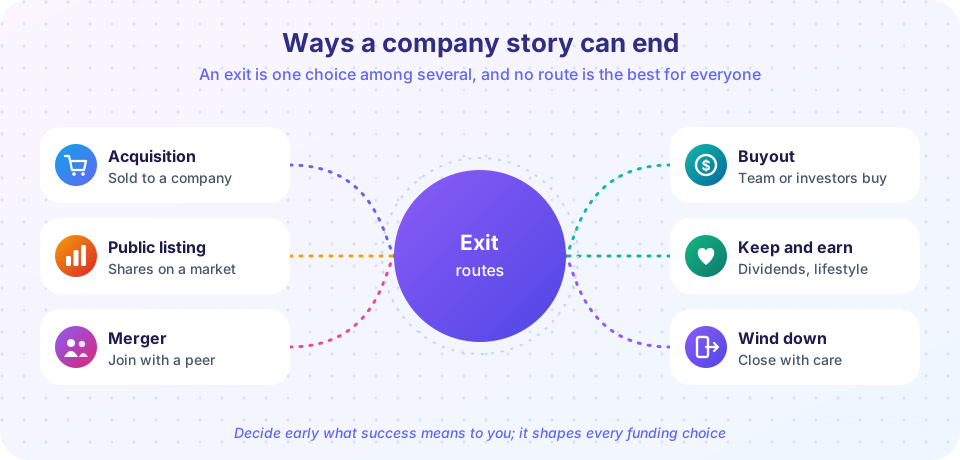
Acquisition. Another company buys yours. A strategic buyer (a larger company in your field) pays for your product, customers or technology; a financial buyer (such as a private equity firm) pays for your cash flow. Some deals buy mainly the team, called an acqui-hire, where the product may be shut down. Acquisitions are by far the commonest exit for venture-backed companies.
Public listing (IPO). The company sells shares to the public on a stock exchange. It brings large funds and prestige, but requires audited accounts, rules on disclosure, legal and bank fees, and constant scrutiny. Founders and early investors usually cannot sell right away, because of lock-up periods that last months. Few companies ever reach this point, and it suits only large and predictable businesses.
Merger. Two companies combine into one, often with shares exchanged. It can suit two similar-sized companies that are stronger together, but culture clashes are common.
Buyout. The management team, employees or an investor buys the owner's shares. A management buyout lets the people who know the business take it over. Employee ownership schemes, in various forms depending on the country, can allow staff to gradually buy a company from a retiring founder.
Keep and earn. Many founders never sell. They pay themselves a salary and dividends, hire a manager, and keep the business for decades. This is a perfectly good outcome, and it keeps control and culture. Friends, family and banks can fund this path; most venture funds cannot.
Wind down. If the business no longer works, closing it in an orderly way is respectable. Pay employees and suppliers what you owe, tell customers in good time, return any prepaid money, settle taxes, return remaining investor funds as the agreements require, and keep records. Where debts exceed assets, take legal advice quickly: your obligations and personal exposure depend on your company structure and country.
How an acquisition works
The steps are similar across many deals:
- Interest. A buyer approaches you, or you hire an adviser to find buyers. Be cautious about sharing confidential details before signing a non-disclosure agreement.
- Letter of intent (LOI). A non-binding document setting out the price, structure and timetable, often with a period during which you agree not to negotiate with others (exclusivity).
- Due diligence. The buyer examines your accounts, customer contracts, employment agreements, intellectual property, security and any legal disputes. Surprises found here reduce the price or kill the deal.
- Definitive agreement. A detailed contract covering price, payment structure, promises about the business (called representations and warranties), non-compete terms and conditions.
- Closing. Money is transferred and ownership passes. Part of the price may be held back in escrow for a period to cover claims.
Deals fail often, and even when they succeed they take months. Founders under stress can make poor decisions. Hire an experienced lawyer and an accountant for any serious sale.
What buyers pay for
Prices are usually set as a multiple of something measurable. For a software business it might be a multiple of annual recurring revenue; for a small steady business, a multiple of annual profit or "seller's discretionary earnings" (profit plus the owner's pay and one-off costs). Multiples vary widely by industry, growth, risk and market conditions, and any single number found online is only a rough guide.
For example, a small business earns $120,000 a year after costs but before the owner's salary, and similar businesses sell for about 2 to 3 times earnings. That suggests a range of $240,000 to $360,000. A higher multiple is justified by steady growth, diversified customers, documented processes, and a business that does not depend on the owner personally.
Part of the price may be an earn-out: if the buyer offers $1,000,000 with $700,000 on closing and $300,000 only if revenue next year stays above an agreed target, the "headline" price may not be what you finally receive. Read the definition of the target carefully; the buyer controls the business after closing and might make decisions that affect it.
Press Run (or Ctrl + Enter) to see the console output here.
No output.
Liquidation preferences: who is paid first
When a venture-backed company is sold, the proceeds do not simply split by ownership. Investors often hold preferred shares with a liquidation preference: they are paid before common shareholders (usually founders and employees).
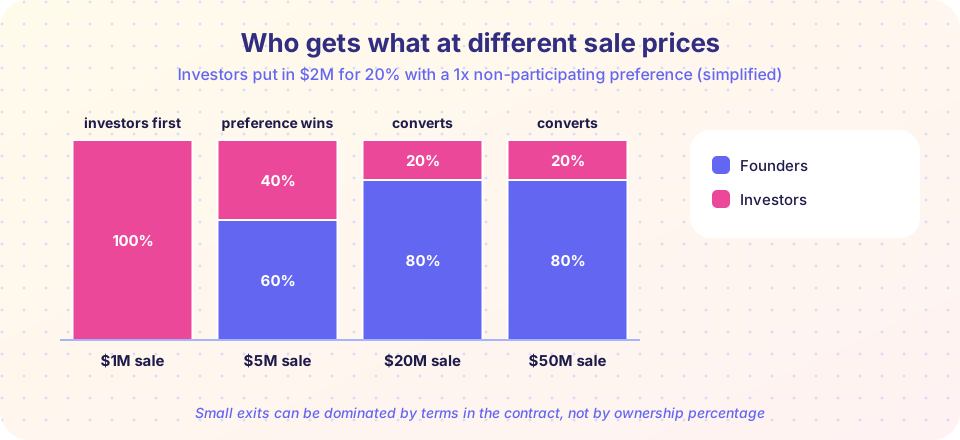
The most common form is a 1x non-participating preference: the investor chooses the better of (a) getting their investment back first, or (b) converting to ordinary shares and taking their percentage. Suppose investors put in $2,000,000 for 20% of the company.
- Sale at $1,000,000: investors take everything, because the preference exceeds the proceeds. Founders receive nothing.
- Sale at $5,000,000: the preference gives them $2,000,000, which beats 20% of $5,000,000 = $1,000,000. Founders and others share $3,000,000.
- Sale at $10,000,000: both choices give $2,000,000. This is the break-even point.
- Sale at $20,000,000: converting gives 20% = $4,000,000, which beats the preference, so they convert. The rest, $16,000,000, goes to the others.
A participating preference is more investor-friendly: investors first take their money back and then share in the remainder by percentage. At a $5,000,000 sale, a participating 1x investor would take $2,000,000 plus 20% of the remaining $3,000,000, which is $600,000, totaling $2,600,000. Terms also include caps on participation, multiples greater than 1x, and seniority between rounds. The real documents are complicated; treat the examples as an illustration and have a specialist review any term sheet.
The lesson is that for modest sale prices, the contract terms can move far more money than a few percentage points of ownership, which is why founders should understand them before signing.
Press Run (or Ctrl + Enter) to see the result here.
Program input · what you'd type while the program runs
Type the answers before you press Run, one per line. Each time the program reads a line (with input()), it gets the next line from this box.
Preparing for an exit
Whatever route you may take, good preparation raises the value and lowers the stress.
- Clean books. Accurate monthly accounts, taxes filed, a clear record of revenue by customer. Buyers pay less for what they cannot verify.
- Reduce dependency on you. Document processes, delegate customer relationships, train a second in command. A business that stops without its founder is worth less.
- Diversify customers. If one client is half of revenue, a buyer will discount heavily or demand an earn-out.
- Own your assets. Make sure intellectual property is assigned to the company, contracts are in the company's name and licenses are current.
- Keep the story honest. Show real numbers, including weaknesses, with a plan. Hidden problems found in due diligence break trust.
- Plan for yourself. Think about what you will do after: remaining with the buyer for a handover, taxes (which vary greatly by country; consult a specialist), and the emotional side. Many founders find the loss of a daily purpose after a sale harder than they expected.
- Care for the team. Ask what happens to staff, and whether those who helped build the value share in it.
Choosing your own definition of success
An exit is a means, not a goal. Ask, before you raise money or build, what success looks like for you: a large sale, a steady income, a social impact, a product that outlives you, or freedom of time. The answers shape the funding you take: venture capital pushes toward a big exit; bootstrapping and loans allow modest endings. There is no wrong answer, but there are mismatches between goals and money.
Common misconceptions
"The sale price is what I will receive." Taxes, preferences, escrows, fees, earn-outs and debts all reduce or delay what founders get. Ask for a worked example of the final payout.
"An IPO is the sign of success." It is one route for a few companies. A profitable private company that serves its customers for 30 years is also a success.
"If we own 40%, we get 40% of the sale." Liquidation preferences, option pools, debt and escrow terms can change the share a lot, especially in small sales.
Check your understanding
Quick check · 5 questions
of 5 answered You scored / 5 · perfect!
-
1. Investors with a 1x non-participating preference invested $3M for 25%. The company sells for $8M. What do they receive?
Preference = $3M. Converting gives 25% x $8M = $2M. They choose the larger, $3M. -
2. The same investors if the company sells for $20M?
Converting gives 25% x $20M = $5M, which beats the $3M preference. -
3. What is an earn-out?
An earn-out ties part of the price to future results after the sale closes. -
4. In due diligence, who examines the company's finances, contracts and technology?
Due diligence is the buyer's check before committing to a deal. -
5. Which preparation step most raises a small business's sale value?
Buyers pay more for businesses that do not depend on one person and whose numbers they can verify.
Summary
- Exit routes: acquisition, public listing, merger, buyout, keeping the company and earning from it, or an orderly wind-down.
- An acquisition runs from interest and a letter of intent through due diligence to a definitive agreement and closing.
- Liquidation preferences can dominate small sales; participating terms favor investors more than non-participating terms.
- Prepare early with clean books, documented processes, diverse customers and owned assets.
- Define success before you raise money, because your funding shapes which endings are available.
Next: Chapter 8 review
Track your progress
Create a free account to tick off lessons and pick up where you left off on any device.
of Entrepreneurship lessons completed