


















Lesson 49 of 49 · Projects and Practice
Further study: where to go next
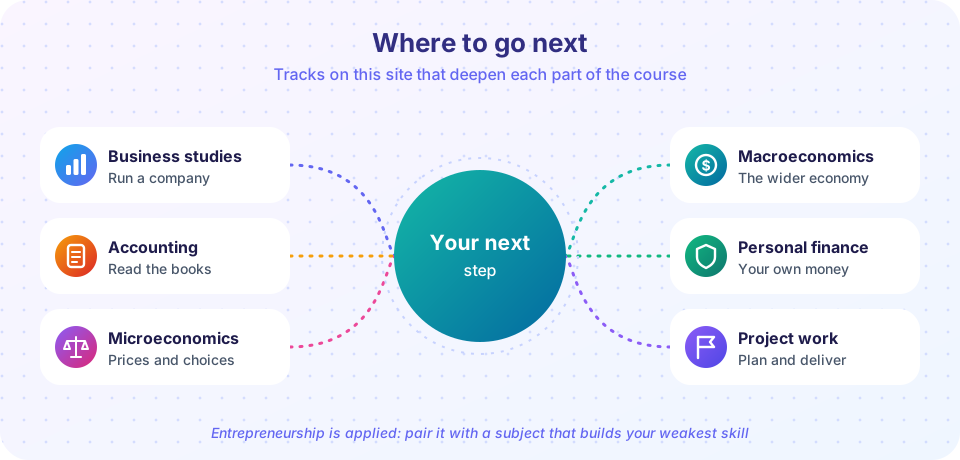
Plan your next steps after the course: related tracks on this site, books worth reading, a 90-day plan to test an idea, and habits that keep a founder learning.
You have reached the end of the course, which means you have seen the whole shape of starting a business: finding a segment, testing channels, understanding unit economics, forming a team, growing, behaving well and choosing an ending. What you do next matters more than anything you read here, because entrepreneurship is a practical skill. People get better at it the way they get better at cooking or football: by doing it, reviewing what happened, and doing it again.
This final lesson helps you decide where to go. It maps the course onto other tracks on this site that build the skills you will lean on most, suggests books and habits, and gives you a concrete 90-day plan to test a real idea, however small.
What you will learn
- How the course connects to other tracks on this site
- Which skills to strengthen first, depending on your weakest area
- Books and practices that keep you learning
- A 90-day plan to run a real, low-cost experiment
Key terms
Experiment: a small, time-boxed test of one assumption with a decision rule agreed in advance.
Customer discovery: structured conversations with potential customers to learn about their problems.
Minimum viable product (MVP): the smallest version of a product that lets you learn whether customers care.
Feedback loop: a cycle of doing, measuring and adjusting.
Deliberate practice: focused repetition of a skill with feedback, aimed at a specific weakness.
Match the next track to your weakest skill
Most beginners are strong in one area and weak in others. A designer might love the product but fear the spreadsheet; an accountant might build a flawless model for a product nobody asked for. Pick the track that fixes your weakest link.
| If you want to... | Go to | What it adds |
|---|---|---|
| Understand how companies are run day to day: strategy, operations, human resources, marketing | Business Studies | The management view that complements the startup view |
| Read and produce financial statements, understand profit, assets and liabilities | Financial Accounting | The language investors and banks use |
| Understand prices, costs, competition and why markets behave as they do | Microeconomics | Theory behind pricing, demand and market power |
| See how interest rates, inflation and growth affect your customers and your funding | Macroeconomics | The wider environment your business operates in |
| Manage your own money while income is irregular | Personal Finance | Personal runway, budgeting, saving and risk |
| Plan and deliver work with a team, on time and on budget | Project Management | Scheduling, risk and delivery methods |
| Test ideas with data and avoid fooling yourself | Statistics and Probability | Sample sizes, confidence and the basics of A/B tests |
| Understand why people choose as they do, and where they err | Behavioral Economics | Biases, defaults and framing for pricing and design |
| Understand people, motivation and groups | Introduction to Psychology | Foundations for teams, customers and leadership |
| Write clear emails, pitches and documents | English Writing and Composition | The communication skill behind every pitch |
| Work with data to measure and forecast | Data Science | Tools for cohorts, forecasts and dashboards |
You do not need to do everything. Choose one or two, set a realistic weekly time, and apply each lesson to your own idea the same week you learn it.
Books worth your time
Books are cheap compared with the cost of learning each lesson yourself. A short list that connects to the chapters of this course:
- The Mom Test by Rob Fitzpatrick (2013) teaches how to talk to customers without biasing their answers. It strengthens the interview skills from the market chapters.
- The Lean Startup by Eric Ries (2011) introduced the build, measure, learn loop and the idea of actionable metrics.
- Crossing the Chasm by Geoffrey Moore (1991) describes the beachhead market and the move from early adopters to the mainstream.
- Positioning: The Battle for Your Mind by Al Ries and Jack Trout (1981) is the classic on positioning.
- Traction by Gabriel Weinberg and Justin Mares (2015) catalogs nineteen marketing channels and a method for testing them.
- SPIN Selling by Neil Rackham (1988) is the research-based guide to discovery questions.
- Slicing Pie by Mike Moyer describes a dynamic equity split for early teams.
- Venture Deals by Brad Feld and Jason Mendelson explains term sheets, valuations and preferences in plain language.
- The Hard Thing About Hard Things by Ben Horowitz (2014) is a candid account of leading a company through difficulty.
- The Goal by Eliyahu Goldratt (1984) is a novel that teaches bottlenecks and the theory of constraints.
Read critically. Many business books draw lessons from a few famous successes, which is a weak form of evidence; ask what the authors would say to a company that did the same things and failed.
A 90-day plan to test a real idea
The course is useless unless it changes what you do. Here is a plan that costs little money and a few hours a week. It follows the chapters: find a segment, test demand, build the smallest thing, and decide.
Days 1 to 14: choose and talk. Pick a problem you know personally. Write down who has it and how they cope today. Hold ten conversations, not about your idea but about their last experience with the problem: what they did, what it cost, what they tried. Write each answer down.
Days 15 to 30: write the promise. From the conversations, write a positioning statement and a one-page landing page. Show it to ten people from the segment and ask them to explain it back. Revise until they understand.
Days 31 to 60: test demand. Drive a small number of people to the page through one or two channels (a community, a direct message, a small ad budget). Measure visitors, sign-ups and, if possible, pre-orders or deposits. Compute CAC and conversion. Write a decision rule beforehand, such as "if 5% of visitors leave an email address and 5 people pay a deposit, we build".
Days 61 to 80: build the smallest version. Do not code a full product. A manual service, a spreadsheet, or a no-code prototype is enough to deliver the value to the first customers by hand. Watch what they do.
Days 81 to 90: decide. Compute unit economics from what you have seen: price, cost to serve, CAC, retention. Update the financial model from this course with real numbers. Then choose one of three: continue, change one major assumption, or stop and apply the lessons to a new idea. Stopping early is not failure; it is the cheapest possible lesson.
Press Run (or Ctrl + Enter) to see the result here.
Program input · what you'd type while the program runs
Type the answers before you press Run, one per line. Each time the program reads a line (with input()), it gets the next line from this box.
Edit the hours per week to fit your life. Be honest: a plan you cannot keep is worse than a smaller one you can.
Habits that keep a founder learning
- Keep a decision journal. For each significant choice, write what you expected and why. Review monthly; you will learn how good your judgment really is.
- Talk to customers every week. Even when the company grows, a founder who stops listening starts guessing.
- Find a peer group. Two or three people at your stage who meet monthly and tell each other the truth. Many founders find this the single most valuable habit.
- Find a mentor, and offer something in return. A specific, small ask ("could you read my pricing page for 15 minutes?") works better than "will you be my mentor?".
- Read your numbers weekly. A simple one-page dashboard: visitors, sign-ups, customers, revenue, churn, cash, runway.
- Look after yourself. Founders who sleep, exercise and take breaks make better decisions. Burnout is a business risk, not a weakness.
Choose a next step
The quick quiz below suggests tracks based on your answers. It is a simple demonstration that runs in your browser; it is not a test and stores nothing.
Common misconceptions
"I need a perfect idea before I begin." Ideas improve through contact with customers. Begin with a real problem and a small test.
"More courses will make me ready." Study helps, but the biggest jumps come from real customers, real numbers and real feedback.
"If my first idea fails, I am not an entrepreneur." Most founders learn from several attempts. Treat each as an experiment with a lesson.
Check your understanding
Quick check · 4 questions
of 4 answered You scored / 4 · perfect!
-
1. In the 90-day plan, what should you do first?
Customer conversations come first because they tell you whether the problem is real and how people cope today. -
2. Why write a decision rule before a demand test?
A pre-written rule prevents you from rationalizing noisy results. -
3. Which book is mainly about asking customers questions without biasing them?
Rob Fitzpatrick's book teaches how to run useful customer conversations. -
4. What is an MVP?
An MVP is built to learn, not to impress.
Summary
- Choose your next track by your weakest skill: accounting, economics, project management, statistics, writing or personal finance.
- Read widely but critically; books give lessons from a limited set of stories.
- Run a 90-day plan: talk, write the promise, test demand, build the smallest version, decide.
- Keep a decision journal, talk to customers weekly, and find a peer group.
- Stopping an idea early is a cheap, valuable lesson, not a failure.
That is the end of the course. Good luck with what you build.
Track your progress
Create a free account to tick off lessons and pick up where you left off on any device.
of Entrepreneurship lessons completed