


















Lesson 11 of 49 · Finding and Validating Ideas
Chapter 3 overview: finding and validating ideas
A map of how to find problems worth solving, talk to customers, size a market and test an idea cheaply before building, with a preview of Chapter 3.
A great many ventures fail for a plain reason: they build something nobody wants. The builders were not lazy or foolish; they fell in love with a solution before checking that the problem was real. Chapter 3 is the antidote. It teaches you to find problems worth solving, to learn from customers without fooling yourself, to estimate how large a market might be and to test an idea at the lowest possible cost.
This chapter contains the most valuable habit in entrepreneurship: treat every idea as a set of guesses and replace the guesses with evidence before you spend serious money. Steve Blank, a Silicon Valley entrepreneur and educator, summed up the habit with a phrase: "get out of the building". Answers about customers are not inside your head or your office; they are with the customers.
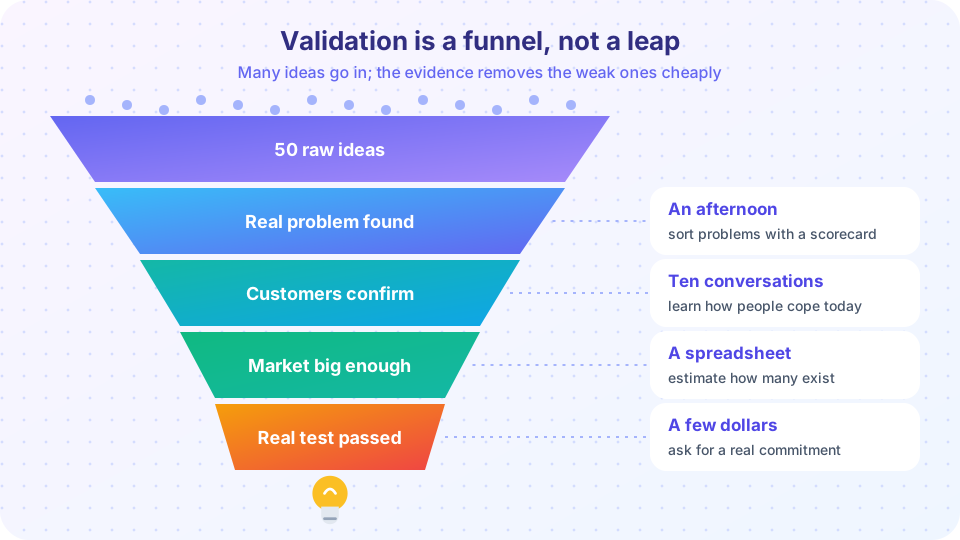
The validation journey
Validation has a natural order. First you pick a problem and a customer group (not a product). Second, you talk to people in that group to learn how they cope today. Third, you estimate whether enough of them exist to make a venture worthwhile. Fourth, you test whether they will take a real step, such as paying, signing up or giving their time. At each stage you may stop, adjust or change direction, and every stop saves months of wasted work.
Validation in four steps
Evidence beats opinion
Keep each step cheap
What the chapter covers
- Finding problems worth solving explains how to judge whether a problem is frequent, painful and costly enough to support a venture, and how to define a customer segment.
- Customer interviews teaches how to ask questions that produce true answers, why compliments are worthless and how to record and analyze what you hear.
- Market sizing shows top-down and bottom-up estimation, the TAM, SAM and SOM layers and Fermi estimates.
- Testing with an MVP describes minimum viable products, landing pages, concierge and wizard-of-oz tests, and how to choose success metrics before you test.
- Chapter 3 review ties everything together with a picture and a ten-question quiz.
Three principles for the chapter
Problem first, solution second. A solution is a hypothesis; the problem is the thing you can observe. Falling in love with the problem keeps you flexible about the answer.
Behavior beats opinion. What people say they will do and what they actually do differ. Whenever possible, ask for something that costs the customer: money, time or reputation.
Define success before you test. If you set the threshold after you see the results, you will talk yourself into whatever you hoped for. Write the number first.
Common misconceptions
"Market research means surveys." Surveys can help later, but early on they mostly measure opinions about things people have not experienced. Conversations and small behavioral tests teach far more.
"If I tell people my idea they will steal it." Execution is much harder than the idea, and feedback from real people is worth far more than secrecy. Where there is a true trade secret or invention, take advice; for most ideas, sharing is safer than hiding.
"Validation means proving I am right." Validation means finding out the truth, and sometimes the truth is "this idea needs to change".
Try it
The first tool is a small funnel calculator. Start with a number of raw ideas and the share that survives each stage. All rates are invented, so replace them with your own experience as you learn.
Press Run (or Ctrl + Enter) to see the result here.
Program input · what you'd type while the program runs
Type the answers before you press Run, one per line. Each time the program reads a line (with input()), it gets the next line from this box.
The second tool draws the funnel from the same numbers. The shrinking bars make the point visually: it is better to discover a weak idea in an afternoon than after a year of building.
Press Run (or Ctrl + Enter) to see the result here.
Program input · what you'd type while the program runs
Type the answers before you press Run, one per line. Each time the program reads a line (with input()), it gets the next line from this box.
Check your understanding
Quick check · 4 questions
of 4 answered You scored / 4 · perfect!
-
1. What does 'get out of the building' mean?
Steve Blank's phrase means answers about customers are found by talking to them, not by thinking alone. -
2. Which should come first in validation?
You start with a problem and customer, not a product, so that you stay flexible about the solution. -
3. Why should you define success numbers before running a test?
Setting the threshold after seeing results invites bias. -
4. Which is the strongest sign of demand?
Costly commitments reveal true interest; compliments are cheap.
Summary
- Validation replaces guesses about customers with evidence, before you invest heavily.
- The order: pick a problem, interview customers, size the market, then test real commitment.
- Problem first, solution second; behavior beats opinion; define success before testing.
- A funnel that removes weak ideas early and cheaply is a sign of a healthy process.
- The next lesson shows how to choose problems worth solving.
Track your progress
Create a free account to tick off lessons and pick up where you left off on any device.
of Entrepreneurship lessons completed