


















Lesson 4 of 49 · Getting Started
Types of ventures
Compare lifestyle businesses, small businesses, scalable startups, social enterprises and corporate ventures, and learn how the type of venture shapes your goals.
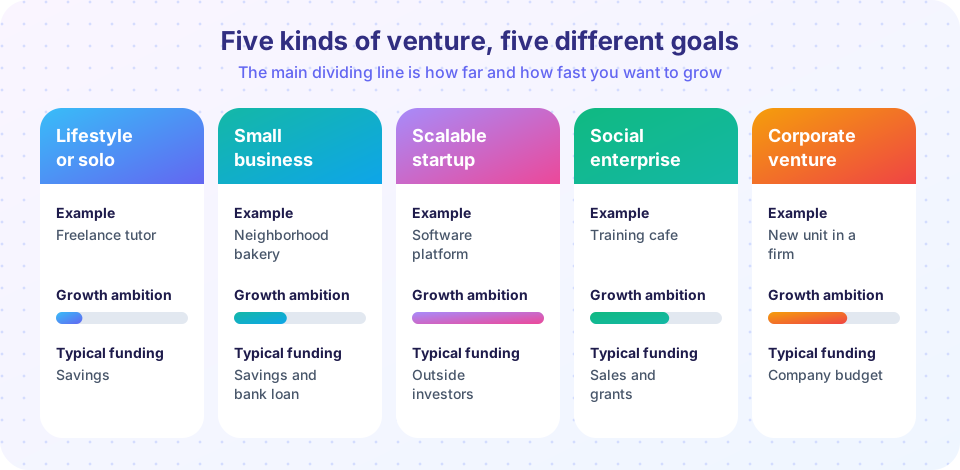
"I want to start a business" can mean very different things. A person who plans to run a neighborhood bakery for thirty years and a person who plans to build a software platform used by millions are both entrepreneurs, but their goals, funding, risks and daily lives will be almost opposite. Choosing the type of venture you want before you begin saves a great deal of confusion later, because advice that suits one type can harm another.
This lesson sorts ventures into five practical types, shows how they differ on growth, funding and risk, and gives you a simple way to decide which one matches your own goals.
What you will learn
- The five main types of ventures and what each is trying to achieve.
- How growth ambition, funding and risk differ between types.
- Why "startup" and "small business" are not the same thing.
- How to match a venture type to your own goals and circumstances.
Key terms
Small business: an independent venture meant to provide a steady income for its owners, usually serving a local or niche market.
Startup: a venture designed to find a repeatable, scalable business model, often aiming for fast growth.
Scalable: able to serve many more customers without costs rising at the same pace.
Social enterprise: a venture that sells goods or services to pursue a social or environmental mission.
Corporate venture: a new business unit created inside an existing company.
Type 1: the lifestyle or solo venture
A lifestyle venture is built around the way the founder wants to live. A freelance illustrator, a private tutor, a person who sells handmade candles online: each aims for good income and control over their time, not for an empire. These ventures usually need little money, can start while the founder still has another job, and are owned entirely by the founder.
The strength of this type is independence and low risk. The limit is capacity: if the founder is the product, income is capped by the hours in a week. Some solo founders respond by raising prices, by teaching others or by building products that sell while they sleep, such as templates or courses.
Type 2: the small business
A small business also serves a defined market, but it usually has premises, staff or equipment. Think of a restaurant, a hair salon, a farm shop or a plumbing company with three vans. Its aim is steady profit and, often, a livelihood for a family or team. Growth is welcome but is typically gradual and funded from earnings or bank loans.
Small businesses form a huge share of firms in almost every country and employ a large share of workers. Their main risks are local competition, thin margins and dependence on a few key people. Because many are similar to existing businesses, their success depends on location, service quality and cost control more than on novelty.
Type 3: the scalable startup
A startup in the strict sense is a venture searching for a business model that can grow rapidly. Steve Blank, a Silicon Valley entrepreneur and teacher, defined a startup as a temporary organization designed to search for a repeatable and scalable business model. Many software and technology ventures fit this description, but so can any venture whose product can reach many customers cheaply, such as a medical device or a manufacturing process with global demand.
Startups often seek outside investment because growth costs money before it earns money. In return, investors take ownership shares (equity) and expect a possibility of very large returns, which means the venture must aim big. The risk profile is high: many startups fail, a few do moderately well, and a very small number become very large. A founder choosing this path accepts that the likely result is uncertain and that control will be shared with investors.
Type 4: the social enterprise
A social enterprise puts a mission at the center: reducing waste, employing people who struggle to find work, bringing clean water or teaching literacy. Unlike a charity that relies mainly on donations, a social enterprise earns most of its income by selling something, and unlike a purely commercial venture it measures success by social or environmental results as well as profit.
Examples include a cafe that trains and employs young people leaving care, a company that sells solar lamps to off-grid households, or a cooperative that pays fair prices to farmers. Their challenge is balancing the two goals: charging enough to survive while keeping the mission affordable for the people it serves. Legal forms vary by country, from cooperatives to community interest companies to certified benefit corporations.
Type 5: the corporate venture
Large firms also behave entrepreneurially. A corporate venture, sometimes called intrapreneurship, is a new product line or business unit created inside an existing company. The people running it have resources, such as brand, cash and distribution, that independent founders lack. They also have constraints: approval processes, expectations from existing customers and the risk of cannibalizing the parent firm's products.
Corporate venturing matters for you even if you never work in a large firm, because large firms are potential customers, partners and buyers of small ventures.
Comparing the types
| Type | Main goal | Typical funding | Growth ambition | Founder's control |
|---|---|---|---|---|
| Lifestyle or solo | Independence and income | Savings | Low | Full |
| Small business | Steady profit, a livelihood | Savings, family, bank loans | Moderate | High |
| Scalable startup | Fast growth, large market | Investors and revenue | Very high | Shared |
| Social enterprise | Mission plus self-sufficiency | Sales, grants, impact investors | Varies | High to shared |
| Corporate venture | New growth for a parent firm | Company budget | Depends on parent | Limited |
Choosing your type
Ask three questions. What do I want my life to look like in five years? If you want flexibility and little debt, a lifestyle or small business may suit you. How much risk can I carry? A startup can mean years of low pay and the possibility of losing the time invested. What problem do I care about solving? If the problem is a social one, a social enterprise may fit.
There is no ranking in which startups are "better". A well-run bakery that supports a family for thirty years is a better outcome for that family than a failed startup. Equally, a venture can change type: a freelancer may hire staff and become a small business, and a small business may discover that its software tool can scale.
Common misconceptions
"A real entrepreneur always wants to build a giant company." Many entrepreneurs deliberately choose to stay small because they value stability, community or time. Both choices are legitimate.
"Startups and small businesses are the same." They differ in growth goals, funding and risk. A new restaurant is usually a small business; a food-delivery platform aiming at many cities is usually a startup.
"Social enterprises cannot make a profit." They can and often must. They simply direct surplus toward the mission or reinvest it.
Try it
The first tool matches your answers to a venture type. It is a thinking aid with simple scoring, not a diagnosis. Change the answers to match your own preferences.
Press Run (or Ctrl + Enter) to see the result here.
Program input · what you'd type while the program runs
Type the answers before you press Run, one per line. Each time the program reads a line (with input()), it gets the next line from this box.
The second tool shows why scalability matters. It compares a service business whose income is capped by hours with a product whose income grows with customers. The numbers are invented.
Press Run (or Ctrl + Enter) to see the result here.
Program input · what you'd type while the program runs
Type the answers before you press Run, one per line. Each time the program reads a line (with input()), it gets the next line from this box.
Check your understanding
Quick check · 5 questions
of 5 answered You scored / 5 · perfect!
-
1. Which venture type is built around the founder's preferred way of living, with low risk and full ownership?
A lifestyle venture aims at independence and good income, not at large-scale growth. -
2. According to Steve Blank, a startup is best described as
The definition stresses search, repeatability and scalability, not just newness or size. -
3. How does a social enterprise differ from a charity that relies mainly on donations?
Social enterprises sell products or services to fund a mission, instead of relying mainly on donations. -
4. Why do scalable startups usually seek outside investment?
Investors provide funds to grow faster, in return for ownership shares and a share of any large success. -
5. A new neighborhood restaurant with five employees is most likely which type?
Premises, staff and steady local profit mark a small business, even though it is a new venture.
Summary
- Five common types: lifestyle or solo, small business, scalable startup, social enterprise, corporate venture.
- The types differ in goals, funding, growth ambition, risk and control.
- Startup in the strict sense means searching for a repeatable and scalable model, not simply being new.
- No type is better; the right one matches your goals, risk tolerance and the problem you care about.
- Ventures can change type as they learn and grow.
Next: Chapter 1 review
Track your progress
Create a free account to tick off lessons and pick up where you left off on any device.
of Entrepreneurship lessons completed