


















Lesson 15 of 49 · Finding and Validating Ideas
Testing with an MVP
Learn what a minimum viable product really is, the main MVP test types such as landing pages and concierge tests, and how to set success metrics before you test.
You have found a problem, talked to customers and estimated the market. Now comes the moment when many founders make an expensive mistake: they disappear for months to build the "real" product. The alternative is to build the smallest thing that can teach you whether customers will actually take the step you need them to take. That smallest thing is called a minimum viable product, or MVP.
The term was popularized by Eric Ries in The Lean Startup (2011), building on earlier use by Frank Robinson and Steve Blank's customer development. The MVP is often misunderstood as "a cheap, bad version of the product". It is better described as an experiment: a way to test a specific assumption with the least effort. This lesson shows the main types of MVP, how to design a test with a number you set in advance, and how to read the result.
What you will learn
- What an MVP is and what it is not.
- The main types of MVP tests: landing page, concierge, wizard-of-oz, pre-sale and prototype.
- How to define a hypothesis and a success metric before testing.
- How to interpret results and decide what to do next.
Key terms
MVP (minimum viable product): the smallest version of a product or test that lets you learn what you need to know from real customers.
Hypothesis: a testable statement about customers, such as "at least 30 of 100 visitors will join the waiting list".
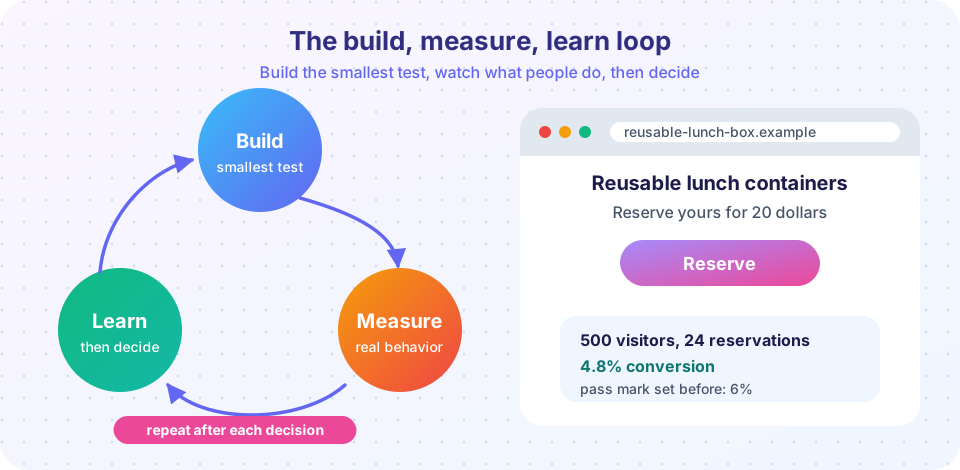
Build-measure-learn: the loop of building a test, measuring behavior and learning from it.
Conversion rate: the share of people who take a desired step, such as signing up.
Smoke test: a test that measures interest in a product that does not yet exist.
What an MVP is and is not
An MVP is the smallest experiment that tests your riskiest assumption. For a meal-delivery idea, the riskiest assumption is not that you can cook; it is that busy people will pay enough to make the business work. So the MVP might be a one-page website offering the service with a "reserve" button, not a kitchen.
It is not a half-finished product that you sell to everyone, and it is not an excuse for shoddy quality. "Minimum" refers to how much you build, "viable" means it must still deliver the core value for the people who use it. Equally, an MVP is not a final product to be polished forever: its purpose is to answer a question.
Types of MVP tests
Landing page (smoke test). Create a simple page that explains the offer and asks for a commitment: an email sign-up, a deposit or a pre-order. Drive a small amount of targeted traffic to it and measure the conversion rate. Joel Gascoigne tested the idea for the social-media scheduling tool Buffer in 2010 with a simple page describing the product and a button for pricing plans, before building it. Visitors' clicks and sign-ups showed demand.
Explainer video. In 2007, Drew Houston showed a short video of Dropbox's file-sync idea before it was ready for the public, and many people signed up for the waiting list. The video was a way to demonstrate a product that was hard to explain in words.
Concierge MVP. You deliver the service manually to a few customers, doing by hand what software or machines would later do. A founder of a meal-planning service might personally create weekly menus for five families. It is not scalable, and that is the point: you learn what customers value before automating anything.
Wizard of Oz MVP. The customer sees what looks like a working product, but you power it by hand behind the scenes. Nick Swinmurn's early test of online shoe sales, which became Zappos, is often described this way: he photographed shoes in local stores, posted them online and bought the shoes at retail when an order arrived, to check whether people would buy shoes on the internet.
Pre-sale or crowdfunding. Ask people to pay before the product exists. A pre-order is a strong signal because it costs the customer money. Be honest about delivery dates and refund policy, and only take money for what you can deliver.
Prototype or demo. A clickable mock-up, a drawing or a 3D-printed model can let customers react to something concrete. Use this when your concept is hard to imagine.
Choose the cheapest test that gives a believable answer to your riskiest question.
Designing the test: hypothesis, metric, threshold
Good tests have three parts, written down before you start.
- Hypothesis: "Office workers who bring lunch will reserve a reusable container for 20 dollars."
- Metric: the observable action, "number of reservations with a deposit".
- Threshold: the pass mark, "at least 30 of the first 500 visitors reserve" (a 6 percent conversion).
The threshold should come from your business needs, not from hope. If you need 1,000 customers to survive and can reach 100,000 people, you need about a 1 percent conversion; set the bar accordingly. Also decide in advance what you will do if the test fails (change the offer, try a different segment or stop) and if it succeeds (run a larger test).
Reading the results
If the result beats the threshold, do not celebrate yet: run a larger test to confirm, and check whether the people who responded are the customers you want. If the result misses, ask why. Compare possible explanations: the offer (price, features), the message (wording, images), the traffic source (wrong audience) or the idea itself (no real demand). Change one thing at a time so you know what mattered.
Be careful with small numbers. If you get 3 sign-ups from 40 visitors, that is a 7.5 percent rate, but with so few visitors the true rate could easily be much higher or lower. Collect enough data for the decision you need. Later in your studies of statistics you can compute confidence intervals; for now, treat results from fewer than 100 visitors as hints, not proof.
Avoiding common traps
- Vanity metrics: page views and social likes feel good but do not show commitment. Prefer sign-ups, deposits and repeat use.
- Testing too many things: if you change price, wording and audience together, you cannot learn which mattered.
- Building too much: if your MVP takes three months, it is probably not minimal. Ask: what is the fastest way to test the riskiest assumption?
- Fooling yourself: if only your friends respond, the test says little about strangers.
Common misconceptions
"An MVP must be a tiny version of the product." It can be a page, a video or a manual service. The aim is learning, not shipping features.
"An MVP can be low quality." It should be minimal in scope but good in what it promises. A confusing page will fail for the wrong reason.
"If the test fails, the idea is dead." A failed test shows that this offer to this audience did not work. Investigate whether to change the offer or the segment.
Try it
The first tool computes the conversion rate from a landing-page test and compares it with your pre-set threshold, with a simple warning when the sample is small.
Press Run (or Ctrl + Enter) to see the result here.
Program input · what you'd type while the program runs
Type the answers before you press Run, one per line. Each time the program reads a line (with input()), it gets the next line from this box.
The second tool shows how uncertain a small-sample result is by simulating many repeated tests of the same true conversion rate. Notice how wide the spread is when there are few visitors.
Press Run (or Ctrl + Enter) to see the result here.
Program input · what you'd type while the program runs
Type the answers before you press Run, one per line. Each time the program reads a line (with input()), it gets the next line from this box.
Check your understanding
Quick check · 5 questions
of 5 answered You scored / 5 · perfect!
-
1. What is the main purpose of an MVP?
An MVP is an experiment designed to learn, not a stripped-down final product. -
2. In a concierge MVP, who does the work?
You deliver the service by hand to learn what customers value before automating. -
3. Which must be written down before a test begins?
Setting the pass mark in advance avoids bias in reading the results. -
4. Why is a pre-order a stronger signal than a social media like?
Commitments that cost something reveal true interest; vanity metrics do not. -
5. A test with 40 visitors gives 3 sign-ups. What is the best interpretation?
Small samples produce wide spreads, as the simulation shows.
Summary
- An MVP is the smallest experiment that tests your riskiest assumption.
- Types: landing page, explainer video, concierge, wizard of oz, pre-sale and prototype.
- Write the hypothesis, metric and threshold before testing, and decide what you will do with each outcome.
- Prefer commitment metrics over vanity metrics, and change one variable at a time.
- Small samples are noisy; collect enough data for the decision you face.
Next: Chapter 3 review
Track your progress
Create a free account to tick off lessons and pick up where you left off on any device.
of Entrepreneurship lessons completed