


















Lesson 38 of 49 · Growth, Ethics and Exit
Growth, ethics and exit: the big picture
A map of the last stage of a venture: compounding growth and metrics, scaling without breaking, ethical decisions, and the routes by which a company story can end.
Getting the first customers is one kind of challenge. Growing from a hundred customers to a hundred thousand is another, and keeping your integrity while you do it is a third. And at some point every founder faces a question they may have avoided: what is the end of the story? Do you sell, list the company, keep it for life, hand it to the team, or shut it down?
This chapter covers that long arc. You will see why steady percentage growth beats flashy bursts, which numbers show whether growth is healthy, how to scale without breaking what works, how to make ethical decisions when the law is silent, and how exits work, including the contract terms that can change who receives what. We keep the numbers simple and the language practical.
What you will learn
- Why compound growth surprises people and how to estimate it
- The main metrics that show whether growth is real
- Why ethics matters for business as well as for conscience
- The routes by which a company's story can end
- How the lessons in this chapter fit together
Key terms
Compound growth: growth where each period's increase builds on the previous total.
Retention: the share of customers who keep using or buying over time.
Scaling: growing output and revenue faster than costs, without breaking quality.
Externality: a cost or benefit that falls on people who did not choose to take part in the transaction.
Exit: an event where owners convert their ownership into cash or otherwise leave the company.
Growth is a rate, not a number
If you gain 10 new users a week, you add the same amount each week. If you grow 5% a week, you add 5% of a bigger number each week, so the increase gets larger. After a year, starting from 100 users, the first approach gives 620 and the second gives about 1,264. The curve looks tame for months and then steepens. This is why many startups feel stuck for a long time and then suddenly seem to take off: the arithmetic of compounding, not magic.
Compounding also works in reverse. A company that loses 5% of its customers every month loses almost half of them in a year, which makes growth hard unless it also adds new ones faster than it loses them. The next lesson explores this in detail with simple formulas you can use for your own plans.
The structure of the chapter
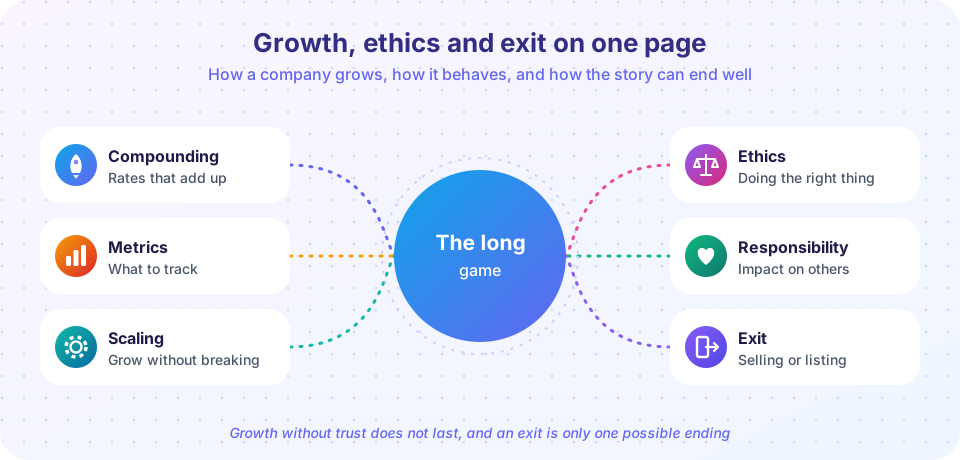
On the left of the hub picture, three topics are about growing well:
- Compounding. How small, steady rates produce large results, and how to use the rule of 72 as a quick estimate.
- Metrics. Which numbers show healthy growth: the five-part AARRR framework, retention curves and cohorts.
- Scaling. Growing without breaking: hiring ahead of need or behind it, processes that survive 10 times the volume, and when to say no to a customer.
On the right, three topics are about behaving well and ending well:
- Ethics. The questions beyond what the law requires: honesty in marketing, dark patterns, data, treatment of staff.
- Responsibility. The effect on people outside your company: society, the environment, suppliers and competitors.
- Exit. Acquisition, public listing, merger, buyout, keeping the company, or closing it responsibly, and the contract terms that decide who gets what.
Growth is a rate
Track what matters
Behave well
End well
Know what success means to you before you raise a cent.
How the lessons fit together
| Lesson | The question it answers |
|---|---|
| Scaling and metrics | How do we grow, and how do we know the growth is healthy? |
| Ethics and responsibility | How do we decide when the law gives no answer? |
| Exits | What are the endings, and what do the terms mean for us? |
| Chapter review | A recap and a ten-question quiz |
Three kinds of success
It helps to name what you are aiming for, because different endings reward different choices. Some founders want scale: the biggest company the market will allow, financed by investors who expect a large exit. They accept risk, dilution and speed. Others want independence: a profitable company that supports them and a small team for decades, owned entirely by themselves. They accept slower growth and avoid investors whose goals differ. A third group wants impact: a company whose main purpose is a social or environmental result, with financial return as the means rather than the goal. They may choose structures and investors that protect that purpose.
None of these is better than the others, but mixing them without noticing causes trouble. A founder who wants independence and takes venture money will find the pressure for a large exit hard to bear. A founder who wants scale and refuses to hire ahead of revenue may lose the race. Spend an hour early on writing which kind of success you want and what you would give up for it. You will return to that page when a funding offer, an acquisition proposal or a tempting shortcut arrives.
The lessons that follow show the arithmetic of each choice, from growth rates to liquidation preferences, so that your decision rests on numbers as well as on instinct.
Common misconceptions
"Growth is always good." Growth that loses money on every customer, damages quality or harms people is not progress. Healthy growth has good unit economics and a business that can cope with its own success.
"Exit means selling to a big company." That is one route. Many owners keep profitable businesses for decades, and others close them responsibly when the work is done.
"Ethics slows you down." Short-term shortcuts often create long-term costs: refunds, regulation, lost trust and difficulty hiring. Good ethics is usually good risk management.
Try it
The first demo is a growth simulator. Change the weekly growth rate and the weekly churn rate and see where the user count lands after a year. It is an illustration of arithmetic, not a forecast.
Slide churn up to match growth: net growth drops to zero and the line goes flat. That is why retention is the base of every durable growth story.
Check your understanding
Quick check · 4 questions
of 4 answered You scored / 4 · perfect!
-
1. Why does compound growth often look slow at first?
A percentage of a small number is a small number; as the base grows, the same rate adds more each period. -
2. Which description best fits an externality?
Pollution from a factory is the classic example: neighbors bear costs they did not agree to. -
3. Which is NOT a normal exit route?
Raising a price is a pricing decision. Exits are events that convert ownership into cash or end the company. -
4. What does a company with 5% growth and 5% churn per week have in net terms?
5% added minus 5% lost is zero net growth, so total users stay flat.
Summary
- Growth is a rate: percentages compound, so patient, steady gains win over time.
- Retention and unit economics decide whether growth is healthy.
- Legal is the minimum standard; ethics asks what you owe customers, staff and society.
- Exits take several forms, and contract terms can change who receives what.
- Decide what success means to you early.
Next: Scaling and metrics
Track your progress
Create a free account to tick off lessons and pick up where you left off on any device.
of Entrepreneurship lessons completed