


















Lesson 28 of 49 · Funding and Finance
Funding and finance: the big picture
A map of startup finance: unit economics, cash flow and runway, funding sources and valuation, with the key terms you need before the detailed lessons.
Every venture runs on a simple loop: money goes out to build and sell something, and money comes back in when customers pay. If the money coming in is larger than the money going out, you can grow, hire and take risks. If it is smaller, you are living on a countdown. Finance, for an entrepreneur, is the skill of knowing which side of that line you are on, how fast you are moving, and where to find money to bridge a gap.
You do not need an accounting degree. You need six ideas, each of which can be calculated on the back of an envelope. This chapter introduces them and then spends one lesson each on the numbers behind a customer, the numbers behind a month, and the numbers behind raising money.
What you will learn
- Why profit and cash are different things, and why cash decides survival
- The six ideas you will use throughout the chapter
- Words that investors, banks and accountants use every day
- How the lessons fit together
Key terms
Unit economics: the revenue and costs of one unit of your business, usually one customer or one order.
Burn rate: the net amount of cash a company spends each month.
Runway: how many months you can operate before the cash runs out.
Equity: ownership of a company, held as shares.
Valuation: an agreed estimate of what a company is worth, used to price a share sale.
Profit is an opinion, cash is a fact
An accountant can say a company earned a profit this quarter even while its bank balance fell. A customer might owe you $10,000 for work you delivered in March and not pay until June. In your accounts you earned the money in March; in your bank you do not have it. Meanwhile your rent, your suppliers and your own food still need paying now.
That gap is why founders say "cash is king". A profitable company with no cash cannot pay wages, and a company with cash can survive losses for a while. The most common cause of death for young businesses is not a bad idea, it is running out of money before the idea has had a chance to work. Chapter 6 teaches you to measure that risk.
The six ideas
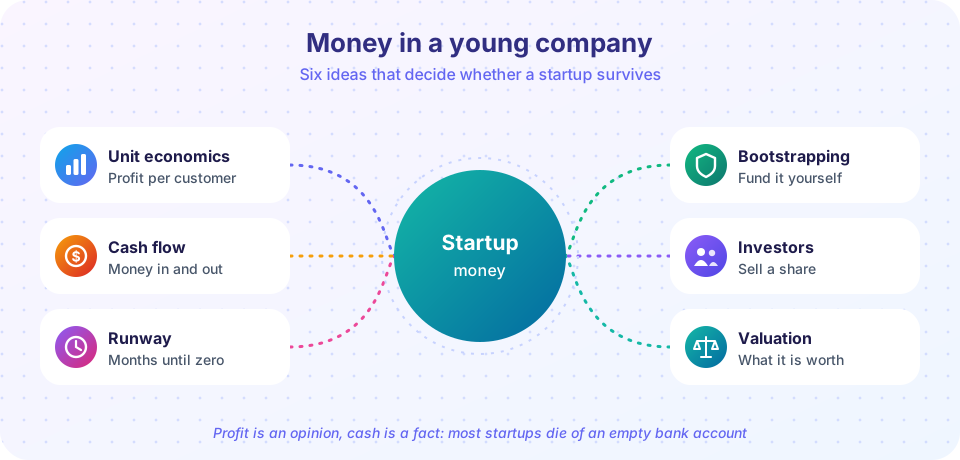
On the left of the hub picture sit the three ideas that describe how your business behaves.
- Unit economics. If you earn $12 of margin per month from a customer and they stay twenty months, one customer is worth $240. If it cost $80 to win them, the business has a chance. If it cost $400, every sale deepens the hole.
- Cash flow. The timing of money in and out. A cash-flow forecast lists each month's expected receipts and payments.
- Runway. Cash in the bank divided by monthly net burn. If you hold $300,000 and burn $25,000 a month, you have twelve months.
On the right sit the three ideas about where money comes from.
- Bootstrapping. Funding the business from savings and, as soon as possible, from customers. You keep control and learn to be frugal, but growth may be slower.
- Investors. People or funds that give money in exchange for shares. They can accelerate growth, but they expect a large return, and they own part of your future.
- Valuation. The price tag you and an investor agree on. It decides how much of the company a given amount of money buys.
Cash keeps you alive
How the business behaves
Where money comes from
What a share costs
Pre-money plus new money equals post-money.
How the lessons fit together
| Lesson | Question it answers |
|---|---|
| Unit economics | Does each customer make us money? |
| Cash flow and runway | How long can we last, and what changes that? |
| Funding and valuation | Where should money come from, and what does it cost us in ownership? |
| Chapter review | A recap and a ten-question quiz |
Why founders skip finance, and why that hurts
Many founders are drawn to the creative side of a business, the product, the brand, the first customers, and treat numbers as paperwork for later. The trouble is that finance quietly decides which of your creative ideas you can afford. A founder who does not know the margin per customer cannot tell whether a promotion helps or harms. A founder who does not watch the bank balance learns about a cash shortage when the payroll bounces, which is the worst time to start looking for money.
The habit to build is a monthly rhythm: ten minutes to update the cash balance, the burn and the runway; thirty minutes to look at customers won, customers lost and the cost of winning them; and a quarterly hour to review the assumptions behind the plan. This is far less than a finance degree, and it turns surprises into forecasts. As you read the lessons, try each calculation with your own numbers, or with the invented company in the examples, and notice which results surprise you. A surprise is a sign that your mental picture of the business was wrong, which is exactly what the numbers are for.
Finally, remember that money talks are people talks. Investors, lenders and suppliers form a view of you from how clearly you explain your numbers. A founder who can say "our payback is seven months and runway is fourteen" earns trust faster than one who says "things are going well".
Common misconceptions
"If we are profitable, we are safe." A profitable business can still run out of cash if customers pay late or inventory eats the bank balance.
"Raising money is success." A funding round is a loan against your future with strings attached. Success is customers paying more than it costs to serve them.
"Finance is for the accountant." An accountant records what happened. A founder decides what to do next, and needs the same numbers to do it.
Try it
Check your own runway with real numbers or invented ones. The calculator is a demonstration of the formula runway = cash ÷ monthly net burn.
Press Run (or Ctrl + Enter) to see the console output here.
No output.
Try raising monthlyRevenue to 21000. The runway becomes infinite because burn is zero: the company pays for itself. That is the goal of every bootstrapped business.
Check your understanding
Quick check · 4 questions
of 4 answered You scored / 4 · perfect!
-
1. Why can a profitable company still fail?
Cash timing matters. A company that has earned money on paper but has not yet been paid can still miss payroll. -
2. A company has $120,000 in cash and a net burn of $15,000 a month. What is its runway?
Runway = cash / net burn = 120,000 / 15,000 = 8 months. -
3. Which pair of ideas describes where money can come from?
Bootstrapping (customers and savings) and investors (sell shares) are two sources of funding; the other pairs describe how the business behaves. -
4. What does valuation decide in a share sale?
At a valuation of $4 million before the investment, a $1 million investment buys 20% of the company after the deal.
Summary
- Cash, not profit, decides whether a young company survives the next month.
- Unit economics, cash flow and runway describe how the business behaves.
- Bootstrapping, investors and loans or grants describe where money can come from.
- Valuation sets the price of ownership when you sell shares.
- The next lessons give each idea a formula and a worked example.
Next: Unit economics
Track your progress
Create a free account to tick off lessons and pick up where you left off on any device.
of Entrepreneurship lessons completed