


















Lesson 1 of 49 · Getting Started
Course map: how this entrepreneurship course works
A guided tour of the whole entrepreneurship course: who it is for, what you need, how to study it, and what each of the nine chapters teaches.
Entrepreneurship is the practice of spotting a problem, building something that solves it, and finding enough people who will pay for it that the whole effort sustains itself. That sentence sounds simple. Doing it is not, and that is exactly why it can be taught: the work has patterns, tools and common mistakes that you can learn before you spend a single dollar of your own.
This course is a complete, practical introduction. It is written for people from about 14 to adult who are curious about starting something: a school project that earns money, a side business, a social enterprise, a technology startup, or simply a better understanding of how companies come to exist. You do not need a business degree, a lot of money, or a brilliant idea. You need curiosity and a willingness to test your assumptions against reality.
What you will learn
- Who this course is for and what you need before you start.
- How the nine chapters fit together into one journey.
- A study method that turns reading into real progress.
- How the interactive examples and the running case study work.
Key terms
Venture: any new organization or project created to pursue an opportunity.
Customer: the person or organization that pays for (or otherwise chooses) your product.
Value proposition: the specific benefit your product promises a specific customer.
Assumption: something you believe is true about your idea but have not yet checked.
Validation: gathering evidence that an assumption is true or false.
Who this course is for
The course assumes nothing beyond basic arithmetic. Percentages appear often, and a few lessons use simple formulas such as profit equals revenue minus costs. Everything else is explained when it first appears. If you are a school student, you can use the lessons to plan a real project such as a school fair stall, a tutoring service or an online shop. If you are an adult changing careers, you can use the same lessons to judge an idea before quitting a job for it.
The examples come from many places: street-food vendors, software tools, farming cooperatives, repair shops, tutoring platforms and handmade goods. Entrepreneurship is not only for technology founders in a few famous cities. A person who opens a bakery, a person who launches a mobile app, and a group that sets up a community solar project all face the same basic questions. Who is this for? What problem does it solve? How will it pay for itself?
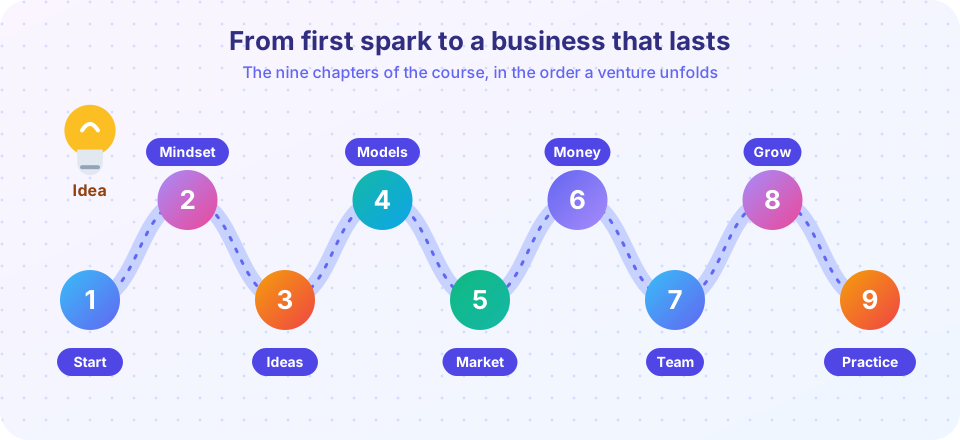
The journey in nine chapters
The chapters follow the order in which a venture usually unfolds, but you will often loop back. Real businesses are not built in straight lines.
- Getting Started defines entrepreneurship, separates the myths from the facts and maps the different kinds of ventures.
- The Entrepreneurial Mindset covers how entrepreneurs think about risk, uncertainty, failure and opportunity.
- Finding and Validating Ideas shows how to find problems worth solving, talk to customers, estimate a market and test an idea cheaply.
- Business Models and Plans explains how a venture creates, delivers and captures value, and how to price it and check the numbers.
- Marketing and Sales covers brands, channels, content, sales conversations and customer relationships.
- Funding and Finance explains bootstrapping, loans, grants, equity investors, financial statements and cash flow.
- Teams and Operations looks at co-founders, hiring, culture, processes, suppliers and legal basics.
- Growth, Ethics and Exit covers scaling, responsible business, sustainability and the different ways a venture can end or change hands.
- Projects and Practice brings everything together in case studies, mini-projects and practice sets.
Start: understand the game
Find and shape the idea
Reach customers and fund it
Build and grow responsibly
Practice it
How each lesson is built
Every content lesson follows the same shape so you always know where you are. It begins with a short list of what you will learn and a box of key terms. The body explains one idea with real examples and worked numbers, usually with an illustration. A "Common misconceptions" box names beliefs that are popular but wrong. The "Try it" section gives you interactive tools: calculators, simulations and charts you can change and run right in the page. A quiz checks understanding, and a summary and a link lead to the next lesson.
Chapter overviews give you the big picture first. Chapter reviews finish each chapter with a recap table and a longer quiz that mixes everything you studied.
Common misconceptions
"You need a revolutionary idea." Most successful ventures improve something that already exists, serve a neglected group of customers, or execute better than competitors. Execution and learning speed matter more than novelty.
"Entrepreneurs are born, not made." Research on entrepreneurs finds no single personality type. The skills of testing ideas, selling, managing money and leading others can all be learned and practiced.
"Reading is enough." Entrepreneurship is a practical craft. You learn it by doing small real things: talking to a customer, running a tiny test, selling one item. This course is built to push you toward those actions.
How to study this course
Pick one real or imaginary idea and carry it through the whole course. It can be small: washing bikes in your neighborhood, selling revision notes, a weekend pop-up kitchen. At the end of each lesson, write two or three sentences applying the idea to your own example. By Chapter 9 you will have a research file, a model, a set of numbers and a pitch.
Study in short sessions of 30 to 45 minutes. After each lesson, close the page and explain the main idea aloud, as if to a friend who has never heard of it. If you cannot, reread the summary. Return to the quizzes a few days later; recalling an answer after a delay strengthens memory far more than rereading.
Finally, treat every number in the interactive examples as invented. The companies in this course are fictional, and their figures exist to teach calculation, not to predict what will happen in a real market. Real figures must come from your own research.
Try it
The first tool is a tiny planner that helps you choose the idea you will carry through the course. Score three candidate ideas on four questions from 1 to 5; the total shows which one to start with. Change the ideas and scores to match your own.
Press Run (or Ctrl + Enter) to see the result here.
Program input · what you'd type while the program runs
Type the answers before you press Run, one per line. Each time the program reads a line (with input()), it gets the next line from this box.
The second tool draws the journey of this course as a simple timeline so you can see how much of the work happens before you spend money. The percentages are an illustration of effort, not statistics.
Press Run (or Ctrl + Enter) to see the result here.
Program input · what you'd type while the program runs
Type the answers before you press Run, one per line. Each time the program reads a line (with input()), it gets the next line from this box.
Check your understanding
Quick check · 4 questions
of 4 answered You scored / 4 · perfect!
-
1. Which description best fits entrepreneurship in this course?
The course defines entrepreneurship broadly: any venture that solves a problem and sustains itself through customers. It is not limited to technology or investors. -
2. Why does the course ask you to carry one idea through all nine chapters?
Applying every lesson to one example turns reading into practice. You may still change or drop the idea as you learn. -
3. What is an assumption in the vocabulary of this course?
Most of entrepreneurship is turning assumptions into evidence, which is called validation. -
4. How should you treat the company figures in the interactive examples?
The companies are fictional. Real decisions need your own research.
Summary
- Entrepreneurship is a learnable craft built from patterns, tools and tested habits.
- The nine chapters follow a venture from idea to growth and exit, with practice at the end.
- Choose one real or imaginary idea and apply every lesson to it.
- Study in short sessions, explain ideas aloud and revisit quizzes after a few days.
- All company figures in the exercises are invented to teach calculation.
Track your progress
Create a free account to tick off lessons and pick up where you left off on any device.
of Entrepreneurship lessons completed