


















Lesson 37 of 49 · Teams and Operations
Chapter 7 review: teams and operations
Review co-founder choice, equity splits, vesting, hiring scorecards, culture, bottlenecks, EOQ and legal structures with a recap table and a ten-question quiz.
You have now covered the human and practical side of building a company: who starts it with you, how ownership is shared, how new people join, and how work and paperwork are kept in order. This review turns the chapter into a single picture and a short checklist you can use whenever a team decision arrives. If a question below feels shaky, follow the link back to the lesson.
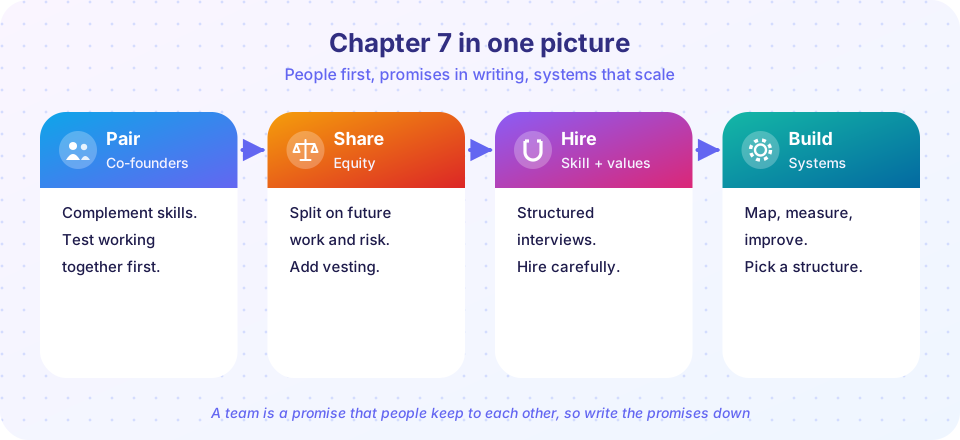
What you will learn
- A recap of every formula and rule of thumb in the chapter
- A short checklist for team decisions
- A mixed ten-question quiz
Recap table
| Topic | Key idea | Rule or formula | Lesson |
|---|---|---|---|
| Co-founders | Complementary skills, shared horizon, tested by real work | Try a small project together first | Co-founders and equity |
| Equity split | Reward future work and risk | Weighted scorecard or dynamic split | Co-founders and equity |
| Vesting | Earn shares over time | 4 years, 1-year cliff: share vested = months / 48 after month 12 | Co-founders and equity |
| Founders' agreement | Roles, ownership, leaver terms, IP, review | Written, reviewed every six months | Co-founders and equity |
| Hiring | Scorecard, structured interview, work sample | Rate every candidate on the same criteria | Hiring and culture |
| Fully loaded cost | Real cost of an employee | salary × (1 + overhead rate) + recruiting + ramp | Hiring and culture |
| Culture | What you reward and tolerate | Write values as behaviors | Hiring and culture |
| Bottleneck | Slowest step sets output | throughput = minimum step capacity | Operations and legal basics |
| EOQ | Best order size | √(2DS ÷ H) | Operations and legal basics |
| Reorder point | When to reorder | daily demand × lead time + safety stock | Operations and legal basics |
| Legal structure | Liability, tax, investor readiness | Sole proprietor, partnership, limited company | Operations and legal basics |
A team-decision checklist
When a people or operations question appears, run through these prompts.
- Is the agreement written? If two people hold different memories of a promise, the promise is not safe.
- Does the incentive match the behavior I want? Equity with vesting rewards staying; a bonus on sales volume only may reward discounts.
- Have I rated skill and values separately? A strong skill rating can hide a values problem.
- Which step limits the output? Spend effort there before elsewhere.
- What could a lawyer or accountant in this country tell me in one hour that saves a month? Buy that hour.
- When will we review this? Put the date in the calendar.
Worked example: three founders, one hire and a warehouse
Consider an invented company, a small business selling hand-made leather bags online. Three people start it: Lena designs, Omar runs production and Priya handles sales and the website. Follow the chapter's ideas as they decide things.
Co-founders and equity. They worked together on a market-stall pilot for two months before forming a company, which showed how each handled a rushed order and a quarrel about a supplier. They score commitment, skills, risk and capital; Lena and Omar quit their jobs and Priya keeps hers for six months, so Priya's share is smaller but she gets the chance to earn more through vesting. They agree on four-year vesting with a one-year cliff for all three, a written founders' agreement with a good-leaver and bad-leaver clause, and a review every six months. When Priya decides after eight months that she wants to return to her old job, the cliff has not been reached, so the company is not stuck with a passive owner, and the parting is friendly because the terms were written down in advance.
Hiring. The business now needs a person to handle production on busy days. The founders write a scorecard: the mission is "ship every order within three days"; outcomes include "cut the defect rate in half within six months"; the competencies include careful craftsmanship and honest reporting of mistakes. They interview three candidates with the same questions, ask for a one-hour paid work sample, and score separately before comparing. One candidate has the best skills and a poor attitude to feedback; they choose the candidate with good skills and strong values, whose weakness is a missing technique that can be taught.
Cost of the hire. The salary is $30,000, overhead of 25% brings the fully loaded cost to $37,500 a year, and the first three months are partly unproductive. The founders check that extra output per month will justify roughly $3,100 of monthly cost before they sign.
Operations. Orders flow through cutting, stitching, finishing and packing at capacities of 10, 6, 9 and 20 bags per day. Stitching is the bottleneck, so hiring a second packer would change nothing. Adding a second stitcher moves the limit to finishing at 9 per day, a 50% gain in output. They also use the EOQ formula for leather purchases, balancing the cost of each order against storage, and keep a one-page checklist for packing so mistakes fall.
Legal. They register as a limited company so they can sign contracts, limit personal liability and allow later investment. Lena signs an agreement that the designs belong to the company, and Omar's contracts with suppliers are in the company's name. A local accountant confirms tax and filing dates.
Every decision above relied on a small piece of arithmetic or a written agreement, none on a special talent. That is the message of the chapter.
Try it
This small tool joins three formulas from the chapter: vesting, fully loaded cost and throughput. Edit the numbers and run it again.
Press Run (or Ctrl + Enter) to see the console output here.
No output.
Set leavesAtMonth to 11, then 12, and see the cliff in action. Then raise the capacity of the slowest step and see which step becomes the next limit.
Check your understanding
Quick check · 10 questions
of 10 answered You scored / 10 · perfect!
-
1. A founder with 3,000,000 shares vests over four years with a one-year cliff. She leaves in month 9. How many shares has she vested?
Nothing vests during the first 12 months, so leaving in month 9 means zero vested shares. -
2. A founder with 2,400,000 shares leaves in month 36 under the same schedule. How many has she vested?
36 / 48 = 75%, so 0.75 x 2,400,000 = 1,800,000 shares. -
3. Why is a weighted equity scorecard useful even if the final numbers are rounded?
The discussion about weights and scores reveals differences in expectations before they become conflicts. -
4. Salary is $50,000 and overhead is 30%. What is the yearly fully loaded cost?
50,000 x 1.30 = $65,000. -
5. Which interview practice reduces the influence of the most forceful person in the room?
Independent scoring protects each interviewer's own judgment from group pressure. -
6. Steps handle 18, 12, 15 and 30 units per hour. What is the throughput?
The slowest step, 12 units per hour, sets the output. -
7. With D = 5,000 units a year, S = $32 per order and H = $2.50, what is EOQ? (Use the square root of 2DS/H.)
2 x 5,000 x 32 / 2.5 = 128,000; the square root is about 358. -
8. Daily demand is 20 units, lead time is 6 days, and safety stock is 40. What is the reorder point?
20 x 6 + 40 = 160 units. -
9. Which legal structure usually protects owners' personal assets from business debts?
A limited company is a separate legal entity, so liability is usually limited, with exceptions such as personal guarantees. -
10. What is the biggest IP risk when freelancers create your logo and code?
Always sign an agreement stating that the company owns work it commissions.
Summary
- Choose co-founders by complementary skills and tested trust; write the agreement and review it.
- Split equity by future contribution; vesting with a cliff protects the company.
- Hire with scorecards, structured interviews and independent scoring; count the fully loaded cost.
- Culture is shaped by what you reward and tolerate; write values as behaviors.
- Fix the bottleneck, plan stock with EOQ, choose a legal structure with local advice, and own your IP in writing.
Track your progress
Create a free account to tick off lessons and pick up where you left off on any device.
of Entrepreneurship lessons completed