


















Lesson 3 of 49 · Getting Started
Why People Make Art: Six Jobs for Images and Buildings
Explore six jobs art has done across history, from worship and power to protest, with named examples from Hagia Sophia to Picasso's Guernica.
Ask a hundred people why art exists and you will hear a hundred answers: to make things beautiful, to say what words cannot, to show off, to remember. History supports all of them, and adds a few more. For most of human history there was no separate "art world". Images and buildings were made because someone needed a god honored, a king recognized, a battle remembered, a child taught or a room made pleasant. The easiest way to understand a work is often to ask what job it was built to do.
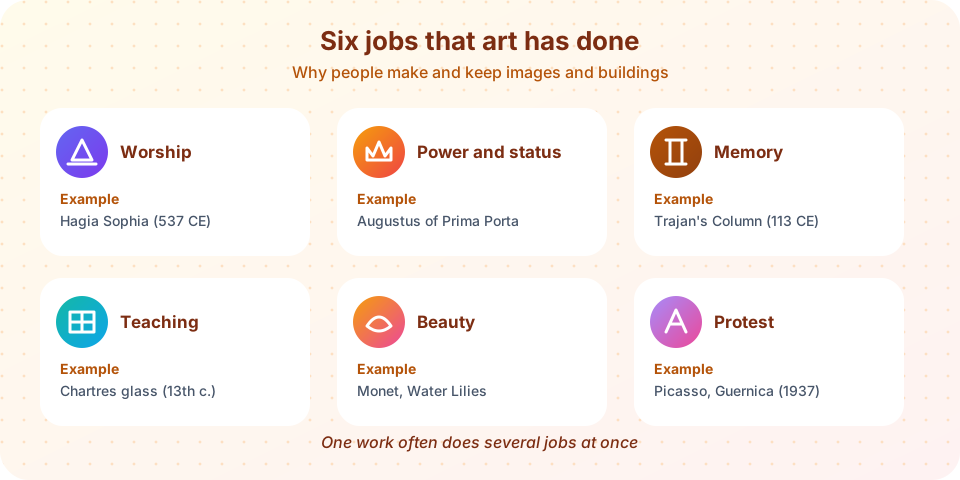
This lesson sorts those jobs into six broad groups. They are not a rigid system: most great works do several jobs at once, and the same object can change jobs over time, as when a temple becomes a museum. But the six groups give you a first question for every work you meet in the chapters ahead.
What you will learn
- Six common purposes of art and a named example of each.
- How patrons, makers and viewers can want different things from the same work.
- Why the setting of a work changes how it is read.
- How to ask "what job was this made to do?" about any object.
Key terms
- Function: what a work was made to do in the lives of its users.
- Patronage: paying for art, by a person, a church, a government or a company.
- Propaganda: images made to persuade people toward a political view.
- Votive: an offering made to a deity in thanks or hope.
- Narrative: a work that tells a story, in one scene or many.
1. Worship and belief
The oldest surviving large buildings, in many parts of the world, are religious. Temples, shrines, churches and mosques all use form to say something about the sacred. A famous example is Hagia Sophia in Istanbul. The emperor Justinian had it built in just under six years, completed in 537 CE, with the architects Anthemius of Tralles and Isidore of Miletus designing a vast dome that seems to float on a ring of windows. Contemporary writers said that worshippers felt as if they stood in heaven. The building was a church, later a mosque, later a museum and is now a mosque again. Its job has changed, yet its dome still does what its builders intended: it makes people look up.
Religious art also teaches and consoles. A small votive statue offered at a Greek sanctuary carried a private hope. A Buddhist mandala paints a cosmic map to be used in meditation. When you meet a work, ask whether it was made to be prayed to, prayed in front of or merely about prayer.
2. Power and status
Rulers and rich families have always used images to say "I am in charge" and "I am legitimate". The marble Augustus of Prima Porta, a Roman statue of the first emperor found near Rome in 1863, shows him in an idealized, calm posture, in military dress, with his right arm raised as if addressing troops. Its decorated breastplate shows a peaceful return of battle standards. The message: here is a leader who brings victory and peace. It is not a snapshot. Augustus was an old man by the end of his life, but statues kept him young.
Power also lives in size and cost. A ruler who can fund a palace or a cathedral advertises wealth, and a merchant family that commissions a chapel advertises piety and money together. Today the same logic drives corporate headquarters and national museums. The question to ask: who is being shown as powerful, and who paid for the showing?
3. Memory and record
Before photography, images were the main way to keep a record. Trajan's Column in Rome, dedicated in 113 CE, wraps a spiral band of relief carving, roughly 200 meters long if unrolled, around a tall marble shaft. It tells the story of the emperor's wars against the Dacians, scene by scene, from marching soldiers to bridge-building. It is both a monument and a document, though a document chosen and shaped by the winner.
Memory also takes smaller forms: family portraits, tomb effigies, war memorials, wedding paintings. When a work records something, remember that records are selective. Ask what the maker chose to show, and what is missing.
4. Story and teaching
Many cultures have used images to teach people who could not or did not read. In the thirteenth century the glass of Chartres Cathedral, rebuilt after a fire in 1194, filled hundreds of panels with stories from the Bible and the lives of saints. The glass also carries images of the guilds that paid for windows: bakers, shoemakers and others appear in small scenes. A worshipper could "read" the building, and the building could also show who contributed to it.
Teaching images extend far beyond churches: Greek vase paintings carry myths, Aztec codices (painted books) record history and calendars, children's primers carry pictures. If a work seems crowded with small scenes, it may be a story to be followed rather than a single picture to be admired.
5. Beauty and pleasure
Some art exists mainly to delight. The Impressionist Claude Monet's Water Lilies series, which occupied him for roughly the last thirty years of his life, fills enormous canvases with light on a pond. Two oval rooms at the Musée de l'Orangerie in Paris, arranged as he intended, opened to the public in 1927, a year after his death. They invite viewers to slow down and be calm. Not everyone treats beauty as unimportant: the ancient Greeks, the Chinese literati painters and Islamic calligraphers all developed sophisticated ideas about it.
Pleasure also includes the pleasure of skill. A viewer may admire how a sculptor turned hard marble into the look of soft cloth. Whether beauty is a purpose or a by-product is itself debated, and we return to this idea in chapters 6 and 7.
6. Protest and ideas
Some works are made to challenge power rather than to flatter it. Pablo Picasso's Guernica (1937) responds to the bombing of the Basque town of Guernica in April 1937 during the Spanish Civil War. Commissioned for the Spanish Republic's pavilion at the Paris World's Fair, the huge black, white and gray painting shows screaming figures, a bull and a wounded horse. It does not depict a specific airplane or bomb, which is part of its power: it turns a particular event into a general cry about civilian suffering. It has toured the world and become a symbol of anti-war protest.
Contemporary artists often work this way, from posters and murals to conceptual installations. If a work seems to argue with you, it is probably asking you to think about an idea.
Try asking the same three questions of every work: Who wanted this made? Who was it for? What did they want it to do? The answers often differ, and the differences are interesting.
Patron, maker, viewer
The jobs of art are not always shared by everyone involved. A patron may want glory, the artist may want to experiment and the audience may want comfort. In 1508 the pope Julius II commissioned Michelangelo to paint the ceiling of the Sistine Chapel. The pope wanted a magnificent space for papal ceremonies; Michelangelo, who thought of himself as a sculptor, took the chance to explore the human body on a gigantic scale. Both aims are visible in the result. A good habit is to ask whose needs a feature serves.
The viewers change too. A tomb statue was once seen by mourners; today it is seen by tourists. A medieval altarpiece made for devotion now sits in a gallery as an example of style. Neither use is wrong, but a careful art historian tries to describe the original use first.
Common misconceptions
"Art has always been about self-expression." The idea of the artist as a lone genius expressing inner feelings is largely modern. For most of history makers worked on commission, in workshops, to a brief.
"Propaganda is only about dictators." Any image that tries to persuade, from medieval coats of arms to modern advertising, uses similar techniques. Spotting them is a skill, not an insult to the work.
"A work has one purpose." Hagia Sophia is a place of worship, a statement of imperial power and a feat of engineering at once.
Try it
Check your understanding
Quick check · 5 questions
of 5 answered You scored / 5 · perfect!
-
1. Trajan's Column in Rome mainly does which job?
The spiral relief narrates Trajan's Dacian wars. It is memory and power together, told from the winner's side. -
2. Which statement about Hagia Sophia is correct?
Completed in 537 CE under Emperor Justinian, it was a church, later a mosque, later a museum and is now a mosque again. -
3. Why is Picasso's Guernica considered a protest work?
Responding to the bombing of a Basque town, Picasso used black, white and gray figures to express the horror of war in general. -
4. Why does the course say 'a work has one purpose' is a misconception?
A cathedral can be a place of prayer, a civic symbol and an engineering feat. Different people also value different things in it. -
5. In the Sistine Chapel example, who wanted a splendid space for papal ceremonies?
Julius II commissioned the ceiling; Michelangelo used the commission to explore the human body at huge scale.
Summary
- Six common jobs of art: worship and belief, power and status, memory and record, story and teaching, beauty and pleasure, protest and ideas.
- Most works do several jobs; patrons, makers and viewers can want different things.
- Settings change over time: a church can become a museum, a tomb statue a tourist sight.
- A good first question for any work: what job was it made to do, and for whom?
Next: The Big Timeline
Track your progress
Create a free account to tick off lessons and pick up where you left off on any device.
of Art History lessons completed