


















Lesson 17 of 49 · Ancient and Classical Art
Chapter 3 Review: Ancient and Classical Art
Review chapter 3 of the art history course: prehistoric and Near Eastern art, Egypt, Greece and Rome, with a one-page summary, a timeline matcher and a ten-question quiz.
You have just traveled from painted caves to the Roman Empire. The key to remembering this long span is not to memorize every monument but to hold on to what each culture wanted its art to do. This review gathers the chapter into a single picture and then tests you.
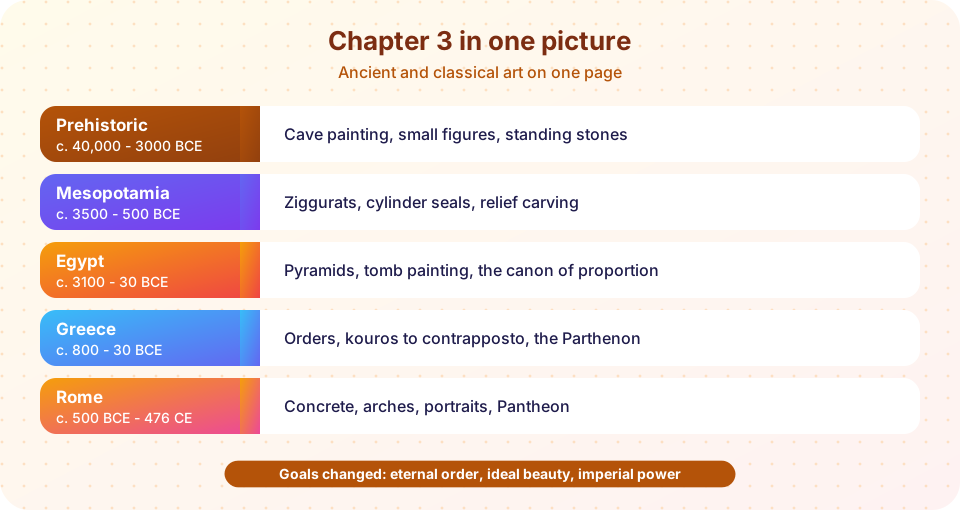
Recap
| Culture | Main job of art | Signature works | Key terms |
|---|---|---|---|
| Prehistoric and Near Eastern | Ritual, identity, then kingship and religion in cities | Lascaux, Venus of Willendorf, Ziggurat of Ur, Ishtar Gate | ochre, register, cuneiform, lamassu |
| Egyptian | Preserve life, order and the king for eternity | Great Pyramid, Palette of Narmer, Nefertiti, Tutankhamun | ka, canon, composite view, ma'at |
| Greek | Honor the gods; ideal beauty and balance | Parthenon, Kritios Boy, Doryphoros, Laocoon | orders, kouros, contrapposto, entasis |
| Roman | Communicate empire; build shared space | Augustus of Prima Porta, Colosseum, Pantheon, Pompeii | verism, concrete, voussoir, dome |
Four contrasts to remember
- Eternity versus ideal. Egypt freezes a clear, rule-bound image for the afterlife; Greece searches for a perfect, living ideal in a body.
- Stone, mud brick and concrete. Materials shape monuments: Egyptian limestone pyramids, Mesopotamian mud-brick ziggurats and Roman concrete domes.
- Hierarchic scale versus portrait truth. Egyptian and Mesopotamian art show rank by size; Roman portraits show a particular face.
- Originals versus copies. Much Greek sculpture survives only in Roman copies, which is why careful sources matter.
When a question asks "which culture made this?" check the job first. A crowd-pleasing arena with arched corridors is Roman, a calm temple with refined curves is Greek, and a stepped brick tower is Mesopotamian.
How the traditions connect
The chapter is not five separate boxes. Ideas and forms moved between cultures, and spotting the links is one of the best ways to remember them.
- Egypt to Greece. Early Greek sculptors learned from Egyptian statues: the archaic kouros stands with the same left foot forward and arms at the sides. Within a century, though, Greek artists began to break the pattern with contrapposto.
- Greece to Rome. Romans admired Greek art, copied it on a huge scale and used the Greek orders as decoration. The Colosseum's three stories of columns, Doric, Ionic and Corinthian, are Greek ideas used as decoration on a Roman structure of concrete and arches.
- Mesopotamia to everywhere. Registers, the habit of telling a story in horizontal bands, and cylinder-seal scenes travel across the ancient Near East and reappear in Egyptian and Greek art.
- Rome to the Middle Ages. The basilica, the arch and the portrait bust all survive into Christian Europe. Chapter 4 takes up that story.
A model comparison: Greek and Egyptian standing figures
Compare an Egyptian statue of a king (Khafre or Menkaure) with a Greek Doryphoros (about 440 BCE). Both are idealized, both are young and strong, both stand in a firm pose. The differences are the point.
- The Egyptian king steps forward with the left foot, yet his weight does not shift: both feet stay flat, his arms are stiff and the figure is attached to a block of stone behind the legs. Everything says stability and permanence, a body prepared for eternity.
- The Greek athlete shifts his weight to one leg. The shoulders and hips tilt in opposite directions, the free arm hangs loosely and the head turns a little. Everything says a body that could move at any moment, a body prepared for life in the city.
Both are answers to the question "how should a human being be shown?", but the questions behind them differ: Egypt asks how to make a figure last; Greece asks how to make it live. If you can phrase a comparison like this for any two works, you are thinking like an art historian.
A note on sources
Much of what we know about ancient art comes through later hands. The Doryphoros survives in Roman copies; Egyptian wall paintings are preserved because they were sealed in tombs; Greek wall painting is almost entirely lost, which is why the vase paintings loom so large. The Pantheon survived because it became a church. Always ask what has survived, and why, before you generalize about a culture.
Try it
Check your understanding
Quick check · 10 questions
of 10 answered You scored / 10 · perfect!
-
1. Which is the best summary of the main job of Egyptian tomb art?
Tomb paintings and statues were working tools for the afterlife. -
2. What is contrapposto?
It first appears clearly in the Kritios Boy, about 480 BCE. -
3. Which building has a dome 43.3 meters across and an oculus?
The Pantheon's concrete dome is 43.3 meters across. -
4. Why do we know many Greek sculptures only through Roman copies?
The Doryphoros and Discobolus are known from copies. -
5. What is hierarchic scale?
It appears in Egypt and Mesopotamia and again in medieval art. -
6. Which statement about colors in ancient sculpture is best supported?
Traces of pigment and modern analysis show painted decoration was common. -
7. What did the Standard of Ur show on its two sides?
One side shows war with chariots and prisoners, the other a banquet. -
8. Which of these is a true statement about the Venus of Willendorf?
The small limestone figure was found in Austria in 1908, with debated meaning. -
9. What did Akhenaten do to Egyptian art?
The Amarna style, with elongated forms and intimate royal scenes, ended soon after his reign (about 1353-1336 BCE). -
10. Which Roman innovation allowed huge interior spaces?
Concrete let builders pour enormous vaults and domes.
Summary
- Prehistoric art is hard to interpret; Mesopotamia, Egypt, Greece and Rome each gave art new jobs.
- Egypt aimed for eternal order; Greece for ideal beauty; Rome for communication and space.
- Materials and techniques shaped each tradition.
- Chapter 4 follows Roman art into the Christian world: Byzantine and medieval art, then the Renaissance.
Track your progress
Create a free account to tick off lessons and pick up where you left off on any device.
of Art History lessons completed