


















Lesson 29 of 49 · Baroque to Romanticism
Romanticism: feeling, nature and protest
Meet the Romantics: the sublime, political outrage and the artist's inner life, from Goya and Gericault to Friedrich, Constable and Turner.
Around 1800 many artists stopped asking "what are the rules?" and began asking "what do I feel?" Romanticism was not a single look. It was a shared belief that emotion, imagination, nature and the individual deserved center stage. Romantic painters could be gentle (a cloud study), terrifying (a shipwreck) or furious (a massacre). This lesson shows how those moods fit together and why they arrived when they did.
What you will learn
- What Romanticism believed and how it differs from Neoclassicism.
- What the sublime is and how painters create it.
- How Goya, Gericault and Delacroix turned current events into art.
- How Friedrich, Constable and Turner changed landscape painting.
Key terms
Romanticism: a movement in art, music and literature from about 1790 to 1850 that put feeling, imagination and the individual above rules and convention.
The sublime: an experience of awe, mixed with fear, in the face of something vast or overpowering. Edmund Burke defined it in a famous 1757 essay.
Picturesque: pleasing, irregular scenery that looks like a picture, such as ruins, winding paths and old cottages.
Rückenfigur: German for "back figure": a person seen from behind, who invites the viewer to share the view.
Plein air: painting outdoors, in front of the subject.
Why feeling took over
Think about the world a young painter in 1800 faced. The French Revolution (1789) had overthrown a monarchy, then turned to terror, then produced an emperor. Napoleon's armies crossed the continent. Factories and steam engines began changing landscapes and cities. Reason, the great Enlightenment hope, had not made Europe peaceful. Artists, poets and musicians looked inward. They wrote poems about solitude, composed symphonies about struggle (Beethoven's years overlap), and painted storms.
Romantics also admired what rationalists dismissed: the medieval past, folk tales, dreams, madness and untamed nature. In their eyes a genius did not follow rules but made new ones.
The sublime in landscape
In 1757 Edmund Burke argued that beauty (smooth, small, delicate things) and the sublime (vast, dark, powerful things) are different experiences. The sublime, he said, arises from terror held at a safe distance. A viewer standing in front of a painting of a storm feels the thrill without the danger.
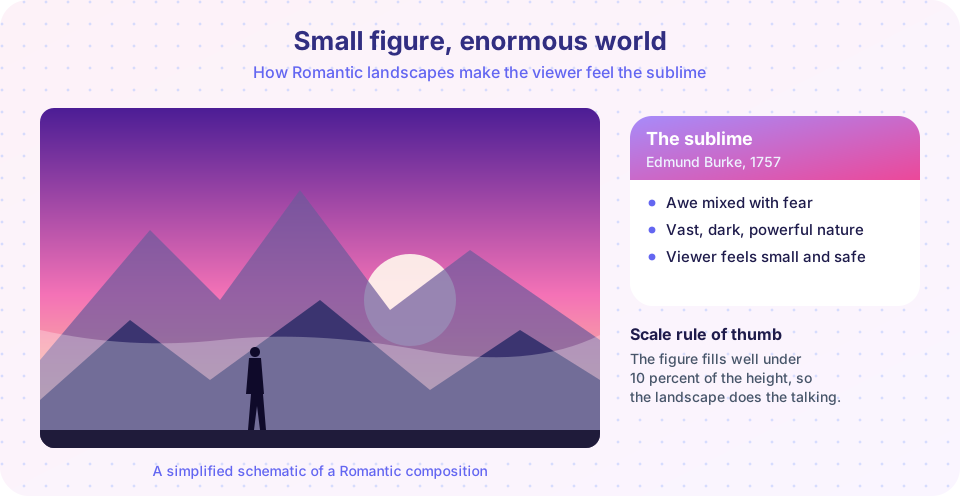
Caspar David Friedrich (1774 to 1840), working in Germany, painted this idea most clearly. In Wanderer above the Sea of Fog (about 1818) a man in a green coat stands on a rock with his back to us, looking at a world of mist and distant peaks. Because we see him from behind (a Ruckenfigur), we step into his place. The painting is about standing in front of something bigger than yourself. Friedrich's religious sense of nature also fills his Monk by the Sea (1808 to 1810), where a tiny figure stands before an almost empty sea and sky.
J. M. W. Turner (1775 to 1851) took the sublime into light and weather. In The Fighting Temeraire (1839) a pale old warship is towed to be broken up by a small steam tug, as a red sunset floods the sky. In Rain, Steam and Speed (1844) a locomotive rushes across a bridge in a haze of color, and objects dissolve into golden mist. Critics argued about whether Turner's late pictures were visionary or unfinished. Many later painters, including the Impressionists, learned from his dissolving light.
John Constable (1776 to 1837) approached nature differently. He painted the ordinary Suffolk countryside he knew, with a big interest in clouds, and made oil sketches outdoors. The Hay Wain (1821) looks calm today, but it was radical in its attention to weather, and when shown at the Paris Salon in 1824 it impressed French painters including Delacroix. In America, Thomas Cole (1801 to 1848) and the Hudson River School painted vast views of the Catskills with a similar sense of awe.
Painting current events
Romantic painters often chose their subjects from the news, and chose to make them painful.
Francisco Goya (1746 to 1828), court painter in Madrid, lost his hearing around 1792 to 1793 and turned toward darker, more private imagery. After French troops occupied Spain, Madrid rose on 2 May 1808, and the next night French soldiers shot Spanish prisoners. Goya painted The Third of May 1808 in 1814. A white-shirted man throws up his arms in front of a firing squad whose faces we cannot see. The lantern at the center lights the victim, not the soldiers. There is no hero in armor, only a terrified human being. Goya's etchings The Disasters of War (made 1810 to 1820, published only in 1863) are even starker. In his last years he covered the walls of his house with the "Black Paintings", including the frightening Saturn Devouring His Son; they were later moved onto canvas.
Theodore Gericault (1791 to 1824) took on a scandal. In 1816 the French frigate Meduse ran aground off West Africa. Its commander, a political appointee with little sea experience, abandoned about 150 people on a makeshift raft; only 15 were still alive when it was found after thirteen days. Gericault interviewed survivors, had a model of the raft built and studied corpses in a morgue. His Raft of the Medusa (1818 to 1819) is huge, and its pyramid of bodies rises toward a speck of rescue ship on the horizon, caught between hope and despair. He made a giant history painting out of a news story, a deliberate challenge to the Neoclassical rule that history paintings should show ancient heroes.
Eugene Delacroix (1798 to 1863) followed with rich color and loose brushwork. His Liberty Leading the People (1830) celebrates the July Revolution, with a bare-breasted allegory of Liberty waving the tricolor over the dead, flanked by a boy and a man in a top hat. Delacroix's fans prized color and passion; Ingres's fans prized line and control. The "line versus color" quarrel between their camps became a famous rivalry in the 1820s to 1850s.
Press Run (or Ctrl + Enter) to see the result here.
Program input · what you'd type while the program runs
Type the answers before you press Run, one per line. Each time the program reads a line (with input()), it gets the next line from this box.
Romanticism's legacy
Romanticism set up many assumptions we still carry: that artists are individuals with unique visions, that feeling is a valid subject, that landscape can express a mood, and that art may challenge power. It also left a darker legacy of exoticism, in which painters showed "the Orient" as a dreamlike place of passion and cruelty; later critics, especially since Edward Said's 1978 book Orientalism, have questioned that habit. When you see a Romantic picture of an imagined Eastern harem or desert, ask who is looking and who is being looked at.
Common misconceptions
"Romantic means romance." The word comes from medieval romances, tales of adventure and wonder. Love is only one of the feelings Romantics explored.
"Romantics rejected all rules." They rejected academic rules, but many studied hard. Turner and Constable made thousands of careful studies.
"Romanticism and Neoclassicism never overlap." Ingres is often called Neoclassical yet painted Romantic subjects; the two outlooks quarrelled and borrowed.
Try it
Drag the sliders in the sublime dial to find the exact balance of mountain, figure and mist where the message changes. Then run the timeline and notice that Constable, Turner and Friedrich were exact contemporaries, working in three different countries on the same big question: what is nature for?
Check your understanding
Quick check · 5 questions
of 5 answered You scored / 5 · perfect!
-
1. According to Edmund Burke, the sublime involves:
Burke separated the sublime (awe and terror at a safe distance) from the beautiful. -
2. What is a Ruckenfigur?
Friedrich often placed a figure with their back to us. -
3. Which painting records an event that happened in Madrid in 1808?
Goya painted the execution of Spanish citizens by French troops in 1814. -
4. Why was The Raft of the Medusa a radical history painting?
Gericault turned a current disaster into monumental art. -
5. Which painter is best known for dissolving light and steam into color, as in Rain, Steam and Speed?
J. M. W. Turner's late works dissolve forms in luminous color.
Summary
- Romanticism (about 1790 to 1850) prized feeling, imagination and the individual over rules.
- The sublime depends on scale and a mix of awe and fear; Friedrich and Turner show it in different ways.
- Goya, Gericault and Delacroix made political and human suffering into monumental art.
- Constable and Turner changed landscape painting through outdoor study and the study of light.
- Romantic exoticism deserves critical reading, since it shaped how the West imagined other cultures.
Next: Chapter 5 review
Track your progress
Create a free account to tick off lessons and pick up where you left off on any device.
of Art History lessons completed