


















Lesson 31 of 49 · Impressionism to Modernism
Chapter 6 overview: Impressionism to Modernism
A guide to modern art from 1863 to 1937: Impressionism, Post-Impressionism, Expressionism, Cubism, abstraction, Dada and Surrealism, and why artists broke the rules.
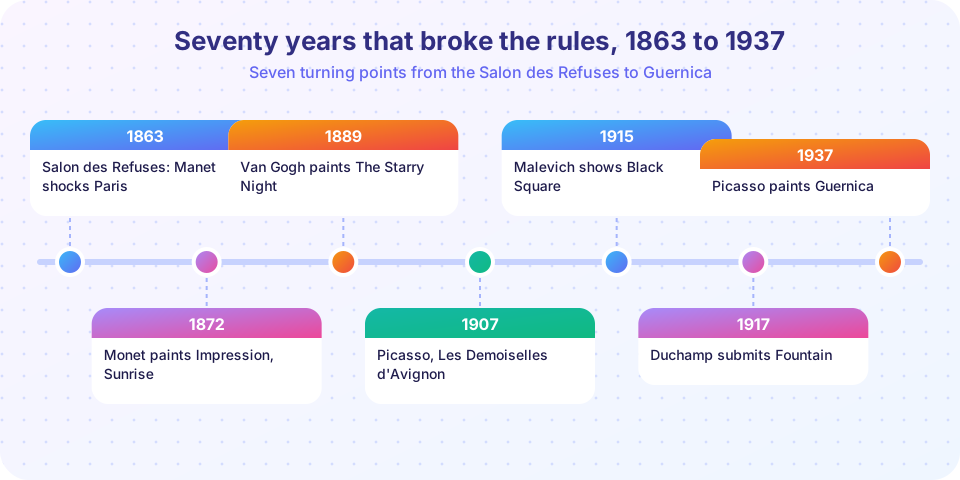
In 1863 a group of French painters were rejected by the official Salon and held a show of their own. By 1937 Picasso was painting an air raid in black, white and gray, and an artist had already exhibited a porcelain urinal as art. In seventy years painting went from careful realism to dripping color fields and fragmented bodies. This chapter explains how that happened and why, so that "modern art" stops looking like a random pile of strange pictures and starts looking like a chain of arguments.
Why did art change so fast?
Four forces explain most of the change:
- Photography. After 1839 a camera could record a likeness in seconds. If accuracy was no longer the painter's special skill, what was painting for? Many artists answered: for what a camera cannot do, such as color, feeling, structure and idea.
- New materials. Paint in collapsible metal tubes (patented in 1841) made outdoor painting practical. New synthetic pigments gave stronger colors.
- Modern life. Railways, department stores, boulevards, cafes and factories created a fast, crowded, anonymous city. Painters wanted to record that experience, not just myths and saints.
- The art market. The old system of Academy, Salon and state commissions began to lose its monopoly. Dealers, private galleries, small exhibitions and critics created alternative routes. Avant-garde (French for "advance guard") artists used them to show daring work.
Impressionism: capture the moment
Post-Impressionism: go further
Expressionism: feeling outward
Cubism and abstraction
Dada and Surrealism
The map of this chapter
| Lesson | Focus | Key names |
|---|---|---|
| Impressionism: painting light | Light, color, modern life | Monet, Manet, Morisot, Cassatt, Degas, Renoir |
| Post-Impressionism and Expressionism | Structure, feeling, symbol | Seurat, Cezanne, Van Gogh, Gauguin, Munch, Matisse |
| Cubism, abstraction, Dada and Surrealism | Breaking the picture apart | Picasso, Braque, Kandinsky, Mondrian, Duchamp, Dali |
| Chapter review | Recap and a long quiz | All |
What "modern" means (and does not)
In everyday speech "modern" means "recent". In art history Modernism means a cluster of movements that, from roughly the 1860s to the 1960s, questioned traditional rules of representation and often believed in progress, experiment and the new. It does not mean every painting made in the 20th century. It also does not mean that everyone liked it. Many viewers laughed at Impressionist pictures and were scandalized by early abstraction; modern art has a long history of being misunderstood at first and sometimes of being plain wrong in its own claims.
This chapter, like most textbooks, concentrates on Paris, Munich, Vienna, Berlin and Moscow, because that is where many movements formed and where the historical record has been most studied. Artists elsewhere were modernising at the same time, in Mexico, India, Japan, the Arab world, Africa and Latin America. Chapter 7 returns to those stories.
Who was in the room?
Look at who gets named in the list of famous painters of this period and you will see mostly men. Women were often kept out of art academies, and barred from life-drawing classes with nude models. Yet Berthe Morisot, Mary Cassatt, Eva Gonzales, Suzanne Valadon, Paula Modersohn-Becker, Hilma af Klint, Gabriele Munter, Sonia Delaunay, Frida Kahlo and many more were central to these movements. Watch for them as you read; their work often shows aspects of modern life that male painters missed.
A quick tour of the lessons
The lessons move in the order the movements appeared, but each one stops to ask what was new. The Impressionism lesson lets you test the color tricks painters relied on: simultaneous contrast and optical mixing. The Post-Impressionism and Expressionism lesson lets you turn a landscape into dots and then shift its hues to feel why Fauve color was shocking. The Cubism lesson gives you a machine that slices an ordinary bottle and shifts the slices, so you can see how multiple viewpoints turn into a design principle.
You will also meet the people behind the movements, including those who tend to be missing from older textbooks. Berthe Morisot, Mary Cassatt, Hilma af Klint and Hannah Hoch appear beside Monet, Picasso and Duchamp, because the story of modern art is richer and more accurate when everyone is in the room. Keep asking, as you read: who made this, who saw it, and who was left out?
Check your understanding
Quick check · 3 questions
of 3 answered You scored / 3 · perfect!
-
1. Which invention most directly pushed painters away from exact likeness?
After 1839 cameras could capture likenesses quickly, so painters looked for other aims. -
2. What does 'avant-garde' literally mean?
The term comes from French military language and describes artists seen as pioneers. -
3. Which statement about Modernism is most accurate?
Modernism is a cluster of movements, not just a date range.
Summary
- Photography, new materials, modern city life and a changing art market pushed artists to experiment.
- The chapter moves from Impressionism through Post-Impressionism and Expressionism to Cubism, abstraction, Dada and Surrealism.
- Modernism names experimental movements, not every modern-era picture.
- Women artists were active throughout, even where institutions excluded them.
Track your progress
Create a free account to tick off lessons and pick up where you left off on any device.
of Art History lessons completed