


















Lesson 44 of 49 · Projects and Practice
Project: write a visual analysis
A step-by-step project: choose an artwork, observe it closely, research its context, form a thesis and write a visual analysis, with Hokusai's Great Wave as a worked example.
The most common assignment in art history is a visual analysis: a short essay that looks hard at one work, explains how it is put together and argues what that arrangement achieves. It is also the best way to prove to yourself that you have learned to see. In this project you will follow a clear process from choosing a work to polishing an essay, using Hokusai's famous woodblock print as a worked example. By the end you will have a repeatable method you can apply to any work in any museum.
What you will learn
- The five-step process for a visual analysis.
- How to turn observations into a thesis, and why a thesis needs evidence.
- How to add context without letting it swamp the looking.
- How to check your draft against a simple rubric.
Key terms
Visual (formal) analysis: a written examination of how a work's visual elements create its effect.
Thesis: a clear, arguable claim that your essay supports with evidence.
Composition: the arrangement of shapes, lines, colors and space within a work.
Evidence: details in the work, or facts from reliable sources, that back up a claim.
Woodblock print: a print made by cutting a design into wood blocks, inking them and pressing paper onto them. Each color needs its own block.
The five-step process
- Choose and look. Pick one work. Spend ten quiet minutes looking before you read anything. Write down everything you notice: subject, medium, size, colors, shapes, where your eye goes first and last.
- Organize. Sort your notes under headings: composition, line, color, light, space, scale, texture.
- Research the basics. Find reliable facts: artist, date, medium, size, where it is kept, and why it was made. Museum websites and scholarly books are better than random web pages.
- Form a thesis. Decide what the visual choices achieve. A thesis says something arguable, not just "this painting uses color".
- Write and revise. Draft, check each claim against what you can actually see, cut anything unsupported, and polish.
Worked example: Hokusai's Great Wave
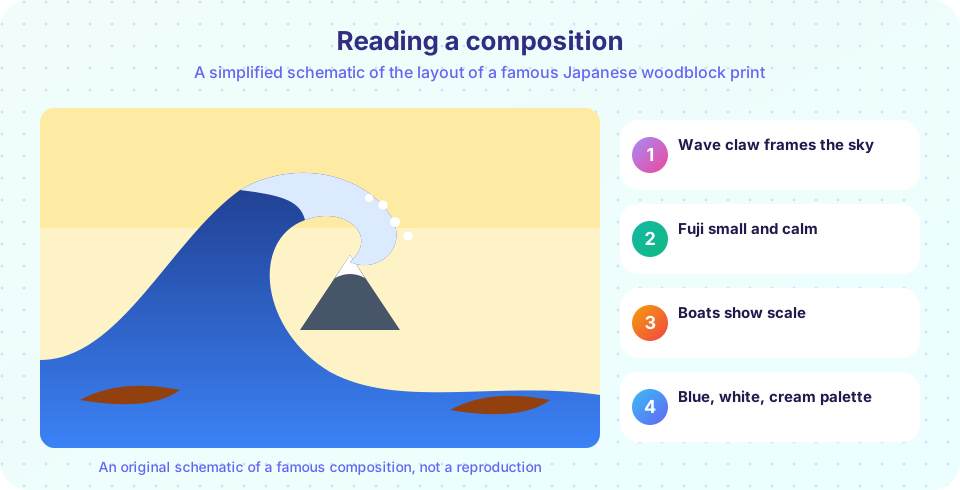
Step 1: observe. The print is Under the Wave off Kanagawa by Katsushika Hokusai (1760 to 1849), made about 1831 as part of the series Thirty-six Views of Mount Fuji (the series later grew to forty-six prints). It is a color woodblock print, small enough to hold in two hands, roughly 25 by 37 centimeters. Notes: a huge blue wave rises on the left with a curling claw of foam; boats with rowers are caught below it; a small, snow-capped mountain sits at the center in the distance; the sky is pale with small thin clouds; the palette is mostly blue, white and cream.
Step 2: organize.
- Composition: The wave takes up the upper left, an enormous diagonal curve that sweeps toward the right and frames the mountain in the hollow of its arc.
- Line: Strong black outlines around forms; fine lines in the foam fingers.
- Color: Blue dominates. The blue is a deep, even tone that was newly popular in Japan around this time thanks to imported Prussian blue pigment.
- Space: Perspective is flattened but depth is clear: boats in the foreground, wave in the middle, mountain far behind.
- Scale: The wave towers over the boats, and the boats overshadow the mountain in the picture, though in life Mount Fuji (about 3,776 meters) is far bigger.
Step 3: context. Hokusai was around seventy. In Edo-period Japan, prints like this were produced by a team (designer, carver, printer, publisher) and sold to townspeople. Because many impressions were printed, there is no single "original": museums in Tokyo, London, New York and Chicago all hold impressions. The Western view of the print is partly shaped by its influence on European artists after Japan opened to trade in the 1850s, but Hokusai made it for a Japanese audience for whom Fuji was a cherished symbol.
Step 4: thesis. A weak thesis: "The Great Wave is a beautiful picture of the sea." A stronger one: "By letting the curve of the wave echo the shape of Mount Fuji and shrinking the mountain to a small triangle in the hollow of the wave, Hokusai makes the sea's power the subject while keeping Fuji as a still point at the center." This is arguable, specific and testable against the picture. A student could disagree and cite other details.
Step 5: write. An outline might be:
| Paragraph | Purpose | Evidence |
|---|---|---|
| Introduction | Identify the work and state the thesis | Artist, title, date, medium |
| Composition | Show how the wave frames Fuji | The arc of the wave, the diagonal, the boats |
| Color and line | Explain the effect of limited blue and strong outline | Blue palette, outlines, white foam |
| Context | Add one or two relevant facts | Team production, series on Fuji, Prussian blue |
| Conclusion | Return to the thesis and say why it matters | The tension between power and calm |
Pitfalls to avoid
- Describing without arguing. "There is a wave, there is a boat" lists parts. Always ask "so what?"
- Context only. A biography is not an analysis. Use context to explain what you see.
- Unsupported claims. "The artist felt sad" cannot be proved from the picture alone.
- Big sweeping words. "Timeless", "universal" and "masterpiece" claim more than they show.
- Copying. Write your own sentences. Quote sparingly and name the source.
Press Run (or Ctrl + Enter) to see the result here.
Program input · what you'd type while the program runs
Type the answers before you press Run, one per line. Each time the program reads a line (with input()), it gets the next line from this box.
Revising with a reader
After your first draft, give it to someone who has not seen the work and ask them to point to the sentence where they could picture the picture best, and the sentence where they got lost. Then read your essay aloud next to the image. Every claim should be something you can point at on the picture or support with a named source. Cut the sentences that fail that test. A tight, evidence-rich page almost always reads better than a longer one that wanders.
Common misconceptions
"Formal analysis means I must not mention the artist." Basic facts (artist, date, place) are part of the introduction, and context can support your claims. The focus stays on the visual evidence.
"A longer essay is a better essay." A tight, evidence-based 600-word essay beats a rambling 1,500-word one.
"Opinion is not allowed." You are encouraged to argue, but every claim must be anchored in details a reader can see.
Try it
Pick any work from this course. Look for ten minutes, fill in the scaffold, and run the rubric checker on your own paragraph (paste it over the sample). Which check fails first? That is your first revision target.
Check your understanding
Quick check · 5 questions
of 5 answered You scored / 5 · perfect!
-
1. What should you do before reading about a work?
Close looking first prevents you from only repeating what others say. -
2. Which is the strongest thesis?
It is specific, arguable and testable against the image. -
3. Why is there no single 'original' of a woodblock print?
Multiple impressions from the same blocks are all authentic prints. -
4. What is the role of context in a visual analysis?
Context explains the visual choices; it does not replace them. -
5. Which sentence is the most evidence-based?
It points to specific visual details and explains their effect.
Summary
- A visual analysis follows five steps: look, organize, research basics, form a thesis, write and revise.
- A good thesis is arguable and tied to visible evidence.
- Context supports, but does not replace, looking.
- Check drafts against a rubric and cut unsupported claims.
Track your progress
Create a free account to tick off lessons and pick up where you left off on any device.
of Art History lessons completed