


















Lesson 47 of 49 · Projects and Practice
Glossary of art history terms
A searchable glossary of more than fifty art history terms from Baroque to contemporary art and from methods to museums, with study tools.
Every field has a language, and art history's language is a mix of Italian, French, German and Latin terms for ideas that are simple once you have met them. This glossary gathers the key terms used in chapters 5 to 8, in alphabetical order, with short definitions and the lesson where each is explained. Use it as a reference, but also as a study tool: cover the definitions and try to recall them, or play the flashcard widget and the quiz generator below.
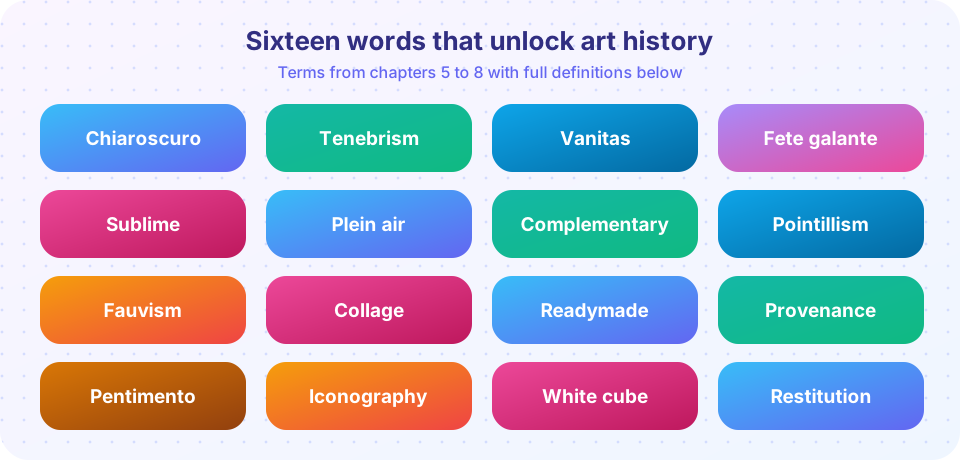
How to use this glossary
- Read once, quickly. You are mapping the vocabulary, not memorizing it.
- Use the terms in your own sentences. Terms stick when you use them to describe a work.
- Group them. Styles, techniques, methods and institutions form natural clusters.
- Return to the lesson. The glossary gives a short definition; the lesson gives the examples.
A to Z
| Term | Definition | Lesson |
|---|---|---|
| Abstract art | Art that does not depict recognizable things from the visible world | Cubism and abstraction |
| Analytic Cubism | The first Cubist phase (about 1909 to 1912): fragmented forms in browns and grays | Cubism and abstraction |
| Arabesque | A repeating pattern of curving, interlacing vines or plant forms | Global traditions |
| Attribution | Naming the artist or workshop responsible for a work | Attribution and provenance |
| Automatism | Making marks without conscious control, used by Surrealists | Cubism and abstraction |
| Avant-garde | "Advance guard": artists seen as pioneers pushing the boundaries of art | Chapter 6 overview |
| Baroque | A dramatic, emotional style of about 1600 to 1750 with strong light and movement | Baroque drama |
| Chiaroscuro | Modelling forms with gradual contrasts of light and dark | Baroque drama |
| Collage | A work made by sticking real materials, such as paper or fabric, onto a surface | Cubism and abstraction |
| Complementary colors | Opposite colors on the wheel that intensify each other | Impressionism |
| Conceptual art | Art in which the idea matters more than the finished object | Postwar art |
| Connoisseurship | Attribution and judgment based on long, trained looking | Attribution and provenance |
| Counter-Reformation | The Catholic Church's response to Protestantism, including reform of religious art | Baroque drama |
| Dada | An anti-art movement born in 1916 in reaction to the First World War | Cubism and abstraction |
| Dendrochronology | Dating wood by matching its tree rings to known sequences | Attribution and provenance |
| Deaccession | A museum's formal removal of an object from its collection | Theories and museums |
| Expressionism | Art that distorts form and color to express feeling | Post-Impressionism and Expressionism |
| Fauvism | Short-lived movement (about 1905 to 1908) of bold, unnatural color; "wild beasts" | Post-Impressionism and Expressionism |
| Fete galante | A scene of elegant people courting in a park, invented by Watteau | Rococo and Neoclassicism |
| Formal analysis | Interpreting a work through its line, shape, color, light and composition | Theories and museums |
| Genre painting | Pictures of everyday life | Dutch Golden Age |
| Gaze | A way of asking who looks and who is looked at, with attention to power | Theories and museums |
| Iconography | The study of subjects, symbols and conventions in images | Theories and museums |
| Impasto | Thick paint that stands out from the surface | Post-Impressionism and Expressionism |
| Impressionism | Painting the fleeting effects of light and atmosphere, from the 1860s | Impressionism |
| Land art | Art made in or with the landscape | Postwar art |
| Minimalism | Art reduced to simple geometric forms, often industrial materials | Postwar art |
| Neoclassicism | A style from about 1760 to 1830 reviving the forms and seriousness of antiquity | Rococo and Neoclassicism |
| Optical mixing | The eye blending separate touches of color into one | Impressionism |
| Pentimento | A visible trace of an earlier idea beneath the final paint | Attribution and provenance |
| Performance art | Art in which the artist's actions are the work | Postwar art |
| Plein air | Painting outdoors in front of the subject | Impressionism |
| Pointillism | Painting with small distinct dots of pure color | Post-Impressionism and Expressionism |
| Pop Art | Art that uses imagery from advertising, comics and consumer goods | Postwar art |
| Post-Impressionism | Artists who built on Impressionism but moved beyond it | Post-Impressionism and Expressionism |
| Primitivism | Western artists' use of non-Western art as raw inspiration, often without credit | Cubism and abstraction |
| Provenance | The documented chain of ownership of an object | Attribution and provenance |
| Quadratura | Painted architecture that merges with real architecture to create illusion | Baroque drama |
| Readymade | An ordinary manufactured object chosen and presented as art | Cubism and abstraction |
| Restitution | Returning cultural objects to the communities or states they were taken from | Theories and museums |
| Rococo | A light, ornate, pastel style beginning in France around 1715 | Rococo and Neoclassicism |
| Romanticism | A movement of about 1790 to 1850 that put feeling, imagination and the individual first | Romanticism |
| Ruckenfigur | A figure seen from behind who invites the viewer into the scene | Romanticism |
| Salon | The official Paris exhibition; also fashionable rooms or gatherings | Impressionism |
| Still life | A picture of arranged objects such as flowers, food and glass | Dutch Golden Age |
| Sublime | An experience of awe mixed with fear before something vast | Romanticism |
| Surrealism | A movement of the 1920s onward using dreams, chance and the unconscious | Cubism and abstraction |
| Synthetic Cubism | The later Cubist phase (from about 1912): flatter shapes, bright color, collage | Cubism and abstraction |
| Tenebrism | Extreme chiaroscuro with most of the picture in darkness | Baroque drama |
| Tronie | A Dutch study of a head or character type, not a portrait | Dutch Golden Age |
| Ukiyo-e | Japanese woodblock prints of the "floating world" | Global traditions |
| Vanishing point | The point on the horizon where receding parallel lines appear to meet | Dutch Golden Age |
| Vanitas | A still life reminding viewers that life is short and wealth is fleeting | Dutch Golden Age |
| White cube | A modern gallery style of white walls and even light | Theories and museums |
Study with the flashcards
Press Run (or Ctrl + Enter) to see the result here.
Program input · what you'd type while the program runs
Type the answers before you press Run, one per line. Each time the program reads a line (with input()), it gets the next line from this box.
Words with more than one meaning
A few terms in this glossary shift meaning with context, and exams often test that. "Salon" can mean the official Paris exhibition, a fashionable gathering or a style of crowded hanging. "Genre" can mean a category of art or, specifically, scenes of everyday life. "Modern" can mean recent, or Modernism as a family of movements, and "contemporary" usually means art since about 1970 in museum practice. When you meet a term in a new text, check how the author is using it, and say which sense you mean in your own writing.
Common misconceptions
"Terms like Baroque or Impressionism were chosen by the artists." Many labels were coined by critics, sometimes as insults (Baroque, Impressionism, Fauvism, Cubism), and later accepted.
"Every artwork belongs in exactly one box." Artists overlap and move between movements, so use terms as handles, not cages.
"The glossary is the lesson." A definition only starts the work: you need examples and your own looking.
Try it
In the flashcards, turn on quiz mode and test yourself on ten terms. Write down the three you missed. Next, use each missed term in a sentence about a specific work from this course.
Check your understanding
Quick check · 5 questions
of 5 answered You scored / 5 · perfect!
-
1. A vanitas is:
Skulls, hourglasses and snuffed candles are common symbols. -
2. Which term means a trace of an earlier idea beneath the final paint?
Pentimenti show where the artist changed their mind. -
3. 'Avant-garde' literally means:
It comes from French military language. -
4. Which pair of terms both describe the use of light and dark?
Tenebrism is an extreme form of chiaroscuro. -
5. What is a tronie?
Girl with a Pearl Earring is a tronie.
Summary
- The glossary gathers more than fifty terms from Baroque art to museum ethics.
- Many labels began as critics' insults and were later adopted.
- Learn terms by using them in sentences about specific works.
- Quiz yourself with the flashcards and the quiz generator.
Track your progress
Create a free account to tick off lessons and pick up where you left off on any device.
of Art History lessons completed