


















Lesson 34 of 49 · Impressionism to Modernism
Cubism, abstraction, Dada and Surrealism
How Picasso and Braque broke the single viewpoint, how artists left recognizable subjects behind, and how Dada and Surrealism attacked reason itself.
Between 1907 and the late 1930s, artists asked questions that would have sounded absurd a century before. Does a picture have to look like anything at all? Can a painting show an object from five sides at once? Can a factory-made toilet be art? Can a dream be a subject? This lesson follows four linked answers: Cubism, abstraction, Dada and Surrealism, and gives you tools for describing each one without just calling it "weird".
What you will learn
- How Cubism broke the single viewpoint and what collage added.
- How abstract artists reached non-representational art by different routes.
- Why Dada appeared during the First World War and what Duchamp's Fountain claimed.
- How Surrealism used dreams, chance and the unconscious, and how Picasso's Guernica shows modern art as political protest.
Key terms
Cubism: a style developed by Pablo Picasso and Georges Braque from about 1907 to 1914 that shows objects broken into planes seen from several viewpoints.
Collage: from French coller, "to glue": a work made by sticking real materials such as newspaper or wallpaper onto a surface.
Abstract art: art that does not depict recognizable things from the visible world, using shape, line and color on their own terms.
Readymade: Marcel Duchamp's term for an ordinary manufactured object selected and presented as art.
Automatism: making marks without conscious control, a Surrealist method for tapping the unconscious.
Cubism: many views at once
In 1907 Picasso painted Les Demoiselles d'Avignon, a large canvas of five nude women whose faces and bodies are cut into angular planes. The work was shocking even to his friends. It draws on Cezanne's planes, on ancient Iberian sculpture, and on African and Oceanic objects Picasso saw in Paris museums. The use of these objects is now widely discussed: artists treated them as raw inspiration, often without knowing or crediting the makers or the objects' original purposes, an attitude critics call primitivism.
Picasso (1881 to 1973) and Georges Braque (1882 to 1963) then worked together so closely that, as Braque said, they were like mountaineers roped together. Their work falls into two broad phases:
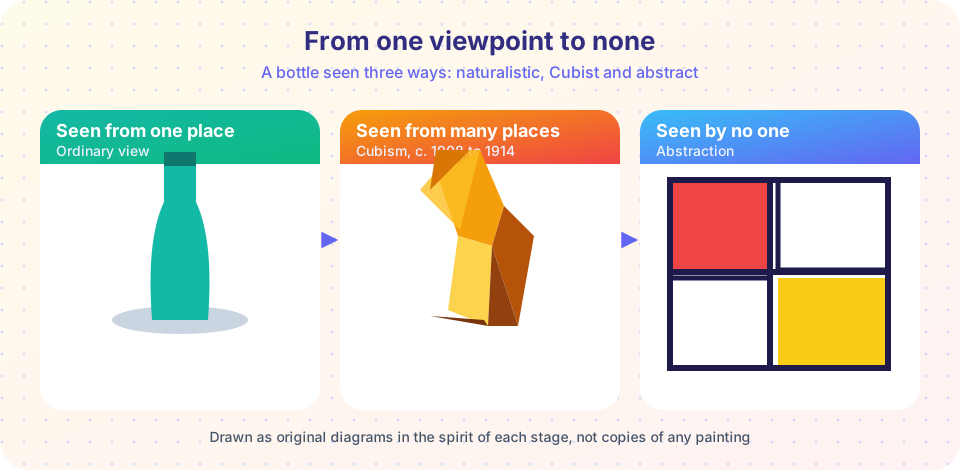
- Analytic Cubism (about 1909 to 1912): objects such as guitars, bottles and portraits are broken into many overlapping facets, in a restricted palette of browns, grays and ochres so that color does not distract from structure. The painter shows an object from the front, side and above at once.
- Synthetic Cubism (from about 1912): shapes become flatter and brighter, and real materials enter the picture. In Still Life with Chair Caning (1912), Picasso glued a piece of oilcloth printed with a chair-caning pattern onto the canvas, and framed it with a rope. The picture now contains a piece of the real world, and the line between art and the object blurred.
The critic Louis Vauxcelles, who named the Fauves, mocked Braque's paintings as full of "little cubes", and the name stuck.
Roads to abstraction
Artists reached abstraction by different routes, which is why no single "inventor" is easy to name.
- Wassily Kandinsky (1866 to 1944), a Russian painter in Munich, wrote Concerning the Spiritual in Art (1911), arguing that color and form can affect the soul as music does, without any story. His series of "Improvisations" and "Compositions" from about 1910 onward are often called the first widely exhibited abstract paintings; the exact date of his first is disputed.
- Hilma af Klint (1862 to 1944), a Swedish artist, began her large abstract Paintings for the Temple in 1906, guided by spiritual beliefs. She kept them mostly private; her will asked that they not be shown until twenty years after her death, and they reached a broad public only in the 1980s. Her case shows how a history of "firsts" can change when more evidence appears.
- Kazimir Malevich (1879 to 1935) exhibited Black Square in Petrograd in December 1915 and called his system Suprematism: the supremacy of pure feeling in painting. A black square on a white ground was both an ending and a beginning.
- Piet Mondrian (1872 to 1944) of the Netherlands reduced a tree into lines and planes over several years, and then made grids of black lines with red, blue, yellow and white rectangles. With Theo van Doesburg he founded the journal and movement De Stijl (1917), which sought universal harmony.
- Sonia Delaunay (1885 to 1979) and Robert Delaunay built abstract color circles and disks, a style called Orphism, and Sonia carried it into textiles, fashion and design.
Press Run (or Ctrl + Enter) to see the result here.
Program input · what you'd type while the program runs
Type the answers before you press Run, one per line. Each time the program reads a line (with input()), it gets the next line from this box.
Dada: a reaction to catastrophe
The First World War (1914 to 1918) killed millions. Some artists, writers and performers concluded that the reasonable, progress-loving culture that produced the war deserved ridicule. In 1916 a group around Hugo Ball opened the Cabaret Voltaire in neutral Zurich with nonsense poetry, noise music and masks. They called it Dada, a word whose origin is debated. In Berlin, Hannah Hoch used photomontage, cutting up magazines into satirical collages of politics and the "new woman". In Paris and New York, Marcel Duchamp (1887 to 1968) developed the readymade.
In 1917 a porcelain urinal signed "R. Mutt" was submitted to an open exhibition of the Society of Independent Artists in New York, titled Fountain. The committee refused to show it, and the original was lost; we know it mainly from a photograph by Alfred Stieglitz. The claim behind the joke is serious: an object becomes art through an artist's choice and through the context in which it is presented, not because of skilled hand-making. Some scholars have argued that the baroness Elsa von Freytag-Loringhoven, a poet and performance artist, may have had a hand in the work. The debate shows how attribution can change.
Surrealism: dreams and the unconscious
In 1924 the poet Andre Breton published the first Surrealist Manifesto, inspired by Sigmund Freud's theories of dreams and the unconscious. Surrealists used chance, dream images and automatic drawing to bypass rational control. There were two strands: automatist painters like Joan Miro, who allowed forms to emerge from free marks, and illusionist painters such as Salvador Dali, whose The Persistence of Memory (1931) renders melting watches with sharp realism so that the impossible looks convincing. Rene Magritte's The Treachery of Images (1929) paints a pipe and writes beneath it, in French, that this is not a pipe: it is a picture of one. Max Ernst invented new techniques such as frottage (rubbings). Meret Oppenheim made a teacup, saucer and spoon covered in fur (1936).
Women artists and Latin American artists were central but often overlooked in early accounts. Leonora Carrington, Remedios Varo and Dorothea Tanning made dreamlike, magical pictures. Frida Kahlo (1907 to 1954), who painted her own life, pain and Mexican identity, was claimed by Breton as a Surrealist, but she famously insisted that she painted her reality, not dreams.
Picasso's Guernica: modern art as protest
On 26 April 1937, during the Spanish Civil War, German and Italian aircraft supporting General Franco's forces bombed the Basque town of Guernica. Picasso, in Paris, painted Guernica in a few weeks for the Spanish Republic's pavilion at the 1937 Paris World's Fair. The huge canvas (about 3.5 by 7.8 meters) is entirely in black, white and gray. A screaming woman with a dead child, a gored horse, a fallen soldier, a bull and a lamp-bearing figure are packed into a fragmented space. The Cubist breaking of form, which began as a formal experiment, becomes a language of anguish. The painting later toured, spent decades in New York at Picasso's request, and returned to Spain after democracy was restored, and it is now in the Reina Sofia museum in Madrid.
Common misconceptions
"Cubism is about cubes." The name was a critic's quip. The aim was multiple viewpoints and flattened space.
"Abstract art needs no skill or meaning." Abstract artists worked out their systems of color, balance and rhythm very carefully, often with philosophical or spiritual aims.
"Dada was a style." It was closer to a protest attitude, expressed in many media.
"Surrealism was only about weird imagery." It was also a political and literary movement with manifestos, journals and arguments about freedom.
Try it
Fracture the bottle with 2 slices, then 12 slices, and decide how many slices it takes for the bottle to stop looking like a bottle. Then compare the four panels in the abstraction ladder: which element do you think carries the "idea" of a tree after the leaves are gone?
Check your understanding
Quick check · 6 questions
of 6 answered You scored / 6 · perfect!
-
1. What new element did Synthetic Cubism add to painting?
From 1912, Picasso and Braque added real pieces of the world to their pictures. -
2. Who made Black Square and founded Suprematism?
Kazimir Malevich showed Black Square in 1915. -
3. What did Duchamp's Fountain claim?
The readymade challenged the idea that skill in making defines art. -
4. Which year did Breton publish the first Surrealist Manifesto?
The manifesto appeared in 1924. -
5. Why was Guernica painted?
It was painted for the Spanish Republic's pavilion at the 1937 World's Fair. -
6. Hilma af Klint is notable because she:
Her spiritual abstractions were kept private and reached the public decades after her death.
Summary
- Cubism (Picasso and Braque) broke the single viewpoint; Synthetic Cubism added collage.
- Abstraction emerged from several routes, including Kandinsky, af Klint, Malevich, Mondrian and Delaunay.
- Dada answered the First World War with protest and the readymade.
- Surrealism used dreams and chance to explore the unconscious, with many women and Latin American artists central.
- Guernica shows modernist form used for political witness.
Next: Chapter 6 review
Track your progress
Create a free account to tick off lessons and pick up where you left off on any device.
of Art History lessons completed