


















Lesson 12 of 49 · Ancient and Classical Art
Chapter 3 Overview: Ancient and Classical Art
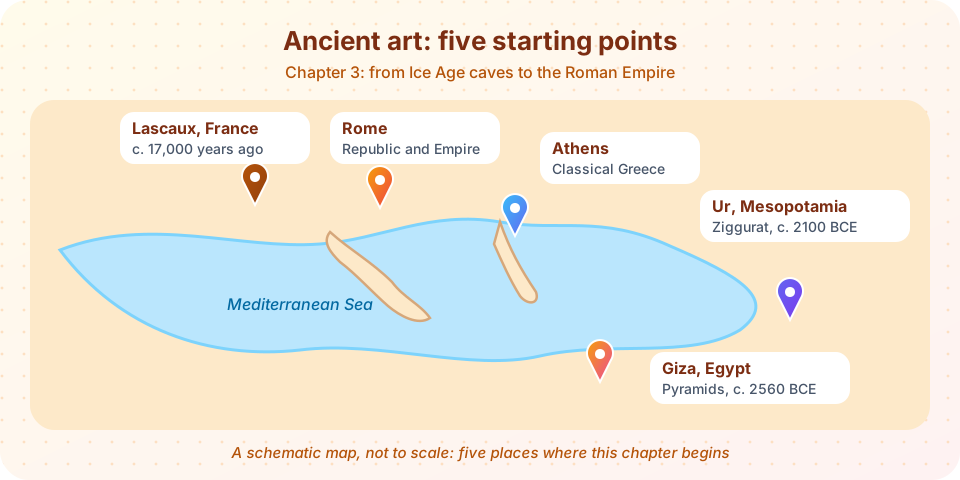
A map of ancient art from Ice Age caves through Mesopotamia, Egypt, Greece and Rome, with a time-zoom explorer and a guide to what each lesson covers.
For tens of thousands of years, people made images, objects and buildings long before anyone wrote a word. Then, from about 3500 BCE, the first cities appeared along rivers in Mesopotamia and Egypt, and with cities came kings, priests, scribes, armies and monuments. Art took on new jobs: to house gods, to glorify rulers, to guard the dead and to keep records. Over the next four thousand years, the cultures around the Mediterranean developed some of the most influential visual traditions in history.
This chapter covers that span in four lessons: the first art and the cities of the Near East, Egypt, Greece and Rome. Each lesson asks the same questions you practiced in chapter 2: what is it made of, how is it arranged, what job did it do and what did it mean to the people who made and used it?
What you will learn
- The order and rough dates of the main ancient traditions.
- What each lesson in this chapter covers.
- How to think about "classical" and "ancient" as labels.
- How far apart in time these cultures really were.
Key terms
- Ancient: in art history, the cultures from the first cities (about 3000 BCE) to the end of the western Roman Empire (476 CE).
- Classical: strictly, the art of Greece and Rome; also used for a period of Greek art, about 480 to 323 BCE.
- Neolithic: the late Stone Age, when farming and settled villages began.
- BCE and CE: "before the common era" and "common era", the same years as BC and AD.
- Artifact: any object made by humans.
The chapter at a glance
Before cities
The first cities
Egypt
Greece
Rome
Each culture asks a different question of art.
What each lesson covers
- Prehistoric and Near Eastern Art: Ice Age caves, small carved figures, megaliths, Sumer and the ziggurat, Babylon and Assyria.
- Egyptian Art: pyramids, tomb painting, the canon of proportion, Amarna and the treasures of Tutankhamun.
- Greek Art: the orders, the Parthenon, sculpture from archaic to Hellenistic and the painted vase.
- Roman Art: the portrait, concrete and the arch, the Colosseum and the Pantheon, Pompeii and the end of the empire.
- Chapter 3 Review: a single-page recap and a ten-question quiz.
How long a stretch is this?
From the Lascaux paintings (about 17,000 years ago) to the fall of the western Roman Empire in 476 CE is roughly 19,000 years, but the great majority of that is the long, slow prehistoric era. Between the building of the Great Pyramid (about 2560 BCE) and Cleopatra VII, the last active ruler of Ptolemaic Egypt, who died in 30 BCE, lie about 2,500 years. That is more than the time that separates Cleopatra from us. The Egyptian tradition that you will study in lesson three lasted so long that it saw the rise and fall of the whole Greek civilization. This is a good reminder that ancient cultures were not fixed "types"; they changed, borrowed and argued, just as modern ones do.
"Classical" and its problems
In everyday speech "classical" means old and excellent. In art history it is a narrower and more argued term. For centuries, European artists and writers treated Greek and Roman art as the standard of beauty, the "classics", from the Renaissance to the Neoclassicism of the late eighteenth century. That attitude shaped museum collections, school curricula and architecture: look at the columns on banks, courthouses and capitols around the world. But it has also encouraged people to measure other traditions against Greece and Rome and to find them lacking. In this course "classical" is a label for a place and time, not a value judgment.
When you read about any ancient culture, look for what the art was for. Egyptian tombs, Greek temples and Roman forums all look different because they answered different needs: eternal life, civic pride and imperial order.
Common misconceptions
"Ancient art was crude because it was early." Egyptian sculptors worked hard stone with copper and stone tools to extraordinary precision, and Greek and Roman builders solved problems of engineering that stood for millennia.
"Greek and Roman marbles were always white." Many were painted in bright colors that have worn off. Traces and modern research show that skin, clothing and details were often colored.
"Everything ancient is Greek or Roman." Persia, India, China, Africa and the Americas had flourishing artistic traditions in these centuries too; chapter 7 and the notes in later chapters return to them.
Try it
Check your understanding
Quick check · 4 questions
of 4 answered You scored / 4 · perfect!
-
1. Roughly when did the first cities appear in Mesopotamia and Egypt?
The earliest cities and states emerged around 3500 to 3000 BCE, bringing monumental art and architecture. -
2. How does this course use the word 'classical'?
The term describes a place and time. The Renaissance and later Neoclassicism admired it, but that admiration is a historical fact, not proof of superiority. -
3. What is true about the time between the Great Pyramid and Cleopatra VII?
About 2,530 years separate them (about 2560 BCE to 30 BCE). About 2,050 years separate Cleopatra from today. -
4. Which statement about Greek and Roman marble statues is best supported?
Traces of pigment and modern analysis show that painted decoration was common.
Summary
- Chapter 3 covers prehistoric and Near Eastern art, Egypt, Greece and Rome, in four lessons plus a review.
- Early art came long before writing; cities and kings brought monumental art with new jobs.
- The Egyptian tradition lasted about three thousand years, so the span between ancient cultures is huge.
- "Classical" names a place and time, not a ranking.
Track your progress
Create a free account to tick off lessons and pick up where you left off on any device.
of Art History lessons completed