


















Lesson 2 of 49 · Getting Started
What Is Art History?
Learn what art historians actually do, how the discipline began with Vasari, and how form, context and meaning work together to explain any artwork.
When you look at a painting, a temple or a chair, you can ask two very different kinds of questions. The first kind is personal: do I like it, and how does it make me feel? The second kind is historical: who made it, for whom, using what materials, and what did it do in the lives of the people who first met it? Art history is the discipline of the second kind of question. It does not forbid the first kind. It simply makes sure your reaction rests on knowledge rather than on guesses.
Art historians work like detectives with a long memory. They examine the object itself, read letters, contracts and diaries, study the places where works were made and used, and compare each object with thousands of others. This lesson explains the three basic lenses they use, the story of how the discipline began, and the kinds of evidence behind every confident statement you will read in this course.
What you will learn
- What art history is and how it differs from art criticism and art making.
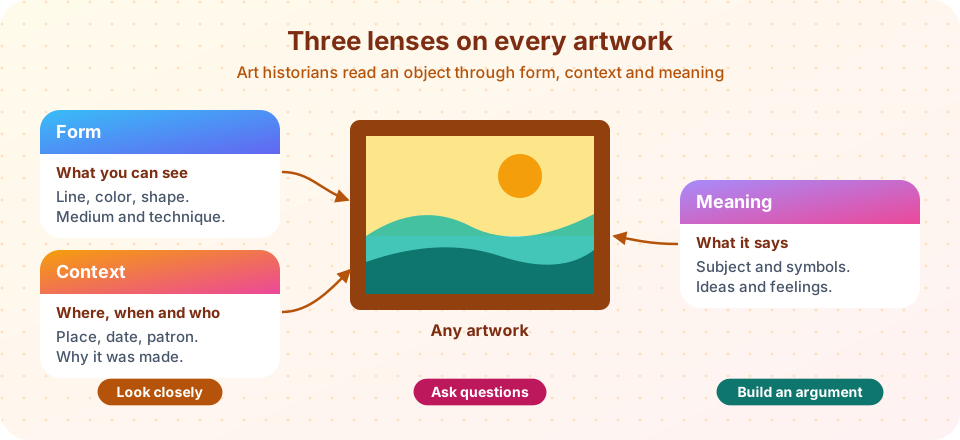
- The three lenses of form, context and meaning, and a question for each.
- How the discipline grew from Vasari to modern approaches.
- The kinds of evidence scholars use, and why attributions can change.
Key terms
- Formal analysis: describing and interpreting a work by its visible qualities, such as line, color, shape and composition.
- Iconography: the study of subjects and symbols, and what they meant in their time.
- Attribution: naming who made a work. It can be revised when new evidence appears.
- Patron: a person or group that commissions or pays for a work.
- Medium: the material and technique of a work, such as oil paint on canvas or carved marble.
Art history, criticism and making
Three activities are easy to confuse. Making art is what artists do. Art criticism judges contemporary work: is this exhibition good, does this novel image succeed? Critics write for the present and take sides. Art history studies works as evidence about the past, whether the past is the Ice Age or last decade. It tries to explain rather than to rank. Of course the three overlap. An art historian may admire what she studies, and a critic uses history to make a point. But the habits differ. A historian asks "what can I show from the evidence?" and a critic asks "what do I think of this?"
The first lens: form
Form is everything you can see in the object itself. Is it a painting, a sculpture, a building, a print, a photograph or an installation? How is it made? Which colors, lines and shapes dominate? How are objects arranged inside the frame? Chapter 2 gives you a full vocabulary for this lens. For now, remember the rule of the first minute: describe what is actually there before you decide what it means.
Form matters because artists make choices. A portrait where the face is lit sharply against a dark ground says something different from the same face in an even, bright light. A building with tall pointed windows leads the eye upward, while a long low building with a flat roof leads it sideways. Form is not decoration added to the "real" meaning. It is part of how the work means.
The second lens: context
Context is the web of circumstances around the work. Some questions are factual: Who made it? When and where? Who paid? Where did it hang, stand or sit? Others are about the world: what was happening politically, religiously, economically and artistically? What materials and skills were available?
Take a late medieval altarpiece. In its church it was seen by candlelight, above an altar, alongside prayers and music, by people who could mostly not read. In a museum today it hangs in a bright room at eye level with a label. Context changes how a work is read. Art historians try to reconstruct the original setting, and they also study the work's later life: the owners, the restorations, the moves between countries. That later story is called its provenance when it concerns ownership, and it matters for both scholarship and law.
The third lens: meaning
Meaning asks what the work says or does. Often this starts with subject matter. A woman holding a wheel and a palm branch in a Christian painting is Saint Catherine of Alexandria, because the wheel is the tool of her martyrdom. Study of such subjects and symbols is called iconography. A deeper question is how a work expresses the values of its culture, for instance how a Roman emperor's portrait tells viewers that he is calm, strong and legitimate.
Meaning is not a single hidden message. A work can mean one thing to the person who paid for it, another to the artist and another to a visitor five hundred years later. Good art history separates these layers. It says "in 1500 this likely signified..." rather than "it really means...".
How the discipline began
People wrote about artists long before art history existed as a subject. In the first century CE the Roman author Pliny the Elder included anecdotes about Greek painters and sculptors in his huge Natural History. The first great book that organizes artists into a story of progress is Giorgio Vasari's Lives of the Most Excellent Painters, Sculptors and Architects (first edition 1550, expanded 1568). Vasari told the history of Italian art as a rise from medieval clumsiness to the perfection of Michelangelo, his hero. The book is a goldmine of facts, gossip and bias, and scholars still read it carefully.
In 1764 the German scholar Johann Joachim Winckelmann published his History of the Art of Antiquity, which treated Greek and Roman art as a sequence of styles with their own rise and fall, a decisive step toward modern art history. In the nineteenth and early twentieth centuries scholars such as Heinrich Wölfflin (his Principles of Art History appeared in 1915) compared styles by their formal features, and Erwin Panofsky (for example, Studies in Iconology, 1939) developed careful methods for reading subjects and symbols.
From the 1970s onward, many historians added further questions. Social historians asked who paid and who profited. Feminist art historians, among them Linda Nochlin, whose 1971 essay "Why Have There Been No Great Women Artists?" became famous, asked how education, access and institutions shaped who was remembered. Postcolonial scholars questioned a story that centered on Europe and asked about collecting during empire. These approaches did not replace the older ones; they added more lenses.
What counts as art?
The word "art" as we use it today, meaning a special category of objects made to be admired, is relatively recent in Europe. In the eighteenth century writers such as Charles Batteux grouped painting, sculpture, music, poetry and dance as the "fine arts". Many cultures made beautiful and important objects without a separate word for art: a Greek vase to hold wine, a Tang tomb figure, a Navajo blanket. Art historians today study all of them. They also argue about the edges: whether a street photograph, a video game or a protest banner belongs in the story. The practical answer is that the discipline follows the evidence of what objects did for the people who made and used them, whether or not those people called it art.
Evidence: how we know what we know
Art historians combine several kinds of proof:
- The object: its shape, materials, tool marks and condition.
- Documents: contracts, account books, letters, inventories and diaries.
- Science: X-rays can reveal paintings under paintings, infrared reflectography can show underdrawing, tree-ring dating (dendrochronology) can date wooden panels, and pigment analysis can show when a color was first available.
- Comparison: matching brushwork, carving habits or architectural details with securely documented works.
Attributions can change. For decades a group of Dutch portraits was credited to Rembrandt; the Rembrandt Research Project, begun in the late 1960s, reexamined them and reassigned many to pupils and followers. This is not a failure of the discipline. It is how knowledge improves.
Whenever you read a confident claim about a work, ask: "What evidence is this based on?" A good textbook tells you. A great art historian can also tell you what would change her mind.
Common misconceptions
"Art history is just opinions." Interpretations differ, but they must be supported by evidence about form, context and meaning. Some claims can be checked and rejected, for example a date contradicted by tree-ring analysis.
"An artwork has one true meaning, the artist's intention." Artists' intentions matter, but patrons, audiences and later viewers also make meaning. Historians weigh all of them.
"Only famous paintings count." Everyday objects, buildings, prints and crafts often tell us more about ordinary people than masterpieces do.
Try it
Check your understanding
Quick check · 5 questions
of 5 answered You scored / 5 · perfect!
-
1. Which question belongs to the 'context' lens?
Context covers the circumstances of making and use: patron, place, date and setting. Colors and balance belong to form; symbols belong to meaning. -
2. What did Giorgio Vasari's Lives (1550) contribute to the discipline?
Vasari organized artists into a narrative of rise and perfection. It is a rich but biased source still used by scholars. -
3. Why can attributions of paintings change?
Attribution is a claim based on evidence. The reassessment of many 'Rembrandts' by the Rembrandt Research Project is a famous example. -
4. What is iconography?
Iconography identifies subjects and symbols, such as the wheel that marks Saint Catherine. -
5. Which statement best matches modern art history?
Modern approaches combine formal, iconographic, social, feminist and postcolonial questions, all tied to evidence.
Summary
- Art history explains works as evidence about the past; it differs from criticism, which judges, and from making.
- The three lenses are form (what you see), context (circumstances) and meaning (what it says or does).
- The discipline grew from Vasari and Winckelmann through Wölfflin and Panofsky to social, feminist and postcolonial approaches.
- Evidence comes from the object, documents, science and comparison, and attributions can change.
- "Art" is a historically specific word; scholars follow what objects did for their makers and users.
Next: Why People Make Art
Track your progress
Create a free account to tick off lessons and pick up where you left off on any device.
of Art History lessons completed