


















Lesson 40 of 49 · Methods, Museums and Projects
Chapter 8 overview: methods, museums and evidence
An introduction to how art historians work: close looking, documents, science, theories and museums, with a map of the chapter.
So far you have learned what artists made. This chapter explains how we know what we know. How can anyone tell who painted a picture, when it was made, whether it is a fake, who has owned it, and what it meant? Why do scholars disagree about so much? And what happens to an object once it enters a museum? Those questions belong to the method side of art history, and they are the skills that turn a visitor into a careful, confident reader of art.
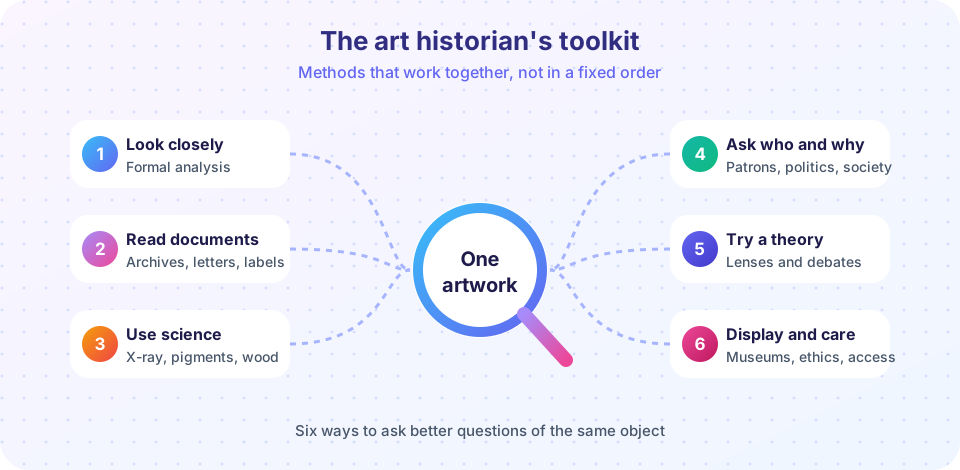
The big picture
An art historian is part detective, part writer and part critic. The work usually moves between four activities:
- Looking. Describing what is physically there: medium, size, composition, color, handling, condition.
- Evidencing. Gathering facts: archives, signatures, inventories, exhibition histories, scientific tests.
- Interpreting. Asking what the work meant to its first viewers, and what it means now, using one or more theoretical lenses.
- Presenting. Writing, curating and teaching in ways that others can check and use.
Look before you read
Find the evidence
Interpret with care
Museums and ethics
What each lesson covers
| Lesson | Questions it answers |
|---|---|
| Attribution, provenance and science | How do we decide who made something, when, and whether it is genuine? |
| Theories, museums and ethics | Which approaches interpret art, how do museums shape what we see, and what are the ethics of collecting? |
| Chapter review | A map and a quiz. |
Why methods matter
Consider an analogy. A scientist can tell you that water boils at 100 degrees Celsius at sea level. A historian can tell you that a painting was made in a particular decade. But in both cases the claim comes with evidence and a method, and good practice shows both. When you read a museum label ("attributed to", "workshop of", "c. 1650"), you are reading a compressed claim about evidence. Each hedge word carries meaning:
- "By" or no qualifier: scholars are confident the named artist made it.
- "Attributed to": probably by that artist, but not certain.
- "Workshop of" or "Studio of": made in the artist's workshop, perhaps with the master's involvement.
- "Circle of" or "Follower of": made by someone connected to or imitating the artist.
- "After": a copy of a known work.
Attributions change. A painting once treated as a masterpiece can be downgraded to a workshop copy, and a neglected canvas can be promoted. Good art historians welcome revision, because it means evidence is being tested.
A quick tour of the lessons
The attribution lesson turns you into a detective. You will use a pigment clock to test whether the colors found in a paint sample could exist at the date claimed for a painting, and you will see how weighted evidence can add up for or against an attribution. The theories lesson gives you a lens chooser: pick a famous work and a lens, and the tool suggests the kinds of questions that lens would ask.
These lessons are less about memorizing facts and more about getting into the habit of asking "how do we know?" That habit will serve you well beyond art history. It is the same attitude a good scientist, journalist or lawyer brings to a claim, and it makes you harder to fool. The chapter also stays honest about uncertainty: many of the most interesting questions in the field, from who painted a particular panel to what a museum should do with an object taken in a war, remain open.
Check your understanding
Quick check · 3 questions
of 3 answered You scored / 3 · perfect!
-
1. On a museum label, what does 'attributed to' usually signal?
'Attributed to' marks a probable but unconfirmed authorship. -
2. Which of these is NOT one of the four activities named in this overview?
The four are looking, evidencing, interpreting and presenting. -
3. Why might an attribution change over time?
Scientific analysis, archives and fresh comparison can all alter attributions.
Summary
- Art history combines looking, evidence, interpretation and presentation.
- Museum label wording such as "attributed to" and "workshop of" compresses claims about evidence.
- Attributions and interpretations change when new evidence or ideas appear.
- The next lessons cover attribution and science, then theories and museum ethics.
Track your progress
Create a free account to tick off lessons and pick up where you left off on any device.
of Art History lessons completed