


















Lesson 41 of 49 · Methods, Museums and Projects
Attribution, provenance and scientific analysis
How experts decide who made an artwork and whether it is genuine: connoisseurship, documents, provenance, X-rays, pigments and famous forgeries.
In 2017 a small painting of Christ holding a crystal orb, Salvator Mundi, sold at auction in New York for about 450 million US dollars, the highest price ever paid for a work of art at auction. Its buyer was told it was by Leonardo da Vinci. Some leading scholars agree. Others think it was largely painted by assistants, and extensive restoration makes judgment hard. The sale shows why the question of who made a work, and how we know, is worth a great deal of money and an even greater amount of scholarship. This lesson shows the tools professionals use.
What you will learn
- The difference between attribution, authentication and provenance.
- What connoisseurship can and cannot prove.
- How X-rays, infrared imaging, wood and pigment analysis help, and why pigments work as a clock.
- How famous forgers were caught, and what provenance gaps from 1933 to 1945 mean.
Key terms
Attribution: naming the artist or workshop responsible for a work.
Authentication: testing whether a work is what it claims to be (not a later forgery or copy).
Provenance: the documented chain of ownership of an object from its creation to the present.
Pentimento (plural pentimenti): a visible trace of an earlier idea beneath the final paint, where the artist changed their mind.
Dendrochronology: dating wood by matching its tree-ring pattern to known sequences.
Connoisseurship: the trained eye
For centuries, attribution depended on the connoisseur, an expert who has looked at thousands of works and recognizes an artist's hand. The Italian scholar Giovanni Morelli (1816 to 1891) argued that you should look not at the grand composition, which can be copied, but at small, unconscious habits, such as how a painter draws an ear, a fingernail or a hand. Bernard Berenson built a career on that kind of looking.
Connoisseurship is still essential, but it has limits. It is subjective, so experts disagree. A skilled workshop can imitate a master's habits. And experts have been fooled: in the 1930s and 1940s many respected authorities accepted forged paintings because they wanted them to be true. Today experienced eyes are paired with evidence that anyone can check.
Documents and provenance
Documents give hard facts. Contracts, letters, invoices, inventories, auction catalogues, exhibition labels, customs stamps and photographs can all link a work to a person and date. The sum of such records is the provenance.
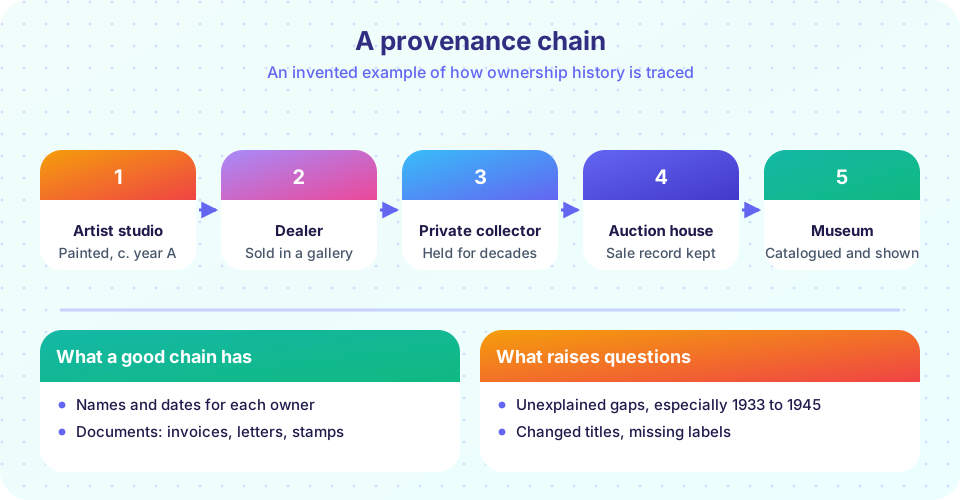
A complete chain does not guarantee authenticity, because documents can be forged or misapplied. But gaps and changes raise questions. Museums now scrutinize works with a gap between 1933 and 1945, since the Nazi regime seized or forced the sale of huge numbers of artworks from Jewish owners and others. In 1998 dozens of countries endorsed the Washington Principles on Nazi-Confiscated Art, which call for identifying such works and finding fair solutions with the rightful owners or heirs. The discovery of a large hidden collection in Munich in 2012, made public in 2013 (the Gurlitt collection), showed that the problem was far from over.
The laboratory
A modern examination uses several kinds of technical evidence.
- X-radiography shows dense materials such as lead white, revealing earlier compositions hidden beneath the surface, repairs, and the structure of a panel or canvas.
- Infrared reflectography sees through some paint layers to the underdrawing, which can show an artist's characteristic way of sketching.
- Dendrochronology dates the wood of a panel painting by matching tree rings. It gives the earliest possible date when the tree was felled, but not the date of painting; panels were usually seasoned for some years.
- Canvas and thread analysis can show whether a canvas came from a bolt of cloth also used by a known workshop.
- Pigment analysis uses microscopes and instruments such as X-ray fluorescence to identify chemical elements in paint. Because some pigments were invented at known dates, they work like a clock.
- Paint-layer and craquelure study examines cracks that form over time. Artificial ageing often looks different from natural cracks.
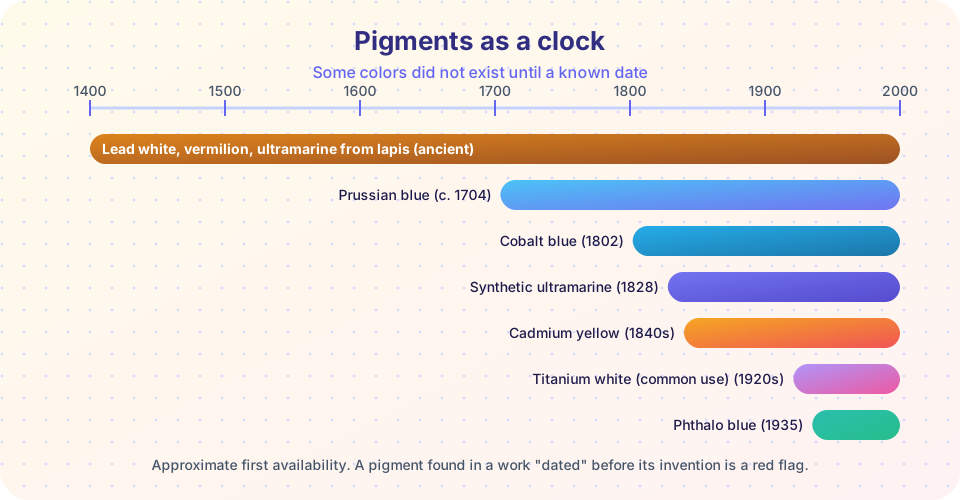
Notice the last sentence: a repair in the 20th century may legitimately contain modern pigments, which is why conservators map where the anachronism appears. Titanium white in the retouched corners of a 17th-century painting is normal; titanium white in the original paint is not.
Forgers and how they were caught
Han van Meegeren (1889 to 1947), a Dutch painter who felt his own work was neglected, made forgeries of Vermeer in the 1930s and 1940s. His Christ at Emmaus was bought for a major Rotterdam museum in 1938 after a leading Dutch expert declared it a masterpiece. After the Second World War he was arrested for selling a Dutch national treasure to the Nazi leader Hermann Goring. He confessed that it was a forgery, and in prison he painted another "Vermeer" to prove it. Later scientific analysis found modern materials he had used, including a synthetic resin to harden the paint and the pigment cobalt blue, which Vermeer could not have had in that form.
Wolfgang Beltracchi (born 1951), a German forger, produced paintings "in the manner of" artists such as Max Ernst and Heinrich Campendonk and invented plausible provenances for them. A laboratory test on one "Campendonk" found titanium white, a pigment that was not in common use in the period it was supposedly painted, and this helped uncover the scheme. He was convicted in 2011 and sentenced to six years.
The lesson of both cases is that forgers fail in the details: materials, aging, or the paperwork. But the first line of defense can be wishful thinking. People believed Van Meegeren's picture because it fitted a gap in what experts wanted to know about Vermeer.
Weighing evidence
Real attribution is a judgment that combines several kinds of evidence. The model below is a teaching toy: it assigns invented weights so you can see how a decision depends on how much each line of evidence is trusted. It is not a real authentication method.
Press Run (or Ctrl + Enter) to see the result here.
Program input · what you'd type while the program runs
Type the answers before you press Run, one per line. Each time the program reads a line (with input()), it gets the next line from this box.
Attribution is a living judgment
The Rembrandt Research Project, which started in the Netherlands in 1968 and worked for decades, sharply reduced the number of paintings accepted as by Rembrandt, then later scholars restored some. This is not a failure: it is science correcting itself. Each museum label is a current best judgment, and the language of the label ("attributed to", "workshop of") is how that honesty is expressed.
Common misconceptions
"A scientific test proves a painting is real." Tests can disprove (an anachronistic pigment) much more often than they can prove. A forger can use period materials.
"Forgers are always crude." Some are skilled. Van Meegeren fooled experts for years, partly through their own wishes.
"Provenance is just paperwork." It records ownership, and gaps can point to looting, theft or legal disputes.
"Dendrochronology gives the painting's date." It gives the earliest possible date from the wood.
Try it
In the pigment clock, set the date to 1650 and tick cobalt blue. Then set the date to 1850. What changes? Next, imagine the cobalt blue appears only in a corner of the painting: what explanation would you check first?
Check your understanding
Quick check · 5 questions
of 5 answered You scored / 5 · perfect!
-
1. What is provenance?
Provenance records who owned a work and when. -
2. Why does Morelli's method look at ears and fingernails?
Unconscious details can reveal an artist's hand better than the overall composition. -
3. What does dendrochronology establish for a panel painting?
It gives a terminus post quem, since wood was usually seasoned for years. -
4. Why is a gap in provenance between 1933 and 1945 significant?
Such gaps prompt checks for looting and forced sales. -
5. A painting dated 1650 contains synthetic ultramarine (1828) in its original paint layers. What is the best conclusion?
The pigment is an anachronism; further tests would check for later restoration.
Summary
- Attribution names the maker; authentication tests whether the work is genuine; provenance documents ownership.
- Connoisseurship is valuable but subjective, and best paired with documents and science.
- X-rays, infrared imaging, dendrochronology and pigment analysis provide checkable evidence; pigments act as a clock.
- Forgers such as Van Meegeren and Beltracchi were caught through materials and paperwork.
- Attributions are judgments that can change as evidence grows.
Track your progress
Create a free account to tick off lessons and pick up where you left off on any device.
of Art History lessons completed