


















Lesson 1 of 49 · Getting Started
Course Map: Your Route Through Art History
Who this art history course is for, what you need to start, how the nine chapters fit together, and how to study so that works of art stay in your memory.
Art history is the study of what people have made to be looked at, lived in, prayed to, worn, carried into battle or hung over a sofa, and of why they made it. It asks practical questions (what is this made of, and who paid for it?) and big ones (what did this image mean to the people who first saw it, and what does it mean to us now?). You do not need to draw, paint or own a passport to follow it. You only need to be willing to look slowly.
This course takes you from the painted caves of the Ice Age to the museums and biennials of the present. It is written for curious beginners: school students working toward art history, visual arts or humanities courses, adults who want to enjoy museums more, and anyone who has ever stood in front of a famous picture and wondered what the fuss was about. Every term is explained the first time it appears, every artist is introduced with a date and a reason to care, and each lesson ends with a short quiz.
What you will learn
- Who the course is written for and what you need before you start.
- How the nine chapters build on one another.
- Four study habits that make artworks easier to remember.
- How this course treats questions where experts disagree.
Key terms
- Artwork: an object, image, building or performance made with the aim of being looked at, used or remembered.
- Style: a recognizable set of choices in form, subject and technique shared by a group of works.
- Period: a stretch of time that historians group together because its art shares features. Periods are tools, not natural facts.
- Context: the circumstances around a work: who made it, for whom, where, when and why.
- Provenance: the recorded history of who has owned or held an object since it was made.
Who this course is for
The course follows the shared core of what students meet in introductory art history classes in many countries: the first-year survey at university, the art history options that appear in international school programs, and the visual-culture units of many school systems. You do not have to be enrolled anywhere to use it.
There are no prerequisites. If you can read a paragraph and look at a picture for a few minutes, you have all the skills you need. A reading habit helps; a visit to a museum helps even more, but the lessons are built so that every artwork you read about can be understood from the description and the diagrams, and you are always told where the full-color originals live so you can look them up. We describe works in words and in our own simplified drawings rather than reproducing them, so keep a browser tab open and search for the museum's own page when a lesson names a painting.
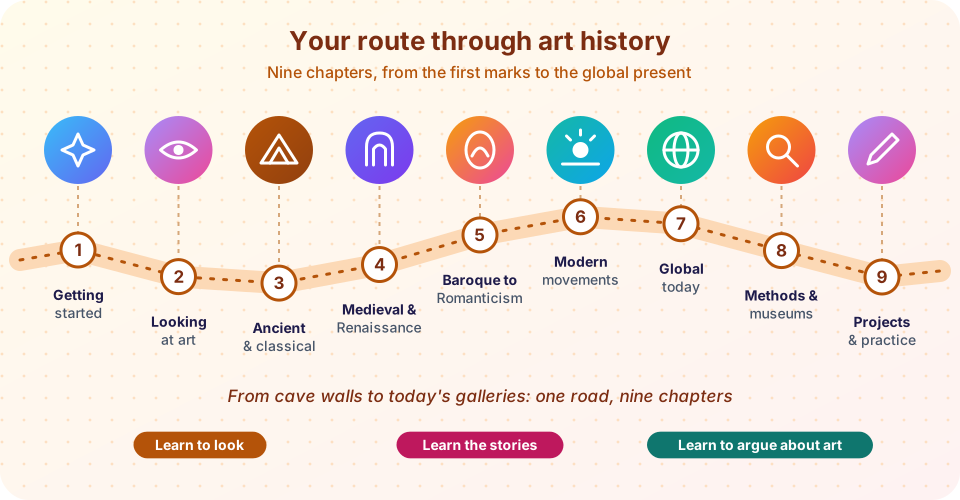
The nine chapters
Part 1: learn to look
- Getting Started
- Looking at Art
Part 2: the story of art
- Ancient and Classical
- Medieval and Renaissance
- Baroque to Romanticism
- Impressionism to Modernism
Part 3: the wider world
- Contemporary and Global
- Methods and Museums
- Projects and Practice
Each chapter opens with an overview and closes with a review quiz.
Chapters 1 and 2 give you the tools: a vocabulary for what you see and a method for turning a first glance into a careful analysis. Chapters 3 to 6 tell the story from the earliest known images to the early twentieth century, in roughly chronological order. Chapter 7 widens the lens to the present day and to traditions across the world. Chapters 8 and 9 show how scholars and museums work and give you projects of your own. If you are in a hurry you can jump to a period that interests you, but the vocabulary in chapter 2 will make every later lesson easier.
A word on "the canon". Most surveys, including this one, spend a lot of time on Europe because that is where the discipline of art history grew up, and because many museums and exams are organized around it. That is a historical accident, not a ranking of human creativity. Each chapter points out where other traditions run in parallel, and chapter 7 gives them the space they deserve.
Four study habits
- Describe before you decide. Spend a full minute describing an image in plain words (what is where, which colors, what is the biggest thing) before you say what it means. Your eyes will find more than your opinions would.
- Anchor every work to three facts. Who made it, roughly when, and what it is made of. With those three facts in memory you can place almost any work on the timeline.
- Compare, always. A work is easiest to understand next to another one: this Roman portrait against a Greek ideal, that Gothic window against a Baroque ceiling. Differences teach you faster than lists of features.
- Say it out loud. Explain a work to a friend in two minutes. Gaps in your understanding show up immediately.
How this course treats disagreement
Art history is full of live arguments: Was a painting really made by this artist, or by his workshop? Is a certain monument a victory celebration or a warning? Should museums return objects taken during colonial rule? Where scholars agree (a bridge was built in a given year), we state it. Where they do not, we give the best case for each side and say what evidence would settle it. The course will not tell you what to feel about a picture. It will show you how to look, how to find the evidence and how to build an argument you can defend.
Start a "looking notebook". Each time a lesson names a work, jot down its title, date and one sentence in your own words about what you noticed. By the end you will have a personal catalogue of a hundred works, which is more than many people carry in their heads after a full degree.
Common misconceptions
"Art history is memorizing names and dates." Dates and names are the coordinates on the map, but the real skill is reading what a work does and why. The quizzes check understanding rather than trivia.
"Old art is better, or modern art is a trick." Quality is a matter of how well a work does its job in its own setting. A Roman portrait bust and a Cubist still life were made to do different things, and each can be judged on those terms.
"You need to be an expert to have an opinion." An opinion backed by observation and evidence is a good start, whatever your background. This course shows you how to build one.
Try it
Check your understanding
Quick check · 4 questions
of 4 answered You scored / 4 · perfect!
-
1. Which habit does this course recommend doing first when you meet a new artwork?
Describing first slows you down and gives you evidence to work with before you form opinions or read other people's interpretations. -
2. What is a period in art history?
Periods are conveniences. Their names and edges are argued over, and traditions outside Europe often follow different divisions. -
3. Which pair describes how the first four chapters are organized?
Chapters 1 and 2 teach vocabulary and method; chapters 3 to 6 then walk through the story in roughly chronological order. -
4. Why does the course spend more time on Europe in the middle chapters?
The emphasis is a historical accident of how the discipline developed, not a ranking of creativity. Chapter 7 and the side notes widen the view.
Summary
- Art history studies works of art in their time, place and purpose, using careful looking and evidence.
- The course has nine chapters: tools, the story from ancient to modern, the wider world, and methods and projects.
- Describe first, anchor each work to who, when and what it is made of, compare constantly, and explain aloud.
- Contested questions are presented with the best case for each side.
Next: What Is Art History?
Track your progress
Create a free account to tick off lessons and pick up where you left off on any device.
of Art History lessons completed