


















Lesson 6 of 49 · Looking at Art
Chapter 2 Overview: Looking at Art
A map of chapter 2: the elements of art, composition, media and techniques, and the three steps from description to interpretation, with a one-minute looking exercise.
Most people look at a work of art for about as long as it takes to read its label. Studies of museum visitors have found that people often spend well under half a minute in front of a single work. Yet almost everything a work has to offer is found by slowing down. This chapter gives you a vocabulary and a routine for slowing down: names for the things you see, a way of thinking about how they are arranged, an understanding of how materials shape a work, and a method for moving from description to interpretation.
None of this requires talent. It is closer to learning the names of birds: once you know there is a difference between a warbler and a finch, you notice them everywhere. After this chapter you will notice line, color, balance and brushwork everywhere, and you will have words for them.
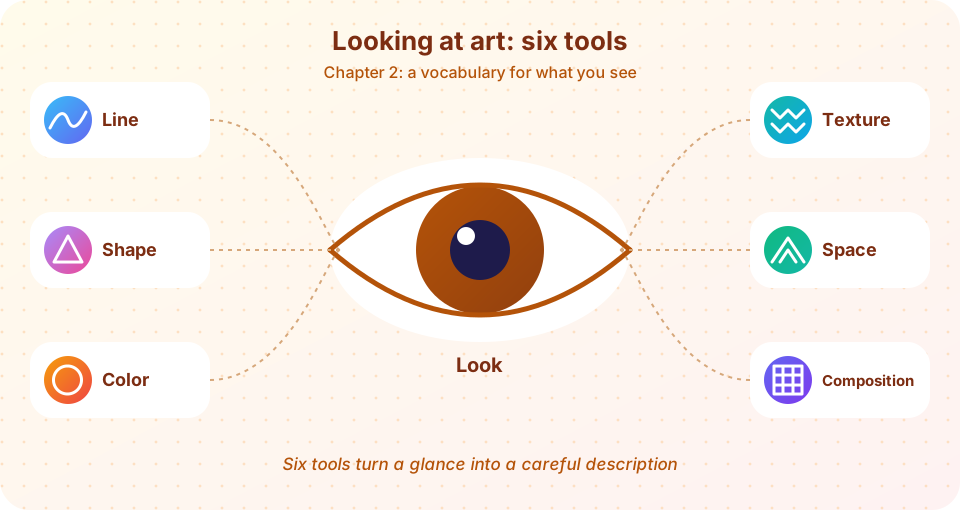
What you will learn
- What each lesson in this chapter covers and how they fit together.
- A one-minute routine for looking at any work.
- Why a vocabulary of form makes interpretation stronger, not weaker.
Key terms
- Formal qualities: the visible features of a work, such as line, color and composition.
- Composition: the way elements are arranged within the work.
- Medium (plural media): the material and technique used to make a work.
- Iconography: the study of subjects and symbols.
The chapter at a glance
The elements
Arranging them
Making it
Interpreting
Each step builds on the one before.
What each lesson covers
- The Elements of Art: line, shape, color, value, texture and space, each with examples from named works.
- Composition and the Principles of Design: balance, emphasis, rhythm, unity, scale and the common compositional patterns such as the triangle and the diagonal.
- Media and Techniques: fresco, tempera, oil, watercolor, stone, bronze, prints and photography, and how each shapes the look of a work.
- Formal Analysis and Iconography: Panofsky's three levels, the structure of a good analysis and how to avoid common traps.
- Chapter 2 Review: a one-page recap and a ten-question quiz.
The one-minute routine
You will refine this routine through the chapter, but here is the version to start with. Use it on the next picture you see.
- Ten seconds: gut reaction. What is your first impression? Note it. It is not wrong, but it is only a starting point.
- Twenty seconds: inventory. Name everything you see, from biggest to smallest. Where is the lightest area? The darkest?
- Twenty seconds: relationships. What is next to what? What leads your eye from place to place? Are things balanced or tilted?
- Ten seconds: question. Write down one question the picture raises: why is that figure so small, why does that corner glow?
Looking is a skill that improves with repetition. Ten one-minute looks at ten different works teach more than one ten-minute look at a single work.
Common misconceptions
"Analyzing a picture ruins it." Many teachers and visitors report the opposite: once you can say what a painting does, you find more to enjoy. Analysis adds layers; it does not have to subtract wonder.
"Formal analysis is just for abstract art." Every work, from a Roman bust to a movie poster, is made of formal choices. They matter in realistic work too.
"There is a right amount of time to spend." There is not. The goal is to look long enough that you notice something you did not notice at first.
Try it
Check your understanding
Quick check · 4 questions
of 4 answered You scored / 4 · perfect!
-
1. What is the main aim of the one-minute routine?
The routine builds the habit of careful looking: gut reaction, inventory, relationships, question. -
2. Which lesson in this chapter covers fresco, tempera and oil paint?
Media and Techniques discusses the materials and processes artists use. -
3. What do formal qualities include?
Formal qualities are the visible features of the work itself. -
4. Why does the chapter say analysis does not ruin a picture?
Attention and vocabulary let people see more, which usually deepens pleasure.
Summary
- Chapter 2 gives you a vocabulary (elements), an organizing sense (composition), an understanding of making (media) and a method (formal analysis and iconography).
- Start with the one-minute routine: reaction, inventory, relationships, question.
- Describing does not ruin enjoyment; it extends it.
Next: The Elements of Art
Track your progress
Create a free account to tick off lessons and pick up where you left off on any device.
of Art History lessons completed