


















Lesson 30 of 49 · Baroque to Romanticism
Chapter 5 review: Baroque to Romanticism
Review Baroque, Dutch Golden Age, Rococo, Neoclassical and Romantic art with a one-page picture, a recap table, flashcards and a ten-question quiz.
You have crossed 250 years of European art in four lessons. This review gathers the whole chapter on one page so you can spot patterns: each style answers the one before it, and each depends on who paid for the pictures and what the pictures were for. Use the illustration and table as a map, test yourself with the flashcards, then take the long quiz.
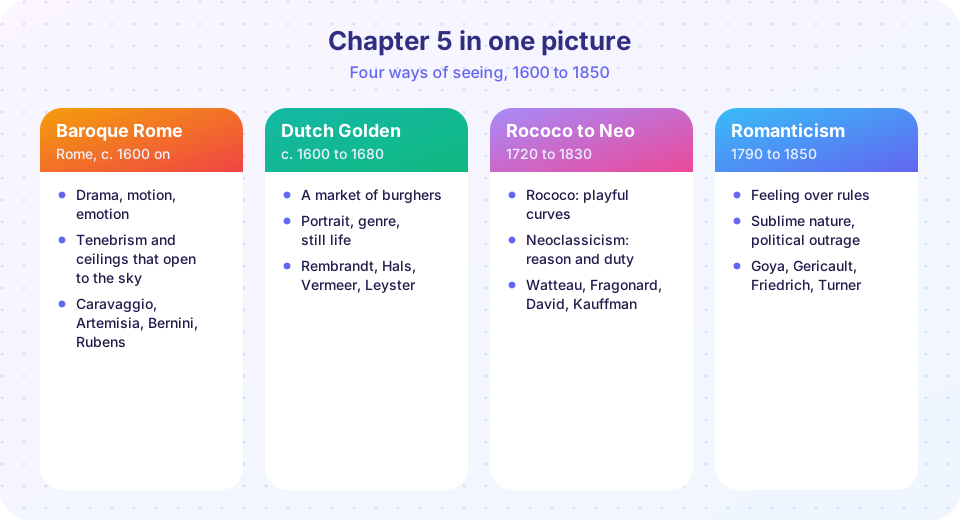
Recap table
| Movement | Dates (approx.) | Where | Patrons | Look and mood | Key names |
|---|---|---|---|---|---|
| Baroque | 1600 to 1750 | Rome, Flanders, Spain | Church, courts | Drama, motion, tenebrism | Caravaggio, Artemisia Gentileschi, Bernini, Rubens, Velazquez |
| Dutch Golden Age | 1600 to 1680 | Dutch Republic | Merchants, guilds, households | Portraits, interiors, landscapes, still life | Rembrandt, Hals, Leyster, Vermeer, Ruysch |
| Rococo | 1715 to 1780 | France, Germany, Venice | Aristocrats, the court | Curved, pastel, playful | Watteau, Boucher, Fragonard |
| Neoclassicism | 1760 to 1830 | France, Italy, Britain | State, Academy, collectors | Straight, hard light, civic virtue | David, Kauffman, Canova, Ingres |
| Romanticism | 1790 to 1850 | Europe, United States | Collectors, the public | Emotion, the sublime, protest | Goya, Gericault, Delacroix, Friedrich, Turner, Constable |
Five patterns to remember
- Light carries meaning. Spiritual and theatrical in Caravaggio, domestic in Vermeer, atmospheric in Turner.
- Patron shapes picture. Altarpieces in Catholic Rome, group portraits and still lifes in Amsterdam, salon decoration in Paris, public history paintings in revolutionary France.
- Each movement reacts. Rococo relaxed Baroque grandeur; Neoclassicism rebuked Rococo; Romanticism rebelled against Neoclassical rules.
- Women worked despite barriers. Gentileschi, Leyster, Ruysch, Kauffman and Vigee Le Brun built careers where women were excluded from many institutions.
- Names are tools, not boxes. Ingres, Chardin and Vigee Le Brun resist easy labels.
Press Run (or Ctrl + Enter) to see the result here.
Program input · what you'd type while the program runs
Type the answers before you press Run, one per line. Each time the program reads a line (with input()), it gets the next line from this box.
How the lessons connect
It helps to see the chapter as one conversation rather than four separate topics. The Baroque of Rome answered the Reformation: if Protestants doubted images, Catholic artists would make images that nobody could ignore. Caravaggio's dark rooms and Bernini's hidden window are two answers to the same demand for intensity. The Dutch Republic, meanwhile, removed that demand. With no altarpieces to paint, artists such as Vermeer and Ruysch turned to quiet rooms and flower pieces, and the market rewarded polish and specialization.
Rococo then reversed the grandeur of court Baroque into something small, private and playful. Neoclassicism, in turn, accused Rococo of frivolity and called for duty and reason, a message that suited the years before the French Revolution. Romanticism finally rejected both the rules of the Academy and the faith in reason: it argued that feeling, nature and individual vision mattered most. If you can tell this chain of reactions in your own words, with one example work for each link, you have the backbone of the chapter.
Compare and contrast prompts
Try writing three to five sentences on each pair. Name both works, pick two visual features, and say what the contrast reveals.
- Caravaggio's The Calling of Saint Matthew and Vermeer's The Milkmaid: two kinds of window light, one theatrical and one domestic.
- David's Oath of the Horatii and Fragonard's The Swing: public virtue against private pleasure.
- Gericault's Raft of the Medusa and Rembrandt's The Night Watch: a news story and a civic portrait, both turned into monumental drama.
Common exam traps
- Calling every dark painting "Caravaggio". Check for the specific features: a single strong source, ordinary models, a sharp diagonal.
- Treating Dutch pictures as simple copies of reality. Interiors were arranged and still lifes held moral messages.
- Using "Romantic" to mean "romantic". The movement is about feeling, imagination and nature in all their forms.
- Forgetting the women of the period. Gentileschi, Leyster, Ruysch, Kauffman and Vigee Le Brun each belong in an answer about the period's range.
Check your understanding
Quick check · 10 questions
of 10 answered You scored / 10 · perfect!
-
1. What does the Council of Trent have to do with Baroque art?
The Catholic Church wanted images that taught and moved believers. -
2. Which pair is correctly matched?
Bernini created the Cornaro Chapel with The Ecstasy of Saint Teresa. -
3. Why did Dutch painters sell mainly to private buyers?
Without church commissions, painters sold to a merchant market. -
4. Which is a typical Rococo trait?
Rococo is pastel, curved and playful. -
5. Who wrote that the highest art was Greek, marked by calm, noble simplicity?
Johann Joachim Winckelmann's 1755 essay shaped Neoclassical ideals. -
6. In which way was Goya's The Third of May 1808 unusual?
The lantern lights the victim, and the soldiers are faceless. -
7. A vanitas painting most often includes:
Skulls, hourglasses and snuffed candles are typical. -
8. What is the main compositional effect of a Ruckenfigur?
We stand where the figure stands and share their view. -
9. Which pair of artists were contemporaries working on landscape in different countries?
Constable (1776 to 1837) and Friedrich (1774 to 1840) overlap closely. -
10. Edward Said's Orientalism (1978) is relevant to which Romantic habit?
Said argued that Western art and writing often invented a distorted 'Orient'.
Summary
- Baroque, Dutch, Rococo, Neoclassical and Romantic art are best understood through patron, purpose and reaction.
- Light, scale and subject are the three fastest clues for identifying a style.
- Women artists worked across the whole period, often against institutional barriers.
- Every label hides exceptions, so always look at the individual picture.
Track your progress
Create a free account to tick off lessons and pick up where you left off on any device.
of Art History lessons completed