


















Lesson 28 of 49 · Baroque to Romanticism
Rococo and Neoclassicism: pleasure against reason
How the playful Rococo of the French court gave way to the severe Neoclassicism of the Enlightenment and revolution, with sorting game and palette plot.
The 1700s were an age of contrast. In the salons of Paris, painters decorated small rooms with pastel flirtations. A few decades later, the same city watched a painter show Roman fathers swearing to die for the republic, and critics cheered. Both styles belong to the same century and share some patrons, yet they could hardly look more different. This lesson sets them side by side so you can learn to tell them apart quickly, and understand why the taste changed.
What you will learn
- What Rococo is, where it began and what it was used for.
- Why Enlightenment thinking, archaeology and revolution produced Neoclassicism.
- How to compare the two styles by line, color, subject and scale.
- Who the main artists were, including women who built careers in both.
Key terms
Rococo: a light, ornate style that began in France around 1715, with curving, shell-like decoration (from the French rocaille), pastel color and playful subjects.
Fete galante: a "courtship party": elegant people flirting and picnicking in a park. Watteau invented the type.
Neoclassicism: a style from about 1760 to 1830 that revived the forms and moral seriousness of ancient Greece and Rome.
Salon: the official art exhibition of the French Academy, held in Paris, which also gave its name to the intimate rooms where Rococo art hung.
History painting: a large picture of a serious story from the Bible, myth or history, meant to teach.
Rococo: art for the salon
When Louis XIV died in 1715, the French court relaxed. Aristocrats moved from the grand halls of Versailles into smaller, cozier town houses in Paris. Those rooms needed decoration at a smaller, more intimate scale, and Rococo supplied it: mirrors framed with golden curls, paneling painted in cream and pale green, small paintings of lovers and goddesses.
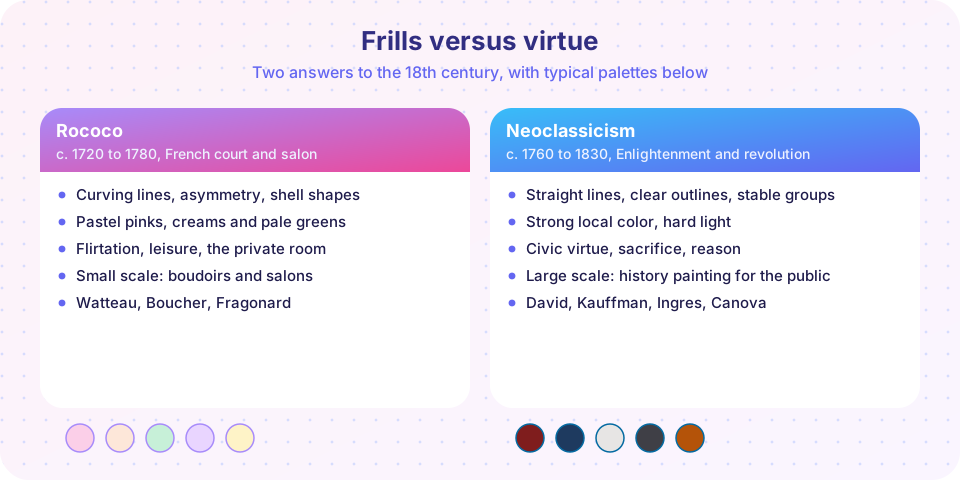
Antoine Watteau (1684 to 1721) invented the fete galante. His Pilgrimage to Cythera (1717) shows couples preparing to leave an island of love, and its mood is tender and slightly sad, because the party is ending. Francois Boucher (1703 to 1770), favorite painter of Madame de Pompadour, the king's official mistress, painted pink-skinned goddesses and cherubs. Jean-Honore Fragonard (1732 to 1806) painted The Swing (about 1767), in which a young woman on a swing kicks off her slipper toward an admirer hidden in the bushes while an older man (her husband or guardian) pulls the rope without noticing. It is witty, erotic and as light as whipped cream.
Rococo was international. In southern Germany and Austria, churches such as the pilgrimage church of Wies (built 1745 to 1754) fill white interiors with gold stucco and ceiling frescoes. In Venice, Giambattista Tiepolo painted airy ceilings in sunlit blue. In England, William Hogarth used a sharper, satirical version to show vice and folly in series such as A Rake's Progress (1733 to 1735).
Not everything in 1700s France was frothy. Jean-Baptiste-Simeon Chardin (1699 to 1779) painted kitchen tables and humble domestic tasks with great sober harmony. His quiet pictures are a reminder that "the 18th century" is bigger than any one style.
Why taste turned
Several forces pushed painters away from froth:
- The Enlightenment. Thinkers such as Voltaire and Diderot argued for reason, civic virtue and useful knowledge. A critic like Diderot, who reviewed the Salons from 1759 on, mocked Boucher's artificial pink bodies and praised pictures that taught moral lessons.
- Archaeology. Digging began at Herculaneum in 1738 and at Pompeii in 1748. For the first time, Europeans saw real Roman paintings, furniture and streets, not just ruins. Engraved books of the finds spread across Europe.
- The theory of Winckelmann. The German scholar Johann Joachim Winckelmann argued in 1755 that the highest art was Greek, marked by calm, noble simplicity. (He knew Greek art mainly from Roman copies, a limit modern historians point out.)
- Politics. As monarchies faced pressure and revolution loomed in France (1789), the heroic virtue of the Roman Republic looked like a fitting model for citizens.
Neoclassicism: art as a civic lesson
Jacques-Louis David (1748 to 1825) is the central painter. His Oath of the Horatii (1784) shows three brothers swearing to their father that they will fight for Rome, while the women of the family weep on the right. Look at the formula: a shallow stage like a relief sculpture, strong light, a hard outline around each figure, the arches of a plain Roman hall behind, and sharp straight lines. The men's legs form strong triangles, and the women's soft curves contrast with them. It is almost a diagram of "duty above feeling".
David joined the Jacobins in the French Revolution and voted for the king's execution. His Death of Marat (1793) shows the revolutionary journalist Jean-Paul Marat dead in his bath, murdered by Charlotte Corday, in a painting that turns a political killing into a secular pieta. After the Terror he became painter to Napoleon, whose coronation he recorded in an enormous canvas (1805 to 1807). His changing patrons remind us that style followed power.
Other Neoclassical artists worked in different media:
- Angelica Kauffman (1741 to 1807), Swiss-born, was a founding member of the Royal Academy in London (1768) and painted classical subjects, portraits and decorative schemes.
- Antonio Canova (1757 to 1822) carved smooth, polished marbles such as Psyche Revived by Cupid's Kiss (1787 to 1793), which combine ideal beauty with delicate emotion.
- Elisabeth Louise Vigee Le Brun (1755 to 1842) painted Marie Antoinette and many aristocrats with a soft, flattering touch that sits between Rococo and Neoclassical taste; she fled France in 1789 and worked across Europe.
- Jean-Auguste-Dominique Ingres (1780 to 1867), David's pupil, defended line over color, though his Grande Odalisque (1814) bends anatomy so freely that critics found it odd.
Neoclassicism shaped architecture too: the Pantheon in Paris (designed by Soufflot, built 1758 to 1790), and, in the United States, buildings such as the Capitol and Jefferson's Monticello used columns, domes and pediments to echo the republics of the ancient world.
Comparing the two styles
| Feature | Rococo | Neoclassicism |
|---|---|---|
| Line | Curving, flowing | Straight, clear contours |
| Color | Pastel and rosy | Strong local color, restrained |
| Subject | Love, leisure, myth as play | Duty, sacrifice, antiquity |
| Scale | Small, for salons | Large, for public viewing |
| Space | Airy, soft edges | Shallow stage, hard light |
| Mood | Playful, witty | Serious, heroic |
Press Run (or Ctrl + Enter) to see the result here.
Program input · what you'd type while the program runs
Type the answers before you press Run, one per line. Each time the program reads a line (with input()), it gets the next line from this box.
Common misconceptions
"Rococo is just late Baroque." It grows out of Baroque, but its scale, mood and purpose differ: it is intimate and playful where Baroque is monumental and spiritual.
"Neoclassicism copied the ancients exactly." Artists used antiquity selectively. David's Romans are filtered through modern ideas about citizenship, and Winckelmann's Greece was mostly known from Roman copies.
"The 18th century only had these two styles." Chardin's quiet realism, Hogarth's satire, Gainsborough's portraits and the early Romantic interest in the sublime all coexisted.
Try it
Play the sorting game until you can sort ten traits correctly without hints. Then look at the Python palettes and notice how the average lightness differs. Change a few hex values to build your own palette for a third style, and see how the number moves.
Check your understanding
Quick check · 5 questions
of 5 answered You scored / 5 · perfect!
-
1. Which painting shows a woman on a swing kicking off a slipper?
Fragonard's The Swing (c. 1767) is a famous Rococo image of playful flirtation. -
2. What event helped fuel interest in antiquity in the mid-1700s?
Digs from 1738 at Herculaneum and 1748 at Pompeii revealed Roman art and life. -
3. Which pair describes Neoclassicism?
Neoclassicism favored clear lines and moral seriousness. -
4. Who painted The Death of Marat?
David painted Marat's death in 1793 during the French Revolution. -
5. Which woman was a founding member of the Royal Academy in London?
Angelica Kauffman was among the founders in 1768.
Summary
- Rococo began in France around 1715: small-scale, curved, pastel art for salons and boudoirs.
- Enlightenment ideas, the digs at Pompeii and Herculaneum, and revolution pushed taste toward Neoclassicism.
- David's art teaches civic virtue with hard outlines and a stage-like space.
- Comparing line, color, subject, scale and mood is a reliable way to tell the two styles apart.
- Both styles had notable women artists, such as Kauffman and Vigee Le Brun.
Track your progress
Create a free account to tick off lessons and pick up where you left off on any device.
of Art History lessons completed