


















Lesson 42 of 49 · Methods, Museums and Projects
Theories, museums and ethics
Formalism, iconography, social history, feminist and postcolonial approaches, how museums shape what we see, and the ethics of collecting and returning art.
Two people can look at the same painting and ask completely different questions. One notices lines and colors. Another reads the symbols. A third asks who paid and who was left out of the picture. Art historians have names for these habits: formalism, iconography, social history, feminist and postcolonial criticism. They are not rival teams you must join, but tools you can pick up depending on the question. This lesson introduces five of those tools, then moves from the page to the gallery wall, asking how museums shape what you see and what ethical questions they face today.
What you will learn
- Five major ways of interpreting art and the questions each asks.
- Why every lens also has a blind spot.
- How museums arrange, light and label art, and how that affects meaning.
- What conservation, provenance and restitution debates involve.
Key terms
Formal analysis: describing and interpreting a work through its visual elements: line, shape, color, light, space, texture and composition.
Iconography: the study of subjects, symbols and conventions in images. Iconology interprets their deeper cultural meaning.
The gaze: a way of asking who is looking and who is being looked at; in art history it is often connected to gender and power.
White cube: the modern gallery style of white walls, even light and wide spacing that isolates each work.
Deaccession: when a museum formally removes an object from its collection.
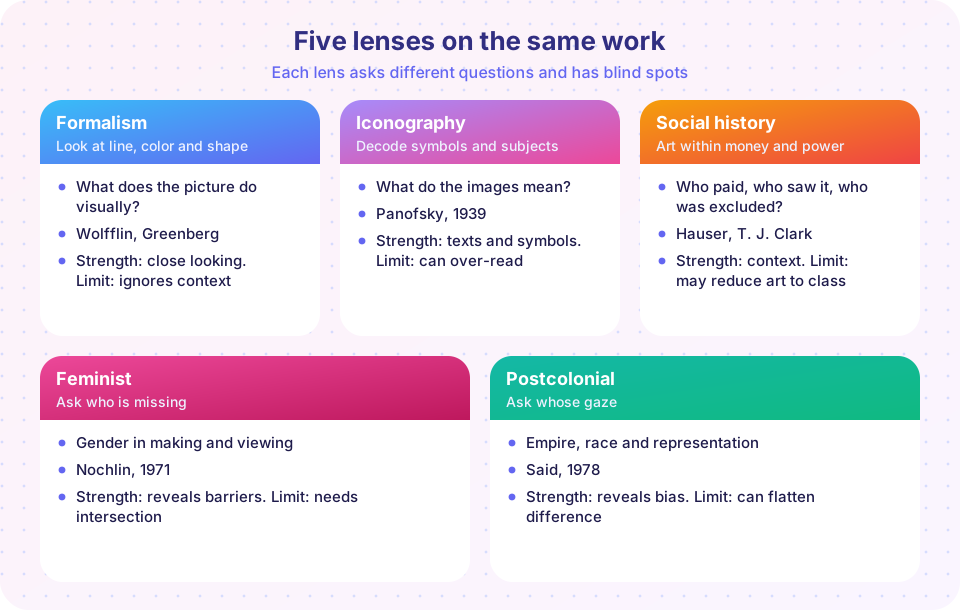
Five lenses
1. Formalism. Formal analysis asks what the picture does visually. The Swiss scholar Heinrich Wolfflin (1864 to 1945) in Principles of Art History (1915) compared Renaissance and Baroque art through five pairs of opposites, such as linear versus painterly (clear outlines versus blended masses) and closed versus open form. Later, the critic Clement Greenberg championed an influential formalist view of modern painting. The strength of formalism is disciplined looking. Its limit is that it can treat a work as if it were made in a vacuum.
2. Iconography and iconology. Erwin Panofsky (1892 to 1968) proposed in Studies in Iconology (1939) three levels of reading: first, describe the basic forms (a man with a lamb); second, identify the subject using texts and conventions (Saint John the Baptist); third, interpret what the image reveals about its culture. This approach is superb for symbol-rich art such as medieval and Renaissance work and Dutch still lifes. Its risk is over-reading, finding hidden meanings in every object.
3. Social history of art. This approach asks who paid, who made, who saw and who was excluded, and how money, class, religion and politics shaped the picture. Arnold Hauser wrote an early Social History of Art (1951). T. J. Clark applied the method to French painting around 1848. Michael Baxandall (1933 to 2008) in Painting and Experience in Fifteenth-Century Italy (1972) described the "period eye": the mental habits (measuring cloth, gauging barrels) that Italians brought to looking at pictures. The strength is context; the risk is reducing art to a mere product of its society.
4. Feminist art history. In her 1971 essay "Why Have There Been No Great Women Artists?", Linda Nochlin argued that the question assumed greatness was a natural gift, when institutions, education and social expectations had in fact blocked women. Later scholars such as Griselda Pollock studied how images construct femininity. The film theorist Laura Mulvey's 1975 idea of the "male gaze" was widely applied to paintings of nudes. Feminist approaches recover lost artists and ask how bodies are represented, but they also have to take account of race, class and sexuality, an approach known as intersectionality.
5. Postcolonial approaches. Edward Said's Orientalism (1978) argued that Western writing and art created a distorted idea of "the East". Art historians then asked how empire shaped what was collected, shown and valued, and whose gaze appears in pictures of colonized people. Strengths: it reveals bias in the standard story. Risks: it can flatten differences between cultures or treat artists as only victims or resisters.
Museums: the frame around the frame
A museum is not a neutral box. Where a work hangs, what stands next to it, how it is lit and what the label says all steer interpretation.
A short history. Private collections and "cabinets of curiosities" came first. Oxford's Ashmolean Museum opened to visitors in 1683. The British Museum was founded in 1753 and opened in 1759. The Louvre in Paris opened as a public museum in 1793, during the Revolution, in a former royal palace, and its collection grew with works taken from conquered lands during Napoleon's campaigns. The Metropolitan Museum of Art in New York was founded in 1870. Museums were often created as instruments of national pride and imperial display, an origin that explains many current disputes.
Display. In the 19th century, museums often covered walls with pictures from floor to ceiling, in dense "salon hangs". In the 20th, the Museum of Modern Art, under its director Alfred Barr, helped popularise a calm, white wall display with ample space. The critic Brian O'Doherty named this the white cube in 1976 and described how it makes art look timeless and separate from the world. A different hang can tell a different story: arranging works by theme, or putting a European painting beside an African sculpture, changes what visitors compare.
Access. Digital images and open-access policies (the Metropolitan Museum released hundreds of thousands of images for free use in 2017) have made collections widely visible, though a screen cannot show scale, surface or texture.
Press Run (or Ctrl + Enter) to see the result here.
Program input · what you'd type while the program runs
Type the answers before you press Run, one per line. Each time the program reads a line (with input()), it gets the next line from this box.
Ethics: conservation, ownership and money
Conservation. Conservators clean, stabilize and repair works. Their guiding principles include doing only what is necessary, using materials that can be reversed, and documenting everything. Even so, cleaning can spark debates. The cleaning of Michelangelo's Sistine Chapel ceiling between 1980 and 1994 revealed bright colors but also drew criticism from those who feared lost subtlety.
Ownership and restitution. Many museum objects entered collections during colonial rule, wars or looting. The Parthenon Marbles, removed from Athens by agents of Lord Elgin in the early 1800s and bought by the British Museum in 1816, are the most famous dispute: Greece asks for their return, the museum argues it holds them legitimately and shows them to a wide audience. Other cases are clearer; Nazi-looted works have been restituted to heirs, and several institutions have transferred Benin objects to Nigeria. Debates involve law (many national laws forbid removing objects from collections), moral responsibility, how to share objects through loans, and what communities want. There is no single answer, and honest discussion includes the objects' makers' descendants.
Money and sponsors. Museums depend on donors, ticket sales and sponsors. Several have faced protests about funding from fossil-fuel companies, and since about 2019 a number of institutions have removed the Sackler family name from galleries after lawsuits about opioid marketing. Critics ask who benefits from "artwashing", while supporters point out that public funding is limited.
Common misconceptions
"There is one correct interpretation." Evidence limits what is plausible, but many readings can be well supported.
"Formal analysis is neutral." What counts as 'good form' is shaped by culture and time.
"Museums just show art." They select, arrange and explain it, and their choices shape what viewers think.
"Restitution means museums will empty." Most debates involve specific objects with documented histories, and solutions include returns, shared custody and long-term loans.
Try it
Pick Guernica and run the lens chooser through all five lenses. Which lens produced the most useful questions for that work? Which produced the least? Then change the Python sample: add five works from a region of your choice and watch the chart change. What does that teach you about how a survey's contents shape its message?
Check your understanding
Quick check · 5 questions
of 5 answered You scored / 5 · perfect!
-
1. Which scholar proposed three levels of reading images in Studies in Iconology (1939)?
Panofsky described pre-iconographic, iconographic and iconological levels. -
2. What was Nochlin's 1971 argument?
She turned the question into one about structures, not innate ability. -
3. What is a 'white cube'?
The term was popularized by Brian O'Doherty in 1976. -
4. Which is a fair statement about the Parthenon Marbles?
Greece has requested their return; the British Museum argues for its legitimate holding. -
5. A weakness of the iconographic approach is:
Looking for symbols everywhere can produce unsupported readings.
Summary
- Formalism, iconography, social history, feminist and postcolonial approaches each ask different questions and each has a blind spot.
- Museums are not neutral: history, display and labels all shape meaning.
- Conservation is guided by minimal, reversible, documented treatment, yet still sparks debate.
- Restitution, provenance and funding raise ethical questions that museums are actively debating.
Next: Chapter 8 review
Track your progress
Create a free account to tick off lessons and pick up where you left off on any device.
of Art History lessons completed