


















Lesson 32 of 49 · Impressionism to Modernism
Impressionism: painting light and modern life
Why Impressionist painters left the studio, how they used color and light, and what their 1874 exhibition changed. With color-mixing demos you can run.
Imagine being laughed at for a painting of a harbor at sunrise. That is what happened to Claude Monet in 1874, and a mocking review gave a whole movement its name. Impressionism looks gentle to us now, with its water lilies and boating parties, but when it appeared it was a challenge to the art world: unfinished-looking surfaces, everyday subjects and colors that seemed too bright. This lesson explains what the Impressionists were really doing, and why it still matters for how we see.
What you will learn
- How the official Salon system worked and why a group of painters left it.
- What techniques the Impressionists used, and what ideas about light and color lay behind them.
- Who the main artists were, including Morisot and Cassatt.
- How to test their color ideas with two simple experiments.
Key terms
Salon: the huge official exhibition held in Paris, controlled by a jury from the Academy. Getting in meant sales and fame.
Impressionism: a movement beginning in Paris in the 1860s and 1870s that painted fleeting effects of light and atmosphere, often outdoors, with quick visible brushstrokes.
Plein air: painting outdoors in front of the subject.
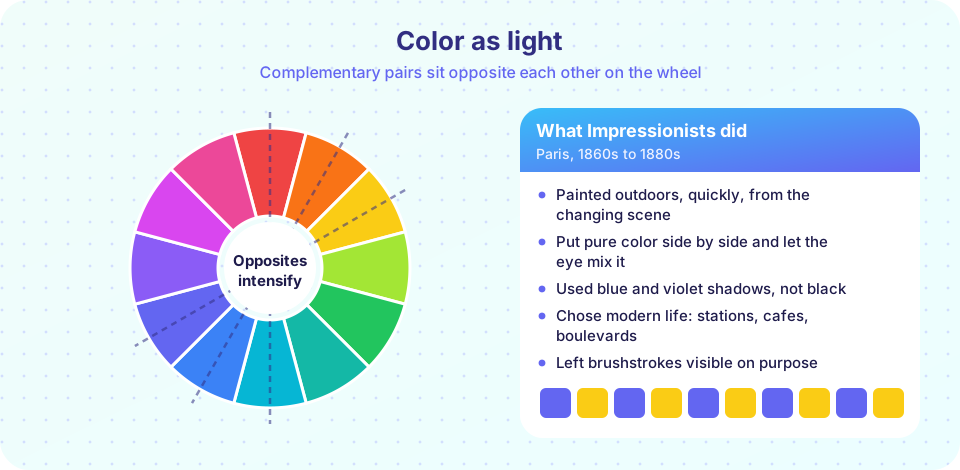
Complementary colors: pairs on opposite sides of the color wheel (for example blue and orange, red and green, yellow and violet) that make each other look more intense side by side.
Optical mixing: the eye blending small separate touches of color into a single color from a distance.
The Salon and the rebels
In the mid-1800s, a painter's career depended on the Salon. The jury favored polished, smooth surfaces and elevated subjects: history, myth, religion, and idealized nudes. In 1863 the jury rejected thousands of works, and the public complained so loudly that Emperor Napoleon III allowed a separate Salon des Refuses ("Salon of the Rejected"). Edouard Manet's Luncheon on the Grass (1863) was shown there. It scandalized viewers: a naked woman sits calmly with two fully dressed men in contemporary clothes. It was not that nudes were forbidden; Salon nudes were mythical goddesses. This one was a modern Parisian woman who looks straight at you. Manet's Olympia (1863, exhibited 1865) caused an even bigger scandal for similar reasons.
Manet was a friend and inspiration of younger painters such as Claude Monet, Pierre-Auguste Renoir, Camille Pissarro, Alfred Sisley, Berthe Morisot and Edgar Degas, though he never exhibited with them. Tired of the jury, they organized their own show in April 1874 in the studio of the photographer Nadar. The critic Louis Leroy mocked it in a review and took the title of Monet's Impression, Sunrise (1872), a hazy view of the harbor at Le Havre, to call them "Impressionists". The group embraced the insult. They held eight shows between 1874 and 1886.
What changed in the paintings
Compare an Impressionist picture with a Salon painting and note these differences:
- Light and weather as subject. The Impressionists wanted to capture a moment under one kind of light. Monet painted the same haystacks in 1890 to 1891 and Rouen Cathedral in 1892 to 1894, in series, to show how light changed the same subject across hours and seasons.
- Visible brushwork. Instead of smooth blending, touches of paint remain separate. Up close the picture looks like a patchwork; from a distance it comes together.
- Colored shadows. Shadows are not gray or black but blue, violet or green, because shadows reflect the sky and surrounding color.
- Modern subjects. Trains in stations, crowded cafes, new boulevards, boating at the weekend, the theater. Baron Haussmann had rebuilt Paris with wide avenues between 1853 and 1870, and its streets became a subject.
- Cropped, asymmetrical compositions. Influenced by photography and by Japanese woodblock prints, which became fashionable after Japan opened to trade in the 1850s (a taste called Japonisme), Degas and others cut off figures at the frame edge as a snapshot would.
The science behind the paint
Several technical changes made this style possible. Paint in collapsible metal tubes, patented in 1841, allowed artists to carry colors outdoors; before that, paints were stored in pig bladders or ground by assistants in the studio. New synthetic and mineral pigments (cobalt blue, synthetic ultramarine, chrome yellow) gave brighter hues. And color theory, notably the French chemist Michel Eugene Chevreul's On the Law of Simultaneous Contrast of Colors (1839), showed that a color looks different depending on its neighbor. A gray looks warmer on a blue background, and a red looks more intense beside green. Painters turned that rule into a method.
The artists
Claude Monet (1840 to 1926) painted harbors, haystacks, poplars, cathedrals and, from the late 1890s until his death, the water-lily pond of his garden at Giverny. His late Water Lilies canvases fill whole rooms and nearly dissolve into pure color and surface.
Berthe Morisot (1841 to 1895) exhibited in most of the Impressionist shows, painting interiors, gardens and domestic life with fast, feathery strokes, as in The Cradle (1872). She was a founding force of the group, and in its time her work sold. Mary Cassatt (1844 to 1926), an American in Paris, joined at Degas's invitation in 1879 and painted mothers and children with strong design, as in The Child's Bath (1893). Both women had limits on where they could go (a respectable woman could not sit alone in a cafe), and their subject matter reflects their access, not a lack of ambition.
Edgar Degas (1834 to 1917) preferred the studio and the theater to open air. He painted ballet dancers and laundresses in pastel and oil, with unusual angles and cropping. Pierre-Auguste Renoir (1841 to 1919) painted sunlit sociable scenes such as Luncheon of the Boating Party (1880 to 1881). Camille Pissarro (1830 to 1903), the eldest, exhibited in all eight shows and mentored younger painters.
Press Run (or Ctrl + Enter) to see the result here.
Program input · what you'd type while the program runs
Type the answers before you press Run, one per line. Each time the program reads a line (with input()), it gets the next line from this box.
Reception, reality and limits
Impressionism was not an overnight success. Critics were harsh, sales were uneven, and several members were poor in the 1870s. By the 1880s dealers like Paul Durand-Ruel promoted the group and found buyers in France and the United States, and by 1900 the movement was widely admired. The story of the heroic outsiders is largely true, but it is also incomplete: Impressionists were mostly middle-class Parisians, they selected subjects of leisure and urban life, and they often left out industrial labour and colonial realities in the same city. Reading what a picture leaves out is as useful as reading what it shows.
Common misconceptions
"Impressionists painted blurry pictures because they could not draw." Most were trained draughtsmen. The loose handling was a decision to show light and atmosphere, not a lack of skill.
"They painted everything outdoors." Many finished canvases in the studio. Monet's late water lily panels were largely painted in his studio from his garden pond.
"Impressionism was a single style." Degas despised the label and painted indoors, Morisot's touch differs from Monet's, and Cassatt's strong outlines owe a lot to Japanese prints.
Try it
In the first demo, slide the hue and keep staring at the gray square: it will never change numerically, yet it seems to shift. In the second, set color A and color B to complementary pairs (blue and orange, red and green) and increase the blur: you should see them merge into a muted gray, which is why Impressionists placed complements side by side.
Check your understanding
Quick check · 5 questions
of 5 answered You scored / 5 · perfect!
-
1. Where was the first Impressionist group exhibition held in 1874?
They rented space in Nadar's former studio on the Boulevard des Capucines. -
2. Where does the name 'Impressionism' come from?
Louis Leroy's 1874 review made fun of the title, and the label stuck. -
3. Complementary colors are:
Opposites such as blue and orange intensify each other. -
4. Which invention helped painters work outdoors?
Tubes patented in 1841 made paint portable. -
5. Which artist did Edgar Degas invite to exhibit with the Impressionists in 1879?
Mary Cassatt, an American in Paris, joined at Degas's invitation.
Summary
- The Impressionists left the Salon system to show unfinished-looking, light-filled pictures of modern life.
- Their method used visible brushstrokes, colored shadows, and complementary colors that blend in the viewer's eye.
- Photography, Japanese prints, tube paint and color theory shaped the style.
- Morisot and Cassatt were central members, working with different access and subjects from the men.
- Impressionism was varied and has its own blind spots, such as leaving out industry and empire.
Track your progress
Create a free account to tick off lessons and pick up where you left off on any device.
of Art History lessons completed