


















Lesson 18 of 49 · Medieval and Renaissance Art
Chapter 4 Overview: Medieval and Renaissance Art
A map of European art from about 300 to 1600: Byzantine, Romanesque, Gothic, the Italian Renaissance and the Northern Renaissance, with a century slider to explore.
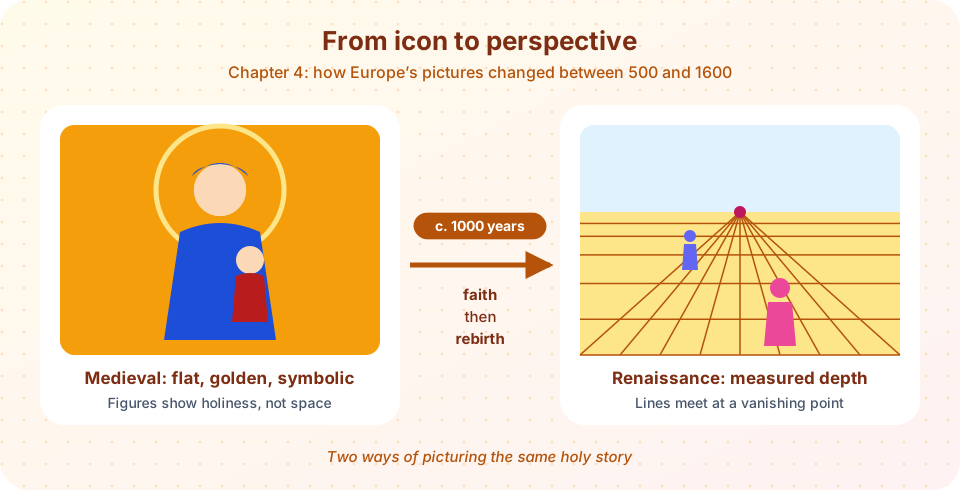
Between about 300 and 1600 CE, European art went through two of its most dramatic transformations. In the first, the Roman world became Christian, and artists learned to use gold, color and soaring buildings to show a heavenly order beyond the everyday. In the second, beginning in Italy around 1400, artists learned to place figures in believable space, to study the body and the natural world, and to sign their names. The two halves of this chapter belong together: you cannot see what the Renaissance changed without knowing what medieval artists were trying to do.
This is also the first chapter where art history begins to look like a conversation. Each generation answers the one before it. Giotto answers Byzantine icons, Masaccio answers Giotto, Leonardo answers Masaccio, and Michelangelo answers them all. It is also a chapter about the Church, the biggest patron of the age, and about the new classes of merchants, bankers and princes who started to compete with it.
What you will learn
- The order of the main styles from Early Christian to Northern Renaissance, with dates.
- How the goals of art changed between the medieval and Renaissance periods.
- What each lesson in this chapter covers.
- Why the word "Renaissance" needs care.
Key terms
- Medieval: of the Middle Ages, roughly 500 to 1400 in Europe.
- Byzantine: of the eastern Roman Empire, with its capital Constantinople, and its artistic tradition.
- Gothic: the style of European art and architecture from about 1150 to 1400, known for pointed arches.
- Renaissance: "rebirth," the revival of classical learning and art, beginning in Italy around 1400.
- Humanism: a movement that emphasized the study of classical texts and the dignity and potential of human beings.
The chapter at a glance
Faith and gold
Stone and light
Rebirth in Italy
Peak of the south
The North
Italy and the North changed art in different ways.
What each lesson covers
- Byzantine and Early Christian Art: catacombs, the first churches, Hagia Sophia, mosaics and icons, and the iconoclasm controversy.
- Romanesque and Gothic Art: pilgrimage churches, cathedrals, stained glass, sculpture and illuminated manuscripts.
- The Early Renaissance in Florence: Giotto, Brunelleschi's perspective, Masaccio, Donatello, Botticelli and the role of patrons.
- The High Renaissance: Leonardo, Raphael, Michelangelo and Venetian color.
- The Northern Renaissance: oil painting in the Netherlands, Dürer and printmaking, Holbein and Bruegel.
- Chapter 4 Review: a one-page recap and a ten-question quiz.
Why "Renaissance" needs care
The idea that Europe suddenly woke up from a "dark age" in 1400 is a story told by the Renaissance writers themselves, especially Vasari, and then amplified in the nineteenth century. It flatters the people who lived through it. Modern historians point out that the Middle Ages produced cathedrals, universities, algebra translated from Arabic, new agricultural methods and a flourishing poetry, and that many "Renaissance" ideas (classical revival, naturalism) appeared earlier, for instance in twelfth-century France or in Giotto's Italy. They also note that the Renaissance was not limited to Italy and was not good for everyone: it coincided with the rise of the slave trade, religious wars and expanding empires. The word is still useful as a label for a set of changes in art, but it is a label, not a verdict.
Whenever you compare a medieval and a Renaissance work, avoid saying the Renaissance one is "better" or "more advanced." Ask instead what each tried to do. A gold mosaic of Christ is not a failed attempt at perspective; it is a successful attempt at presenting holiness.
Common misconceptions
"Medieval artists could not draw realistically." Many did not aim to. Some medieval works, such as certain Gothic sculpture, show lifelike faces and drapery. The aim was often symbolic order.
"The Renaissance started in 1400 exactly." Change was gradual, with earlier roots and overlapping styles.
"All Renaissance art was Italian." The Netherlands, Germany and France had parallel flowerings, discussed in lesson five.
Try it
Check your understanding
Quick check · 4 questions
of 4 answered You scored / 4 · perfect!
-
1. Which pair correctly describes the change this chapter covers?
Medieval art often aimed to show holy order; Renaissance artists developed perspective and naturalism. -
2. Why does the course call 'Renaissance' a label rather than a verdict?
The term is useful, but its flattering story about an earlier 'dark age' is contested. -
3. Which lesson covers Leonardo, Raphael and Michelangelo?
The High Renaissance lesson covers them. -
4. What does humanism emphasize?
Humanism shaped Renaissance education and art.
Summary
- The chapter runs from Early Christian and Byzantine art to the Northern Renaissance (about 300 to 1600).
- Medieval art served faith with gold, stone and light; Renaissance art added perspective, anatomy and individual signatures.
- "Renaissance" is a label with a contested story; the Middle Ages were not a dark age.
- Each lesson answers a specific question about what artists were trying to do.
Track your progress
Create a free account to tick off lessons and pick up where you left off on any device.
of Art History lessons completed