


















Lesson 36 of 49 · Contemporary and Global Art
Chapter 7 overview: contemporary and global art
From Abstract Expressionism and Pop to conceptual art, and from Islamic geometry to Indigenous painting: how art became global after 1945.
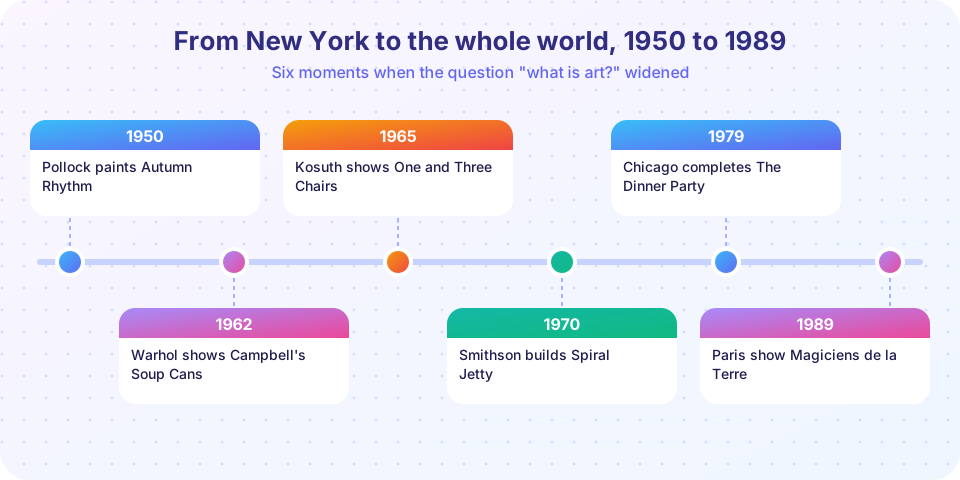
After 1945 the art world changed in two ways at once. Inside the Western story, artists kept asking what counts as art: a drip, a soup can, an idea written on paper, a performance with no object left behind. And outside the old center, people were insisting, more loudly each decade, that art had always been made everywhere, in traditions with their own rules and histories. This chapter does both jobs. It follows the postwar Western avant-garde to the edge of the definition of art, then widens the map to the long traditions and modern voices that the older textbooks left out.
The big picture
| Period | What was happening | Why it matters |
|---|---|---|
| 1945 to 1960 | New York becomes a major art center; Abstract Expressionism | Scale, gesture and feeling go global through the art market and museums |
| 1955 to 1970 | Pop Art, Minimalism, Conceptual art | Art engages with mass media, industrial materials and ideas |
| 1960 to 1980 | Performance, Land art, feminist art, video | Artists use the body, landscape, time and political critique |
| 1980 to today | Biennials, postcolonial critique, new media, restitution debates | The map of art history is redrawn |
After 1945: New York
Pop and idea art
Body and land
Many traditions
The global now
What each lesson covers
- Postwar art: from Abstract Expressionism to Conceptual art: the New York School, Pop, Minimalism, Conceptual, Performance, Land and feminist art.
- Global traditions and contemporary voices: Islamic, Chinese, Japanese, African, Mesoamerican and Indigenous Australian art, Mexican muralism, and artists such as El Anatsui, Kusama and Ai Weiwei.
- Chapter review: recap table and a ten-question quiz.
Three questions to bring with you
- Who decides what counts as art? Museums, critics, dealers, collectors, artists and communities all play a part, and their power is unequal.
- What is "contemporary"? Strictly it means made now, but in museums "contemporary art" usually means art since about 1970 and "modern" art means roughly 1860 to 1970. The boundary is a convention.
- Whose story is told? A history that shows only European and American artists is not neutral: it is a choice. This chapter tries to correct that by placing long non-Western traditions beside modern ones, not as footnotes.
Words such as "non-Western" and "global" are practical labels with problems: they define most of humanity by what it is not. Where possible, this chapter names specific cultures, regions and artists.
A quick tour of the lessons
The postwar lesson moves quickly through a half-century of experiments. It lets you follow a LeWitt-style instruction and watch how the same rule produces different drawings, which is the heart of the idea behind Conceptual art. The global lesson gives you a pattern maker for Islamic-style star polygons and explains, with a little number theory, why some stars close in one stroke and others break into several pieces.
Throughout, the chapter tries to keep two promises. First, it will be specific: it names cultures, regions, makers and works, not "the East" or "tribal art". Second, it will be honest about its own limits. One chapter cannot cover all of world art, so the traditions chosen here are examples and starting points for further reading, not a complete list. You will also meet questions that have no final answer, such as who should own the Parthenon Marbles or how to display an object made for ritual. Treat these as invitations to think carefully rather than puzzles with a single correct solution.
Check your understanding
Quick check · 3 questions
of 3 answered You scored / 3 · perfect!
-
1. Which city became the leading center of the art world after 1945?
Artists, dealers and museums made New York the center of postwar art, though not the only one. -
2. What does 'contemporary art' usually mean in museums?
It is a convention that varies by institution, but it usually points to the last half century. -
3. Why might a history that shows only European and American artists be misleading?
Leaving out other traditions is a choice that shapes what we think art is.
Summary
- After 1945 Western art moved from painting-centred modernism to Pop, Conceptual, Performance and Land art.
- At the same time, other traditions and voices challenged the idea that art history has one center.
- "Contemporary" and "modern" are conventions, not natural categories.
- This chapter combines the postwar avant-garde and long global traditions.
Next: Postwar art: from Abstract Expressionism to Conceptual art
Track your progress
Create a free account to tick off lessons and pick up where you left off on any device.
of Art History lessons completed