


















Lesson 9 of 49 · Looking at Art
Media and Techniques: Fresco, Oil, Marble, Bronze, Prints and Photographs
How materials shape art: fresco, tempera, oil, watercolor, carving, bronze casting, printmaking and photography, with a layer diagram and two interactive demos.
Every artwork is made of something, and the choice of material shapes almost everything about it: its look, its size, its cost, how long it lasts and who can afford it. A medium (plural media) is the material together with the technique used to work it. The phrase "oil on canvas" on a museum label is not decoration; it is evidence. It tells you how the painter could blend colors, how long the work took, how it can be transported and what its surface will look like in light.
This lesson tours the main media you will meet in the rest of the course, explains what each one lets an artist do, and gives you a habit: before interpreting any work, ask what it is made of and how that choice affected what you see.
What you will learn
- The main painting media and what makes each one distinctive.
- The difference between carving, modeling and casting in three dimensions.
- How prints and photographs allow multiples.
- Why the medium is part of the meaning of a work.
Key terms
- Support: the surface a work is made on, such as canvas, wood panel, paper or a wall.
- Pigment: powdered color. A binder such as egg yolk, oil or gum holds it together.
- Subtractive: made by removing material, as in carving. Additive: made by building up, as in modeling clay.
- Edition: a set of identical prints made from one matrix.
- Matrix: the plate, block or screen from which a print is made.
Painting: pigment plus a binder
All paint is pigment in a binder. Changing the binder changes the paint.
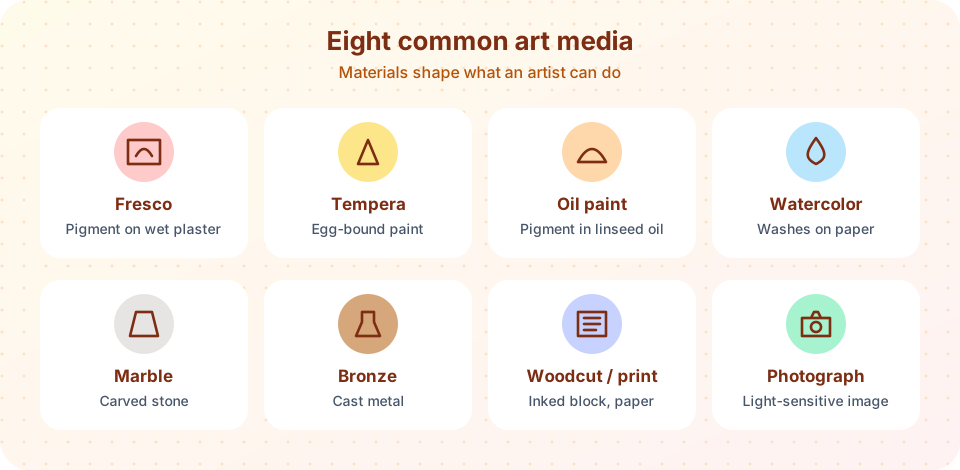
Fresco (Italian for "fresh") applies water-based pigment to wet lime plaster on a wall. As the plaster dries, a chemical reaction locks the color into the wall, which makes the picture very durable and part of the architecture. The painter must work in patches called giornate (day's work), because the plaster must stay damp. Giotto's frescoes in the Arena Chapel in Padua (about 1305) and Michelangelo's Sistine Chapel ceiling (1508 to 1512) are famous examples. Fresco does not allow slow blending or major corrections, which is why artists prepared large drawings first.
Tempera uses egg yolk as the binder. It dries fast and produces clear, bright colors, applied in thin strokes. It was the standard medium for panel painting in medieval and early Renaissance Europe. Botticelli's The Birth of Venus (about 1485) is usually described as tempera on canvas, an unusual combination.
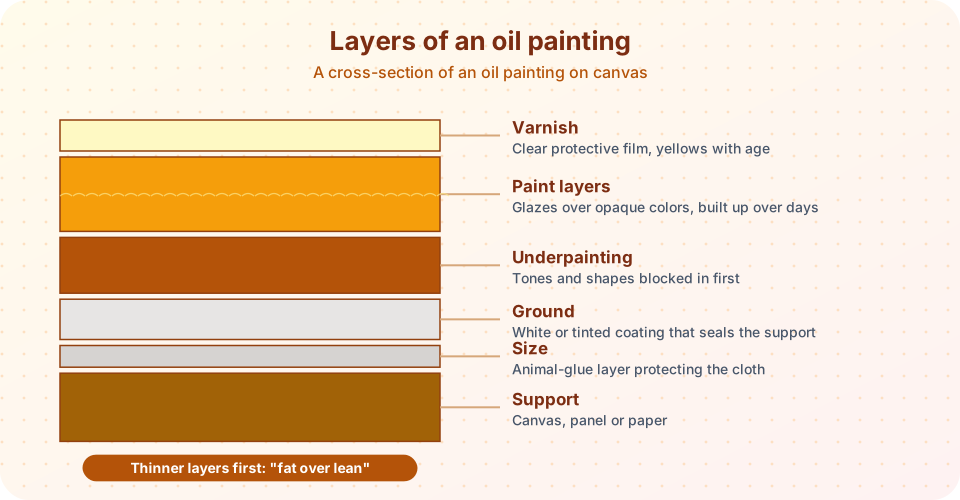
Oil paint uses linseed or another drying oil as binder. It dries slowly, so the painter can blend smoothly, rework passages and build up translucent layers called glazes that glow like stained glass. Early Netherlandish painters such as Jan van Eyck used oils with great sophistication in the 1430s, though they did not invent the medium, which had been used in a smaller way earlier. Venetian painters such as Titian then exploited oil on stretched canvas, which was lighter and could be made much larger than a wooden panel. A major change came in 1841 when the American painter John Goffe Rand patented a collapsible metal tube for paint, making it practical to carry colors outdoors, which helped the Impressionists paint landscapes on the spot in the 1860s and 1870s.
Watercolor and gouache use gum arabic as binder and water as the thinner. Watercolor is transparent, so the white of the paper shows through and gives luminosity. It cannot easily be covered over, so the painter works from light to dark. Gouache is opaque. J. M. W. Turner transformed watercolor into a medium for atmospheric landscape in the early nineteenth century, and many East and South Asian traditions developed their own refined water-based techniques centuries earlier, including ink wash on silk and paper.
Acrylic paints, developed commercially in the mid-twentieth century, use a plastic polymer binder. They dry quickly, are waterproof when dry and suit bold, flat color, which is why artists such as David Hockney adopted them in the 1960s.
Drawing
Drawing uses dry or liquid materials: graphite, charcoal, chalk, pen and ink, pastel. Drawings were first seen as preparation, not finished art. The Renaissance made the drawing an object of study and collecting: Leonardo's notebooks are drawings of anatomy, water and machines. A drawing shows the artist's thinking more directly than a finished painting.
Sculpture: carving, modeling, casting
Three-dimensional art offers a different set of choices.
- Carving is subtractive: the sculptor removes material from stone or wood. Michelangelo famously said, in the way biographers report it, that the figure was already in the stone and he only freed it. His David (1501 to 1504) was carved from a single block of Carrara marble that other sculptors had begun and abandoned. Mistakes cannot be undone, so carving demands planning.
- Modeling is additive: the sculptor builds up soft material such as clay or wax, which can be changed at any time.
- Casting copies a modeled form in metal. In the lost-wax (cire perdue) method, the artist models in wax, coats it with clay, melts out the wax and pours molten bronze into the empty mold. Greek bronzes such as the Riace warriors (found in 1972, made in the fifth century BCE) and the Benin court plaques were made this way. Casting allows hollow, thin-walled figures that can stretch out into space in ways stone cannot support.
Compare a marble and a bronze of similar subjects. Marble needs support under outstretched arms, so you often see a tree stump or a drape propping a limb. Bronze can leap and balance on one foot.
Prints and multiples
A print is made by transferring ink from a matrix to paper, which allows many copies. Main families include:
- Relief (woodcut): ink sits on the raised surface that remains after carving away the rest.
- Intaglio (engraving, etching): ink is pressed into lines cut or etched into a metal plate. Albrecht Dürer's engravings of around 1500 and Rembrandt's etchings of the 1600s are among the high points.
- Lithography: invented by Alois Senefelder around 1796, it works on the principle that grease and water repel each other on a flat stone.
- Screen printing: ink pushed through a stencil on a mesh, used by Andy Warhol in the 1960s.
Prints changed the world. They spread images, from religious scenes to political satire, to people who could never own a painting, and they carried ideas between countries. Japanese woodblock prints, produced as inexpensive commercial art for city dwellers, later influenced Western painters such as Van Gogh and Monet.
Photography
The first surviving photograph was made by Nicéphore Niépce around 1826. In 1839 the French government announced the daguerreotype, a process by Louis Daguerre that produced a unique image on a silvered plate, and in England William Henry Fox Talbot published a negative-and-positive process that allowed multiple copies. Photography forced painters to ask what painting could do that a camera could not, and that question helps explain Impressionism and later abstraction. Today photographs are made by film or by digital sensors, and the medium has expanded to video, film and screen-based art.
Architecture and materials
Buildings are media too. Romans used concrete (a mix of lime, volcanic ash and aggregate) to span huge vaults and domes, such as that of the Pantheon, completed in the 120s CE. Gothic builders used stone ribs and flying buttresses to open walls to glass. In 1851 the Crystal Palace in London, made of iron and glass in prefabricated parts, showed what the industrial age could do. Later, steel frames and reinforced concrete allowed skyscrapers.
Why the medium is part of the meaning
Media carry associations. Marble suggests permanence and prestige; a bronze equestrian statue signals authority; a woodcut suggests the popular and the cheap; a fresco belongs to a building and cannot be moved; a photograph claims a link to reality (though it can be staged or edited). Contemporary artists exploit this: using humble materials such as felt or newspaper, or deliberately choosing a "wrong" medium, makes a point about value and status. When you study any work, ask not only "what does it depict?" but "why this material?"
Common misconceptions
"Van Eyck invented oil painting." He was a master of it, but oil had been used earlier. He is credited with bringing its use to a very high level.
"Old paintings looked just as they do now." Varnish yellows with age, pigments fade or darken and old repairs discolor. Conservators sometimes clean works to reveal the original brightness, and these cleanings can be controversial.
"Prints are copies and therefore lesser." In printmaking, each impression is an original made from the matrix. Many artists, such as Dürer and Hokusai, were masters of the medium.
Try it
Check your understanding
Quick check · 5 questions
of 5 answered You scored / 5 · perfect!
-
1. Why must a fresco painter work in small patches?
Fresco works on damp lime plaster, so each day's patch (giornata) is painted before it dries. -
2. What is an advantage of oil paint?
Slow drying lets a painter rework passages and build luminous layers. -
3. Which technique is additive?
Modeling builds up material. Carving, etching and block cutting remove it. -
4. Which statement about prints is correct?
Prints are a major art form and spread images widely, from Dürer's engravings to Japanese woodblock prints. -
5. Why can bronze figures stretch out limbs more freely than marble ones?
Cast bronze can be hollow and thin-walled and still strong, so limbs can reach out; marble often needs props.
Summary
- Medium means material plus technique, and it shapes a work's look, scale, cost and permanence.
- Paint is pigment in a binder: water and lime (fresco), egg (tempera), oil, gum arabic (watercolor), polymer (acrylic).
- Sculpture can be carved (subtractive), modeled (additive) or cast; lost-wax casting makes hollow bronzes.
- Prints and photographs make multiples and spread images.
- Ask "why this material?" about every work.
Track your progress
Create a free account to tick off lessons and pick up where you left off on any device.
of Art History lessons completed