


















Lesson 48 of 49 · Projects and Practice
Cheat sheet: art history on one page
A one-page recap of art history from ancient times to today: eight eras, quick-ID clues, ten questions to ask any artwork, and an interactive year slider.
This lesson fits the whole course on one page. It is not a replacement for the lessons, but a map you can use before an exam, a museum visit or a conversation about art. Start with the picture, then read the era table, the quick-ID clues and the ten questions. Slide the year in the interactive ruler to see where any date falls and what was happening in art then.
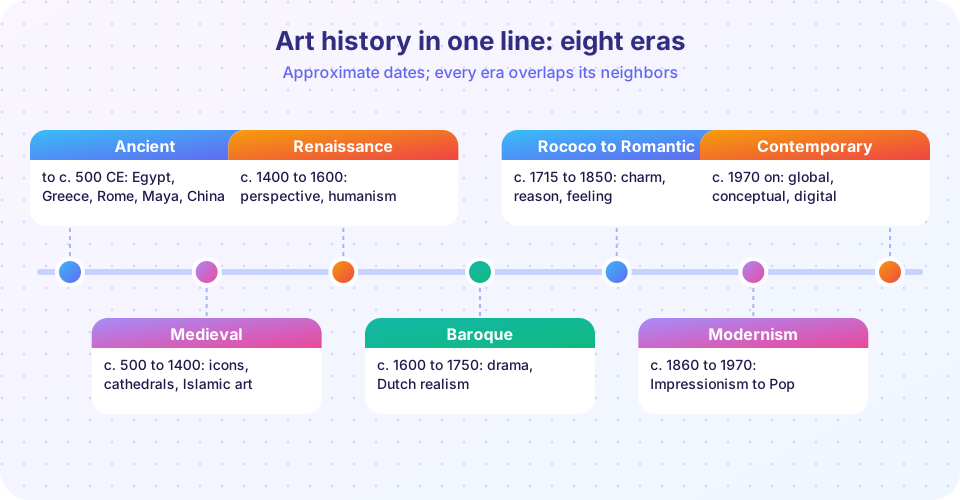
Eight eras at a glance
| Era | Approx. dates | Big idea | Look for | Names to know |
|---|---|---|---|---|
| Ancient | to about 500 CE | Art serves rulers, gods and the dead | Monumental stone, idealized figures, strict conventions in Egypt; naturalism in Greece and Rome | Egyptian tomb painters, Phidias, Roman portraitists |
| Medieval | about 500 to 1400 | Art serves faith | Gold, flat figures in icons, Romanesque and Gothic churches, Islamic geometry and script | Byzantine icon painters, Gothic cathedral builders |
| Renaissance | about 1400 to 1600 | Humanism and the study of nature | Linear perspective, anatomy, balance, classical subjects | Brunelleschi, Leonardo, Michelangelo, Raphael, van Eyck |
| Baroque | about 1600 to 1750 | Art that moves you | Strong light, diagonals, drama; Dutch realism and still life | Caravaggio, Artemisia Gentileschi, Bernini, Rembrandt, Vermeer |
| Rococo to Romantic | about 1715 to 1850 | Charm, then reason, then feeling | Pastel curves; hard-edged civic scenes; sublime landscapes and protest | Fragonard, David, Goya, Gericault, Friedrich, Turner |
| Modernism | about 1860 to 1970 | Break the rules, show the new | Visible brushwork, strong color, fragments, abstraction, ideas | Monet, Van Gogh, Picasso, Kandinsky, Duchamp, Pollock, Warhol |
| Contemporary | about 1970 onward | Many voices, many media | Installation, performance, video, global themes | Kusama, Ai Weiwei, El Anatsui, Kara Walker |
| Global traditions | All eras | Long histories outside the European story | Islamic geometry, Chinese ink, Japanese prints, African bronzes, Indigenous painting | Fan Kuan, Hokusai, Benin and Ife artists, Papunya Tula painters |
Eras overlap and vary by region. "Renaissance" is about Italy and then Northern Europe; Japan, China and West Africa follow their own timelines. Use the table as a map, not a rulebook.
Quick-ID clues for chapters 5 to 7
| If you see... | Think... |
|---|---|
| Deep shadow, one strong beam of light, ordinary faces | Baroque tenebrism (Caravaggio and followers) |
| A quiet interior, window light, a skull or hourglass among objects | Dutch Golden Age, perhaps vanitas |
| Pastel colors, curving foliage, flirtation | Rococo |
| Hard outlines, a shallow stage, noble sacrifice | Neoclassicism |
| A tiny figure before a huge storm or mountain | Romanticism and the sublime |
| Broken brushstrokes, outdoor light, boulevards | Impressionism |
| Dots of pure color | Seurat and Pointillism |
| Thick swirling paint, intense emotion | Van Gogh, Expressionism |
| Pure, wild color | Fauvism |
| Faceted forms, several viewpoints | Cubism |
| Colored rectangles, no subject | Abstraction (Mondrian, Malevich) |
| A mundane object shown as art | Dada, readymade, Duchamp |
| Dream imagery painted precisely | Surrealism |
| Soup cans, comic dots | Pop Art |
| An instruction or an idea instead of an object | Conceptual art |
Ten questions to ask any artwork
- What is it? Medium, size, date, place.
- What do I see first, and where does my eye go next?
- How are line, color, light and space used?
- Who made it, and what do I know about their situation?
- Who paid for it or asked for it?
- Who was meant to see it, and where?
- What is the subject, and what symbols or conventions does it use?
- What does it respond to, and what does it influence?
- Whose perspective is missing?
- How do I know? What evidence supports my reading?
Label language in one line
By (confident) > attributed to (probable) > workshop of (studio) > circle of (close follower) > after (a copy). c. means "about".
Press Run (or Ctrl + Enter) to see the result here.
Program input · what you'd type while the program runs
Type the answers before you press Run, one per line. Each time the program reads a line (with input()), it gets the next line from this box.
Five takeaways
- Art answers its time. Patron, purpose, technology and politics explain style.
- Each movement reacts to the last. Rococo to Neoclassicism to Romanticism is a chain of reactions.
- Light, line, color and space are the vocabulary. Learn to describe them before interpreting.
- Evidence beats impression. Provenance, science and sources support claims.
- The map keeps widening. Global traditions and overlooked artists are not extras but part of the story.
Where the cheat sheet stops
A one-page summary has to simplify, and simplification has a cost. It cannot show how Caravaggio's light felt to a congregation in Rome, or how Hokusai's blue looked to a Japanese buyer in the 1830s. It cannot show the artists who do not fit the tidy boxes: Chardin's quiet kitchens beside Rococo froth, Hilma af Klint painting abstraction in private, or Emily Kame Kngwarreye starting a late career in her seventies. Treat the sheet as the outline of a drawing, and let the lessons and the works themselves fill in the color.
Common misconceptions
"Art history is a straight line of progress." Styles do not improve each other in a line; they answer different needs and often coexist.
"The cheat sheet is enough for an essay." It organizes what you know; essays need specific details from specific works.
"Dates must be memorized exactly." Know sequences and approximate spans; hedge when unsure.
How to use the cheat sheet
A cheat sheet is useful only if you build it yourself, even partly. Read this page once, then close it and try to rebuild the era table from memory on a blank sheet: eight rows, one big idea each, three names each. Where you get stuck, you have found a weak spot. Open the relevant lesson, read just that section, and try again. Within three or four rounds the table will stick, and it will be yours.
Use the quick-ID table the same way. Cover the right-hand column and try to say which movement each clue points to. Then check. When you are looking at real works, practice the move from clue to hypothesis: "this has hard outlines and a shallow stage, so I suspect Neoclassicism; what else would I expect to see if I am right?" That habit of testing a first guess against further evidence is what separates identification from guesswork.
Putting it together in an exam answer
Imagine you are shown an unfamiliar picture and asked to place it in thirty seconds. A reliable routine is to look at light and line first (dramatic or even, hard or soft), then subject (everyday, mythic, symbolic, none), then scale and material, and finally to guess an era and name one reason for the guess. If your guess is wrong but your reasons are sensible, you will usually still earn most of the credit, because you have shown the method. If you cannot decide between two eras, say so and give the evidence for each, rather than hiding the doubt.
Check your understanding
Quick check · 5 questions
of 5 answered You scored / 5 · perfect!
-
1. Which clue most suggests Baroque tenebrism?
Strong contrast and street models are Caravaggio's hallmarks. -
2. Which label word signals the greatest confidence in authorship?
By is confident, attributed to is probable, workshop and circle are looser, after is a copy. -
3. What best describes Modernism's big idea?
From Impressionism on, artists questioned traditional rules. -
4. Which question helps you find missing voices?
Asking whose perspective is absent reveals gaps in the story. -
5. Which statement about eras is accurate?
Era names are convenient labels, not sharp boundaries.
Summary
- Eight eras form the backbone of the course, from Ancient to Contemporary, with global traditions throughout.
- Quick-ID clues connect what you see to a likely movement.
- Ten questions guide the study of any artwork.
- Label words encode levels of confidence; "c." means about.
- Eras overlap, and the story keeps widening.
Track your progress
Create a free account to tick off lessons and pick up where you left off on any device.
of Art History lessons completed