


















Lesson 19 of 49 · Medieval and Renaissance Art
Byzantine and Early Christian Art: Catacombs, Mosaics and Icons
Follow Christian art from the Roman catacombs to Hagia Sophia, the mosaics of Ravenna, the icon and the iconoclasm controversy, with a mosaic maker you can try.
For its first three hundred years, Christianity was a minority religion, sometimes persecuted, with no grand buildings and little art. Then, in the early fourth century, everything changed. The emperor Constantine ended the persecutions, made the Church a favored institution and moved the center of the empire east. Within a few generations Christian artists had inherited the tools of Roman builders, the wealth of an empire and a new set of tasks: to house crowds of worshippers, to picture a God who could not be seen and to tell holy stories to people who could not read.
The art that resulted is not an attempt to copy the world. It is an attempt to show what lies behind the world. Figures stare at you from golden backgrounds, light pours through rings of windows, and the walls of a church seem to dissolve in glitter. This lesson follows that story from the catacombs of Rome to the great church of Hagia Sophia in Constantinople and to the icons that are still painted today.
What you will learn
- How early Christians adapted Roman forms: catacomb painting, the basilica and the sarcophagus.
- How Hagia Sophia's dome works and why it amazed visitors.
- How mosaics and icons present holiness.
- What the controversy over icons (iconoclasm) was about.
Key terms
- Catacomb: an underground burial place, with painted chambers, used by early Christians in Rome.
- Basilica: a Roman public hall, adopted as the standard Christian church plan, with a long central nave.
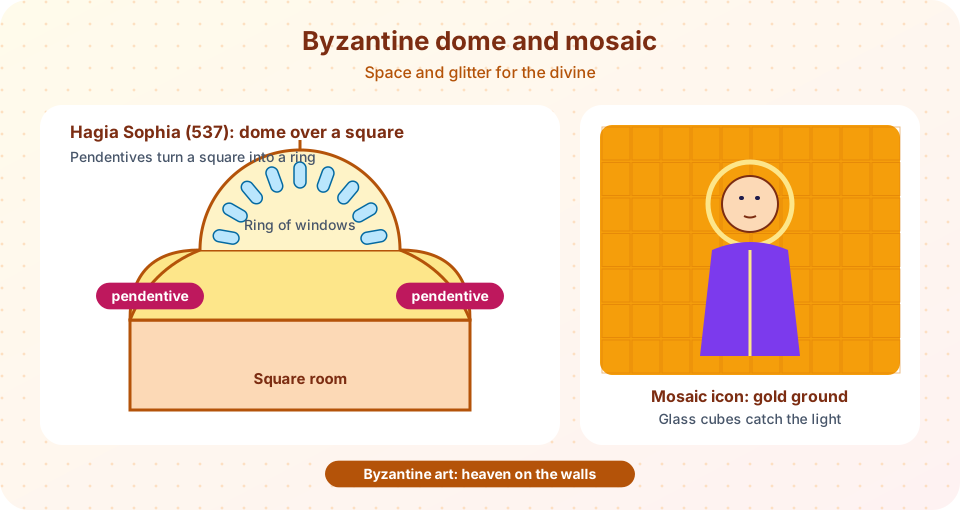
- Pendentive: a curved triangle of masonry that turns a square base into a circle for a dome.
- Mosaic: a picture made of small cubes (tesserae) of glass, stone or ceramic.
- Icon: a sacred image, usually painted on wood, venerated in the Eastern Church.
- Iconoclasm: "image breaking," the rejection or destruction of religious images.
Early Christian art in Rome
The oldest Christian images appear in the catacombs of Rome, the underground cemeteries used from the second to the fourth centuries. Their painters borrowed the look of Roman wall painting but changed the meaning. Instead of pagan gods, a young man carrying a lamb on his shoulders, the Good Shepherd, a figure adapted from Greek and Roman imagery, came to stand for Christ. Other symbols were hidden in plain sight: a fish (the Greek word ichthys was read as an acronym for "Jesus Christ, Son of God, Savior"), an anchor for hope, a dove for peace.
When Constantine legalized Christianity (the Edict of Milan, 313), the Church needed buildings, and it did not use the pagan temple, which was a house for a god's statue and too small for a congregation. It adopted the basilica, the Roman law court and meeting hall: a long rectangular room with a central nave, side aisles and a semicircular apse at the end. Old Saint Peter's in Rome, begun in the 320s over the traditional tomb of the apostle, was the grandest. It was demolished and replaced in the Renaissance, but its plan became the model of Western churches.
In Ravenna, a city in northern Italy that became an imperial capital in the fifth century, buildings such as the small Mausoleum of Galla Placidia (about 425 to 450) have walls and vaults covered in glass mosaic: a night sky of blue and gold stars over a Good Shepherd, in a space that feels like a jewel box.
Constantinople and Byzantine art
In 330 Constantine dedicated a new capital on the Bosphorus, where Europe meets Asia, and called it Constantinople (modern Istanbul). When the western Roman Empire collapsed in 476, the eastern half survived for another thousand years, until the Ottoman conquest of 1453. Historians call it the Byzantine Empire (after Byzantion, the earlier Greek name of the city), although its people called themselves Romans.
Hagia Sophia
In 532, rioters burned the church of Hagia Sophia ("Holy Wisdom"), and the emperor Justinian decided to build something that had never been seen. His architects, Anthemius of Tralles and Isidore of Miletus, who were mathematicians and engineers more than traditional builders, finished it in 537, an astonishing five years. The key problem was how to put a round dome over a huge square space. They used pendentives: four curved triangular sections that rise from the corners of the square and form a continuous ring at the top. On that ring sits the dome, about 31 meters across, pierced at its base by forty windows. Because the windows sit between the ribs of the dome, the light seems to cut the dome away from the building. The contemporary historian Procopius wrote that the dome seemed to hang from heaven. In reality, it was a daring structure: part of it fell in an earthquake in 558 and was rebuilt higher in 562, with changes that made it more stable.
Inside, marble in many colors, gold mosaic and the glittering light were meant to leave worshippers feeling that earth and heaven had touched. Hagia Sophia was the largest cathedral in the world for almost a thousand years. After the Ottoman conquest of 1453 it became a mosque, minarets were added, and figural mosaics were plastered over. In 1934 it became a museum, and in 2020 it was converted again into a mosque, a change that provoked both celebration and criticism.
Mosaics
Byzantine mosaics are made of tesserae: small cubes of colored glass, some backed with gold leaf. They were set into the wet plaster at slightly different angles, so that light bounces in many directions and the wall seems to shimmer as you move. The scene is placed against a gold ground, which removes any sense of a real place and says: this is the realm of heaven.
The most famous mosaics are in San Vitale in Ravenna, finished about 547. Two panels face each other: the emperor Justinian with clergy and soldiers, and the empress Theodora with her attendants. They stand in rows, rigid, frontal, with calm faces, large eyes and halos around the heads. Justinian never visited Ravenna in person; the mosaics present the court's power as a sacred procession, with no cast shadows, floating feet and an overall effect of timelessness.
The style
Common features of Byzantine painting and mosaic include:
- Frontality and symmetry: figures face the viewer directly.
- Elongated, weightless bodies: robes fall in stylized folds without showing the shape of the body underneath.
- Large, calm eyes: connecting with the viewer.
- Gold backgrounds: removal from the everyday.
- Hierarchic scale: Christ or the Virgin dominates.
- Limited depth: no single viewpoint. Some scholars discuss "reverse perspective", where lines seem to spread toward the viewer, but how deliberate this was is debated.
None of this means Byzantine artists could not draw naturally. Their earliest work followed Roman naturalism. The later style was a choice to show spiritual presence rather than a physical scene.
Icons and the fight over images
An icon is a sacred image, usually painted in egg tempera or wax on a wooden panel, that believers venerate as a window to the holy person depicted. One of the oldest to survive is the encaustic icon of Christ Pantocrator ("ruler of all") from Saint Catherine's Monastery in Sinai, from the sixth century, whose face seems to be two different faces: gentle on one side and stern on the other.
Not everyone approved. Some Christians believed that images broke the commandment against making idols. From about 726 to 787 and again from 815 to 843, imperial policy in Byzantium banned religious images, and many were destroyed. The opponents, the iconoclasts, saw veneration of images as idolatry; their opponents, the iconophiles, led by theologians such as John of Damascus and, later, Theodore the Studite, argued that since God had become human in Christ, he could be depicted, and that honoring an image honored the person depicted, not the wood and paint. In 843 images were restored, an event celebrated in the Eastern Church as the Triumph of Orthodoxy. The argument gave Eastern Christian art a settled theology and a strong tradition of copying approved models.
Byzantine art spread to Venice (the Basilica of San Marco, rebuilt in the eleventh century with golden domes), to Sicily, and to Russia, where the monk Andrei Rublev painted his luminous icon of the Holy Trinity (about 1411 to 1425). It is still the model for Orthodox icon painters today.
Elsewhere in these centuries
Christian Byzantium was not the only center. In 691 to 692 the Dome of the Rock was built in Jerusalem, with inscriptions and golden mosaic vines but no human figures. Islamic art developed calligraphy, geometric ornament and arabesques as principal decoration, and built great mosques such as the Great Mosque of Córdoba, begun in the 780s with its double-tiered horseshoe arches. In Ireland and Britain, monks produced intricate illuminated books, like the Book of Kells (about 800), covered in interlaced patterns and animals, and in the court of Charlemagne (crowned emperor in 800) artists revived Roman models in the Carolingian Renaissance. These strands feed into the Romanesque and Gothic story in the next lesson.
To tell Byzantine from later Western art, look at the ground behind the figures. A gold or flat color ground with no landscape signals a sacred, timeless space, while a view of land and sky invites us to imagine a place.
Common misconceptions
"Byzantine" means complicated and corrupt. The word is a modern insult from the Enlightenment. The empire was a long-lived and sophisticated state.
"Byzantine art is flat because the artists were unskilled." The style was chosen to express spiritual reality, and craftsmen achieved astonishing technical results.
"Icons are worshipped as gods." Orthodox doctrine distinguishes veneration of the person depicted from worship of God alone.
Try it
Check your understanding
Quick check · 5 questions
of 5 answered You scored / 5 · perfect!
-
1. What does a pendentive do?
Pendentives are curved triangles that make a ring at the top of the square room for the dome to rest on. -
2. Why was the basilica adopted as the model for churches?
Temples housed a statue; the basilica could hold worshippers. -
3. What does a gold ground do in a Byzantine mosaic?
Gold creates a timeless, sacred space. -
4. What was the main argument of the iconophiles?
Theologians such as John of Damascus defended images on the basis of the Incarnation. -
5. Who built Hagia Sophia for Justinian in 532-537?
They were mathematicians and engineers who designed the huge dome on pendentives.
Summary
- Early Christians adapted Roman forms: catacomb painting, the basilica and the Good Shepherd.
- Constantinople became the capital of the Byzantine Empire, whose great church, Hagia Sophia (537), solved the problem of a dome over a square with pendentives.
- Mosaics on gold grounds, and icons, show holiness rather than a view of the world.
- Iconoclasm (726-787, 815-843) was a fierce argument about images; images were restored in 843.
- Meanwhile, Islamic, Irish and Carolingian traditions developed their own art.
Track your progress
Create a free account to tick off lessons and pick up where you left off on any device.
of Art History lessons completed